Clear Sky Science · en
Intramedullary nail design for Thais with novel multi-femur shape optimization approach
Why this matters for broken thigh bones
When someone breaks the long bone in the thigh, surgeons often stabilize it with a metal rod slipped inside the hollow center of the bone. Most of these rods are designed for Western anatomy, even when they are used in Asian patients whose thigh bones curve differently. This study shows how tailoring the rod’s shape to Thai thigh bones could make surgery safer, lower the risk of the rod poking into the bone, and reduce the chance of implant failure.
The problem with a one-shape-fits-all bone rod
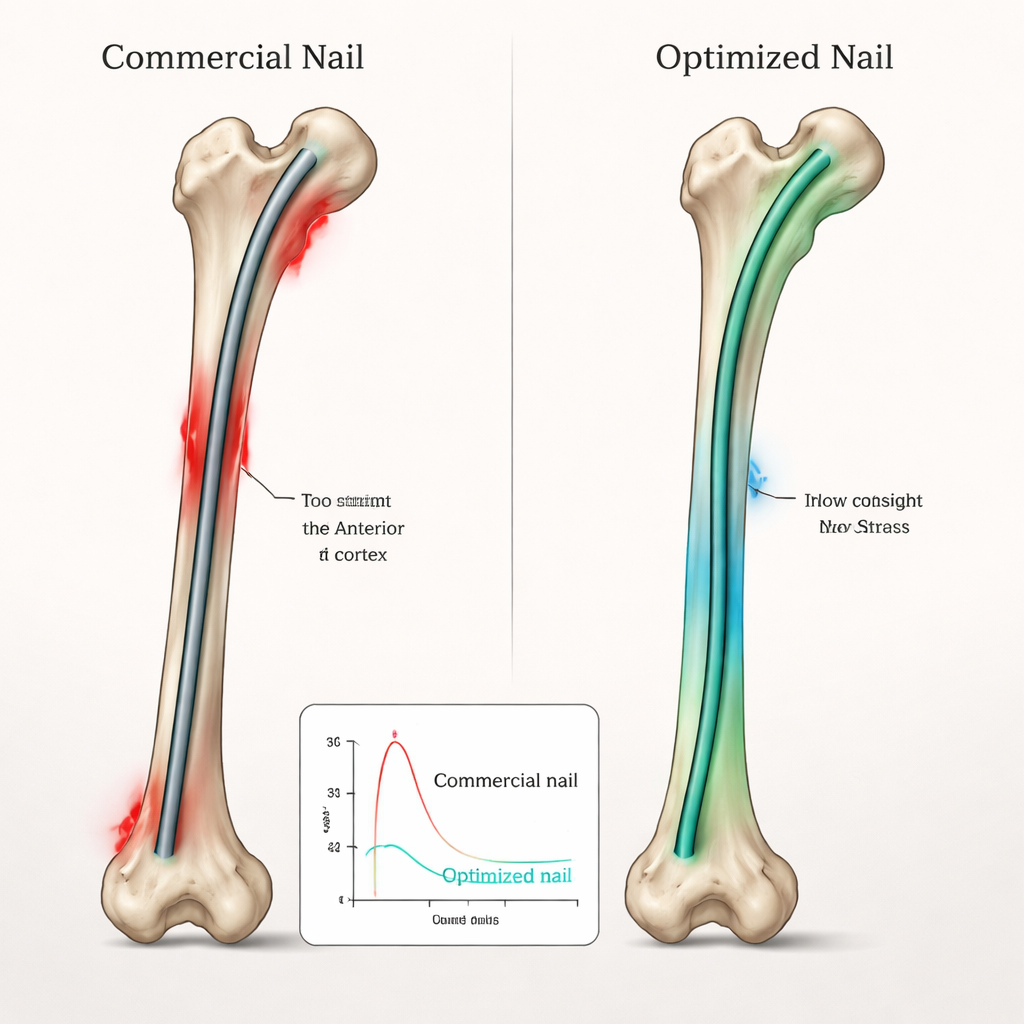
Intramedullary nails are long metal rods inserted into the central canal of the femur to hold a broken bone together as it heals. Existing commercial nails are mostly based on Caucasian anatomy and are relatively straight, with large radius-of-curvature values. But many Asian thigh bones bend more noticeably along their length. When a rod is too straight for a curved bone, its tip can press hard on the front wall of the bone, sometimes even drilling through it. That mismatch not only risks immediate damage during surgery but also creates high internal stresses that can weaken bone and implant over time.
Capturing the true variety of Thai thigh bones
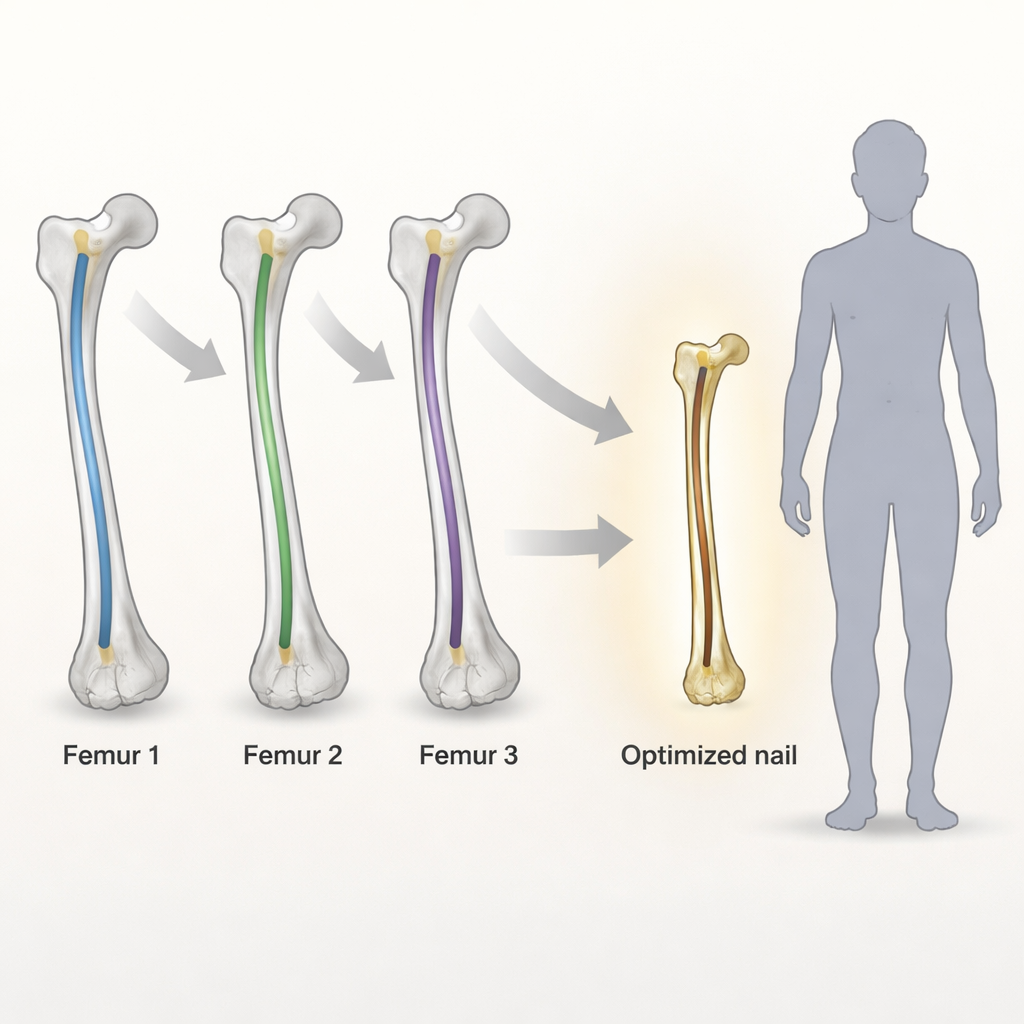
To design a better-fitting nail, the researchers first studied real anatomy instead of relying on averages. They analyzed CT scans from 60 Thai femurs and used computer tools to reconstruct detailed 3D models. From each bone they measured how strongly it curved and how thick the outer shell of hard bone was at key locations where the nail would pass. Using a clustering technique, they grouped the 60 bones into ten categories that together captured the full spread of Thai femur shapes. One “representative” femur from each group was then chosen as a testbed for designing a single nail that would work well across many different people.
Engineering a nail that bends like the bone
Rather than forcing the bone to match the rod, the team reshaped the rod to follow the bone. They described the lower part of the nail as four smoothly connected circular arcs, each allowed to curve more or less within a realistic range. A computer-based genetic algorithm then treated these four curvatures like adjustable genes. For each candidate design, virtual versions of the same nail were inserted into all ten representative femurs, and a detailed mechanical simulation calculated how much internal stress the bone would feel from being slightly bent open by the rod. The algorithm repeatedly refined the design to find a single nail shape that kept those stresses as low as possible in every femur, not just one idealized bone.
How the new design stacks up against standard nails
Once the optimized nail was found, the team tested it on a new set of ten Thai femurs that were not used in the design stage. They compared it with three common commercial nails that had much larger curvature radii. In the simulations, the custom Thai nail almost eliminated the extra stress caused by insertion, while the commercial nails produced forces thousands of times higher. When the researchers added screws and mimicked the forces of standing on one leg, the new nail again showed far lower stress, especially around screw holes and at the point where the rod’s thickness changes—areas where implants often crack or fail. By better following the natural bend of the bone canal, the new design spread forces smoothly instead of concentrating them in a few dangerous spots.
What this means for patients and future implants
For patients, the take-home message is simple: implants that are shaped for their population’s bones may be safer and more durable than imported one-size-fits-all hardware. This study demonstrates a blueprint for how to design such devices: start from real 3D anatomy, represent the range of shapes in a population, and let optimization algorithms search for a single design that works well across them all. While the work is based on computer models and still needs testing in physical experiments and clinical trials, it strongly suggests that Thai-specific, and eventually region-specific, bone rods could reduce surgical complications, ease insertion for surgeons, and provide more reliable support as fractures heal.
Citation: Sayabut, D., Virulsri, C. & Tangpornprasert, P. Intramedullary nail design for Thais with novel multi-femur shape optimization approach. Sci Rep 16, 5488 (2026). https://doi.org/10.1038/s41598-026-35172-7
Keywords: femur fracture, intramedullary nail, implant design, Thai anatomy, bone curvature