Clear Sky Science · en
Study on the synergistic mechanism of mechanical response and microstructural evolution in cement-silt-modified aeolian sand
Turning Desert Sand into a Building Resource
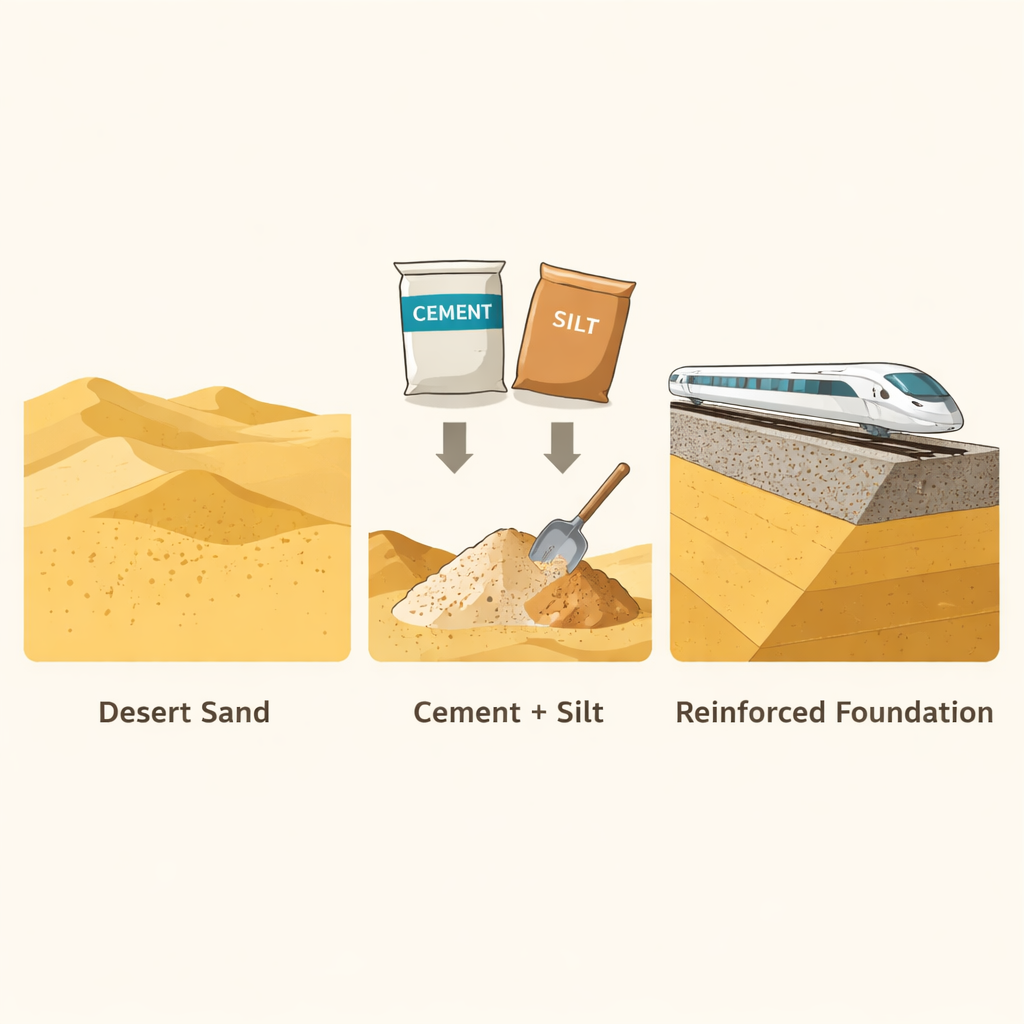
Vast deserts may look empty, but their wind-blown sands could help build the railways and roads we rely on—if only that sand were strong enough. This study explores how to transform naturally weak desert sand into a sturdy, durable material using small amounts of cement and fine soil (silt). The goal is to support high-speed rail lines in harsh desert regions while cutting costs, saving natural gravel, and reducing environmental damage.
Why Desert Sand Is a Construction Challenge
Aeolian sand—the loose sand shaped and moved by wind—covers huge areas of arid regions worldwide. Its grains are fine, smooth, and poorly packed, which makes the sand light, highly permeable, and almost cohesionless. These traits cause serious engineering problems: embankments can sink, road surfaces can crack, and railway foundations can deform under the pounding of fast trains. Moisture in desert soils can also draw salts upward, damaging materials over time. In short, raw desert sand is far too unstable to meet the very strict safety and performance standards required for high-speed railway foundations.
Mixing Simple Ingredients for Stronger Ground
To tackle this, the researchers mixed desert sand with cement and silt in different proportions, then molded and compacted the blend into small cylinders. They varied three main knobs: how much cement was added (5–9% by weight), how much silt replaced sand (soil-sand ratios from 2:8 to 4:6), and how long the samples were allowed to cure (7, 14, or 28 days). After controlled curing in warm, humid conditions, each sample was squeezed in a compression machine to measure how much load it could carry before failing. Microscopes and image analysis software were then used to peer inside the material, measure pore sizes, and see how the internal structure evolved as the mix and curing time changed.
What Matters Most for Strength
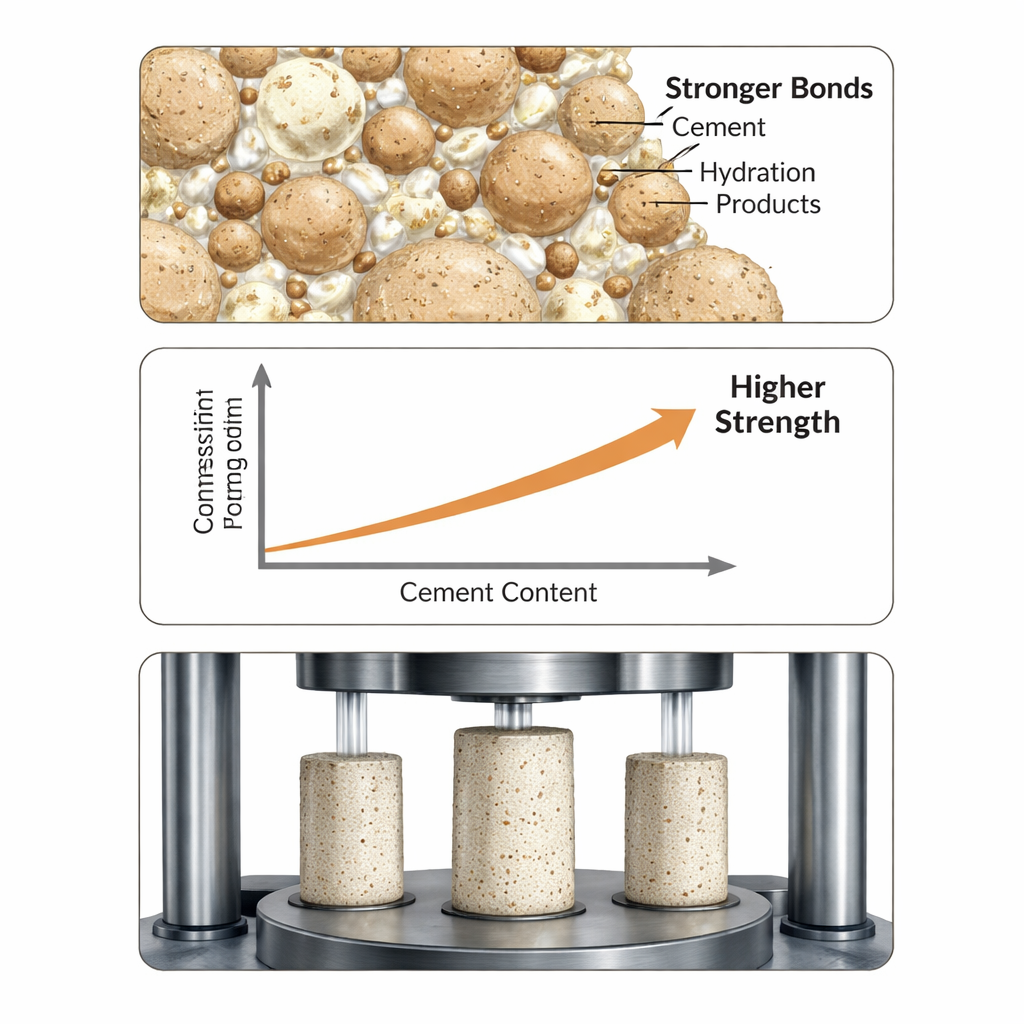
The tests showed that all three factors—cement content, silt amount, and curing time—helped, but not equally. Increasing cement from 5% to 9% raised compressive strength by roughly 150–200%, making cement the single most powerful lever. Adding more silt (shifting the soil-sand ratio toward 4:6) also boosted strength by improving how particles pack together. Longer curing, from 7 to 28 days, allowed more cement hydration products to form, steadily densifying the material and further increasing strength. To go beyond simple comparison, the authors used three data-analysis tools—grey relational entropy, a type of neural network, and logistic regression—to rank the importance of each factor. All three approaches agreed: cement content dominates, with curing age, silt proportion, density, and moisture playing meaningful but smaller supporting roles.
How the Microscopic Glue Works
At the grain scale, pure desert sand is like a pile of marbles with big empty spaces in between. Introducing silt adds much smaller particles that slip into those gaps, improving contact between the larger sand grains. When cement is added and water is present, chemical reactions create new solid phases—gels and crystals—that coat and bridge both sand and silt. These hydration products fill pores, tie particles together, and gradually build a three-dimensional skeleton throughout the material. Over time, further reactions between cement products and minerals in the silt create additional binding phases, while good compaction and well-chosen moisture ensure these products form evenly. The combined effect is a denser, more continuous structure that resists cracking and carries much higher loads.
Finding a Practical Recipe for Railways
Using both strength data and microscopic measurements, the study identified an especially effective mix: about 8% cement with a 4:6 ratio of silt to sand. This blend produced high compressive strength, a very compact internal pore structure, and better deformation behavior than higher-cement mixes, which tended to fail more abruptly. Field tests for a high-speed railway project confirmed that this recipe comfortably met design requirements after just seven days of curing. For non-specialists, the main takeaway is that with the right modest blend of cement, silt, compaction, and curing time, otherwise unusable desert sand can be turned into a stable, reliable foundation material—helping conserve natural aggregates and supporting more sustainable construction in some of the world’s harshest landscapes.
Citation: Li, X., Miao, C., Yuan, B. et al. Study on the synergistic mechanism of mechanical response and microstructural evolution in cement-silt-modified aeolian sand. Sci Rep 16, 5490 (2026). https://doi.org/10.1038/s41598-026-35170-9
Keywords: aeolian sand, cement stabilization, silt-modified soil, railway subgrade, desert engineering