Clear Sky Science · en
Resourceful utilization of crop residue by smallholder farmers in major grain-producing areas: pathways and countermeasures
Turning Farm Leftovers into Everyday Benefits
Every harvest leaves behind mountains of stalks, leaves, and stems that most of us never think about. For small farmers in China’s grain heartland, these “leftovers” can be a hidden source of income, animal feed, and soil fertilizer—or a source of choking smoke when burned in the open. This study follows hundreds of farm households in flat plains and rugged hills to see how they actually use crop residues, what stands in their way, and which changes could turn waste into value while cutting air pollution.
What Happens to Stalks After Harvest?
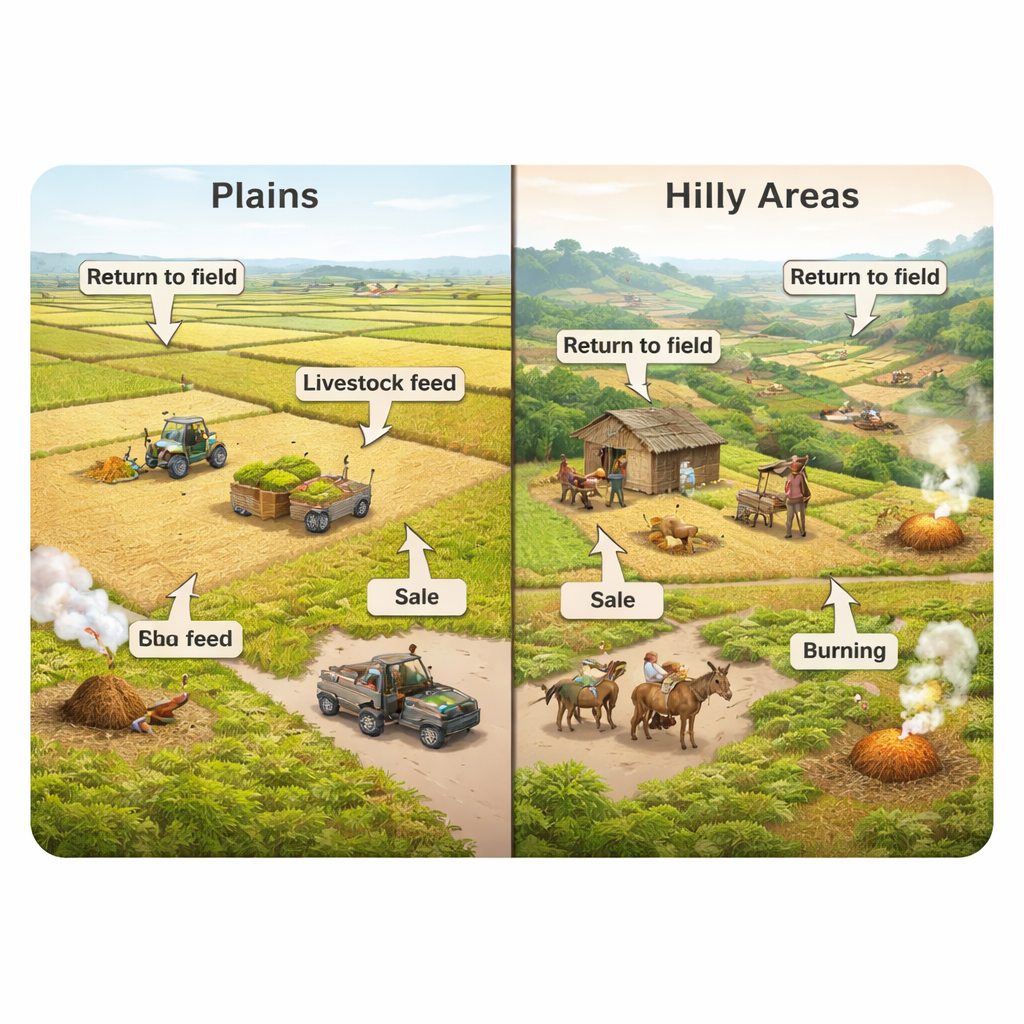
The researchers surveyed 382 smallholder families who grow maize, wheat, vegetables, and oil crops on less than two hectares of land. They asked how much residue farmers produce, what they do with it, how much money and labor they invest, and what they earn in return. Across all farms, about four-fifths of crop residues were put to use rather than simply thrown away. Nearly half became fertilizer, plowed back into the soil to maintain fertility. About one fifth was fed to livestock. Smaller shares were sold, burned for household fuel, or used as raw material for simple handicrafts or industrial products. Yet almost one in six bundles of residue was still discarded or burned in the open, contributing to smoke and health risks.
Two Landscapes, Two Different Realities
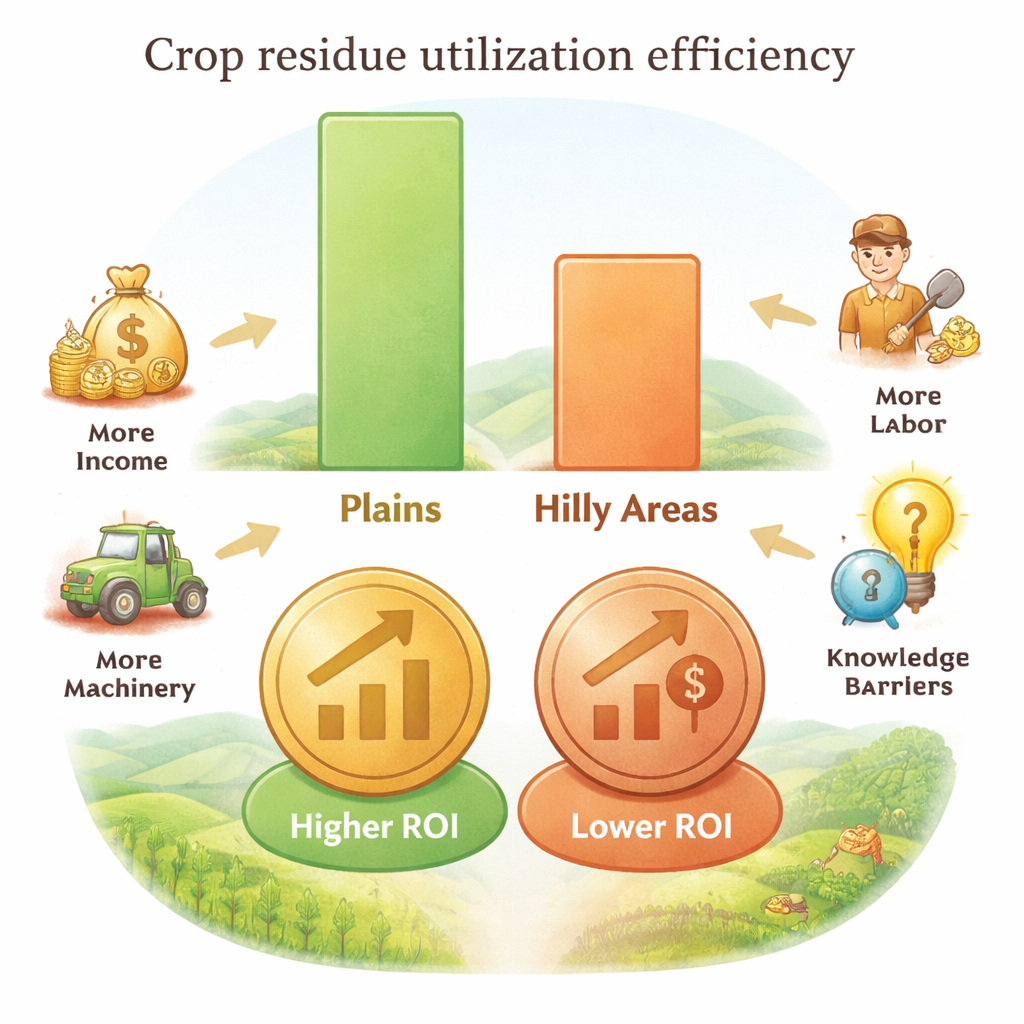
Life in the plains and the hills looks very different when it comes to crop residues. Farms on the flat plains are larger and easier to reach with machines, and they produce roughly twice as much residue per household as farms in the hills. As a result, plains farmers reuse about 87% of their residues, often with the help of tractors and shredders, while hilly-area farmers manage only about 71%. In the hills, broken terrain, small plots, and poor roads make it hard to collect and transport bulky stalks. Many farmers there still leave vegetable residues in the field or burn them, especially because these wet, heavy leftovers are difficult to store, carry, or sell.
What Farmers Gain—and What Holds Them Back
Using residues wisely does pay off. On average, plains farmers gained about 165 US dollars per hectare in benefits from residues, after spending about 80 dollars on cash and labor costs. Hilly-area farmers earned around 145 dollars while spending about 67 dollars. That means the return on each dollar invested was higher on the plains than in the hills. Turning residues into livestock feed or household fuel brought the strongest payoffs, while selling residues often barely covered—or even failed to cover—the extra costs of collection and transport, especially in rugged areas. Most farmers said they were motivated by protecting the environment and avoiding waste, but their biggest obstacles were the extra work and money needed. In hills, farmers also cited a lack of knowledge, equipment, and local buyers as serious barriers.
Why People’s Circumstances Matter
The study shows that residue use is shaped not just by land and machines, but also by age, gender, income, and awareness. Farmers with higher farm income, larger fields, and more residue are more likely to turn stalks into feed, fertilizer, or saleable goods. In the hills, older farmers and women—who are often left behind when younger adults migrate to cities—tend to rely on labor‑intensive uses like household fuel and simple raw materials. Training, subsidies, and the presence of a nearby market all change how attractive different options look. Where there are no buyers, even farmers who would like to sell residues often end up dumping them by the roadside or burning them for lack of alternatives.
Practical Ways to Turn Waste into Value
To help small farmers make more of their residues, the authors propose a set of down-to-earth measures. In plains, they suggest training programs that focus on safely using machinery and managing large volumes of residue, plus modest payments per ton to cover the cost of collecting and selling surplus stalks. In hilly areas, they recommend more basic, hands-on teaching through Farmer Field Schools, with special attention to women and older farmers, and simple low‑labor techniques such as using decomposing agents to break down residues in place. They also argue for better land consolidation so machines can operate more efficiently, and for building local residue markets with village‑level collection points and small vehicles that can handle steep, narrow roads.
Cleaner Air and Better Livelihoods
For non-specialists, the main message is straightforward: what happens to crop stalks after harvest matters for both climate and daily life. When residues are burned or dumped, they pollute the air and waste a free resource. When they are used as fertilizer, feed, or fuel, they save money, raise yields, and cut smoke. This study shows that small farmers on China’s plains are already close to making residues a good deal, while farmers in the hills still face steep practical barriers. With carefully targeted training, fairer financial support, and smarter local markets, those leftover stalks could become a reliable tool for cleaner villages, healthier soils, and more secure farm incomes.
Citation: Ge, Y., Fan, L. Resourceful utilization of crop residue by smallholder farmers in major grain-producing areas: pathways and countermeasures. Sci Rep 16, 5065 (2026). https://doi.org/10.1038/s41598-026-35164-7
Keywords: crop residue, smallholder farmers, straw burning, sustainable agriculture, China rural livelihoods