Clear Sky Science · en
Nonparametric statistical approach to wind farm siting in Poland using GIS
Why wind farm locations matter
As countries race to cut climate‑warming emissions, wind turbines have become a familiar sight on the horizon. But deciding exactly where to place hundreds or thousands of turbines is far from simple. The wrong location can waste good wind, annoy nearby residents, or harm wildlife and protected landscapes. This study looks at every onshore wind farm in Poland—2,585 turbines in total—to understand how real‑world projects actually fit into the surrounding environment, and how their size and technology shape those choices.
Taking stock of Poland’s wind boom
Poland has long relied heavily on coal, but wind power is now one of the country’s main low‑carbon electricity sources. New rules are making it easier to build turbines closer to houses and to upgrade older farms, and the European Green Deal is channelling major investment into renewables. Against this backdrop, the authors assembled a detailed national picture of existing wind farms. They examined where turbines sit in relation to towns, roads, power lines, rivers, forests, farmland and many categories of protected nature areas, using high‑resolution maps and geographic information systems. They then grouped wind farms by their total area and by the power rating of individual turbines, from small machines under 1 megawatt to modern units up to 4 megawatts, and looked for systematic differences among these groups. 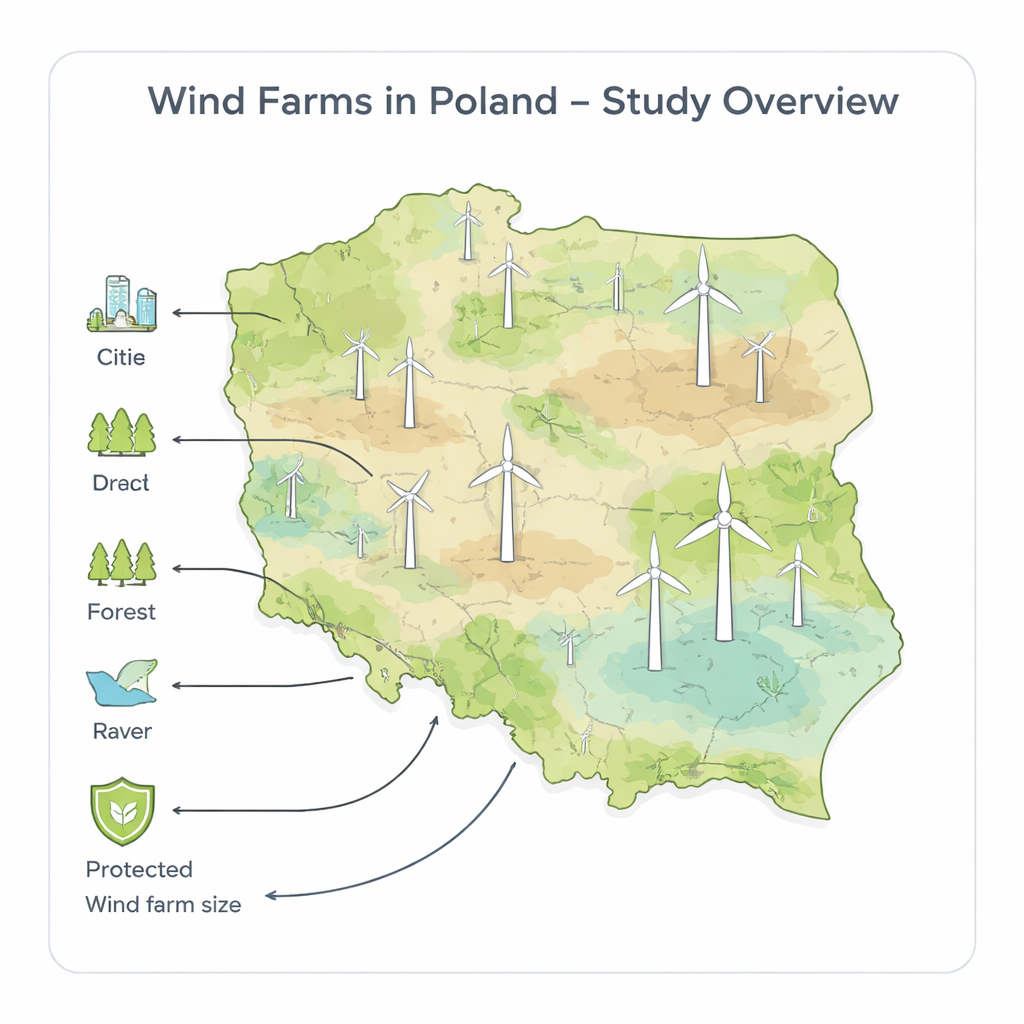
Reading patterns in complex terrain
Instead of assuming that the data follow neat bell‑shaped curves, the researchers used so‑called nonparametric statistical tests that are better suited to real, uneven datasets. These tests compared the “typical” conditions experienced by different groups of turbines—such as median wind speed, ground slope or distance to the nearest road—without forcing the data into rigid formulas. The analysis showed that mid‑sized and large wind farms tend to occupy areas with stronger winds and more favourable terrain, which makes sense for maximising energy output. Higher‑capacity turbines were often placed at somewhat higher elevations and on flatter ground, reflecting the engineering challenge of transporting and installing very large machines in rugged landscapes.
Living alongside towns, roads and water
The study also explored how developers balance access to infrastructure with the need to limit noise, visual impact and construction costs. Many small and medium farms are located several kilometres from town borders, helping to reduce disturbance for residents. Larger farms and higher‑power turbines are generally pushed even farther from built‑up areas and individual buildings, in line with safety and noise guidelines. At the same time, turbines cannot be too far from roads and power lines without driving up costs. The authors found that medium‑sized farms often sit at modest distances from roads and grids, while the very largest projects sometimes straddle existing road corridors or extend beyond nearby power lines, requiring new connections. Distances to rivers, canals and wetlands varied, but big farms tended to nudge closer to various water bodies, simply because they cover more land and have fewer siting options.
Protecting nature while building energy
Poland’s wind farms must also coexist with an intricate network of protected areas, from national parks to the EU‑wide Natura 2000 system that safeguards habitats and bird populations. Here, too, the authors found clear but nuanced patterns. High‑capacity turbines of 3–4 megawatts were typically installed farther from sensitive habitats, bird areas and national parks than smaller machines, reflecting stricter precautions for taller structures that can pose greater risks to birds and bats. Yet the largest‑area wind farms were sometimes closer to protected sites than their mid‑sized counterparts, underscoring how limited land availability can squeeze projects toward conservation zones even when planners try to maintain generous buffers. 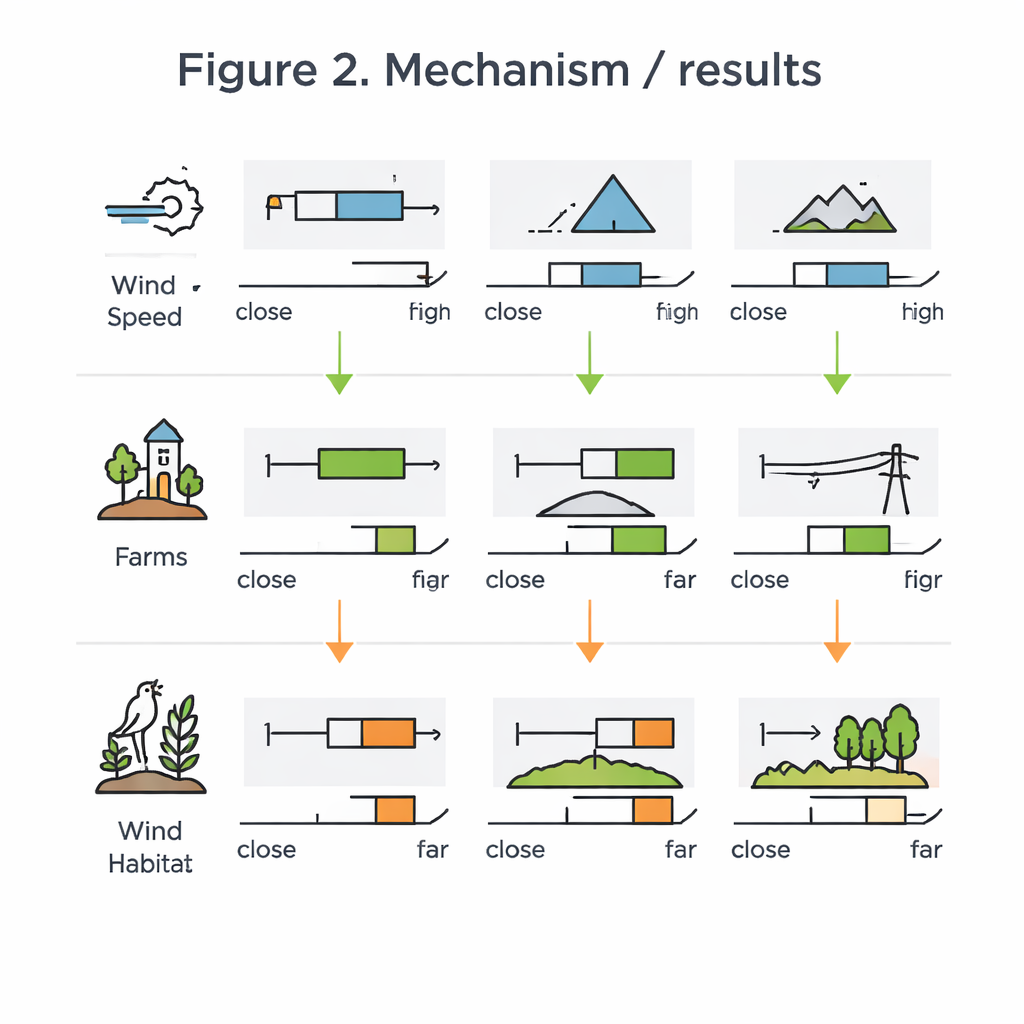
What this means for future wind projects
For non‑specialists, the key message is that there is no single “perfect” place for a wind farm. Real projects are the result of trade‑offs among wind quality, construction logistics, nearby communities and nature protection. By systematically comparing all existing Polish wind farms, this study shows where those trade‑offs have actually landed so far. Mid‑sized and large farms tend to chase better winds, while bigger turbines are generally kept farther from homes and sensitive wildlife areas. At the same time, the sheer footprint of large projects can push them closer to rivers, wetlands or protected landscapes. The authors argue that these patterns can guide planners and policymakers in choosing future sites that capture strong winds while avoiding unnecessary harm to people and ecosystems—helping Poland expand clean energy in a way that is both efficient and environmentally responsible.
Citation: Amsharuk, A., Łaska, G. Nonparametric statistical approach to wind farm siting in Poland using GIS. Sci Rep 16, 4891 (2026). https://doi.org/10.1038/s41598-026-35160-x
Keywords: wind energy, wind farm siting, renewable power, environmental planning, Poland