Clear Sky Science · en
Peatland inception and development across Kalimantan, Indonesia
Why ancient wetlands matter today
Tropical peatlands might look like ordinary swamps, but underfoot they hold vast stores of partly decayed plant material built up over thousands of years. This buried carbon helps cool the planet by keeping greenhouse gases out of the air. In Kalimantan, the Indonesian part of Borneo, peatlands are being rapidly drained and burned for agriculture. This study asks a deceptively simple question with big climate implications: how long have these peatlands been locking away carbon, how fast have they done it through time, and how much are we now undoing in just a few decades?
Peat islands in a changing tropical world
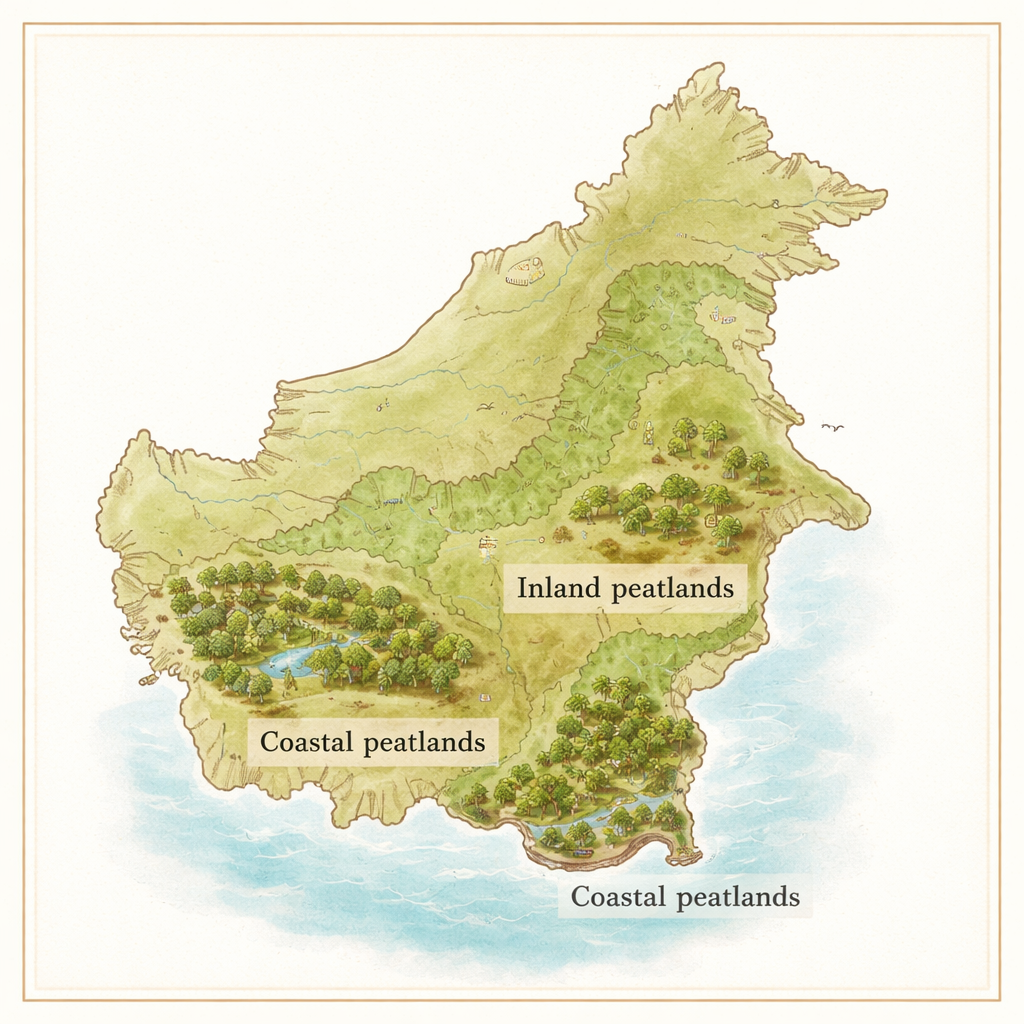
The researchers focused on two broad kinds of peatlands in Kalimantan: inland peat formed in river basins far from the sea, and coastal peat growing on low, flat land near shorelines. They collected 15 long cores of peat—essentially vertical columns of mud and plant remains—from four regions across West and East Kalimantan. Using 55 radiocarbon dates and statistical age–depth models, they reconstructed when peat started to form at each site and how quickly it accumulated. Inland peat in the upper Kapuas River basin turned out to be remarkably old: some deposits began forming in the late Pleistocene, more than 40,000 years ago. By contrast, most coastal peatlands only started during the Holocene, within the last 8,000 years, when sea levels rose and shorelines stabilized.
Building a giant underground carbon bank
Peat grows when plant material piles up faster than it decomposes in the waterlogged soil. The team combined their age models with measurements of bulk density and carbon content to estimate long-term carbon accumulation rates through time. Both inland and coastal peatlands showed their highest average rates in the middle Holocene, roughly 8,200 to 4,200 years ago. During this period of relatively stable, wet climate and, along the coasts, high sea level, peatlands in Kalimantan locked away on the order of 50–90 grams of carbon per square meter each year. Inland sites were typically deeper—often over 7 meters and in some places up to 14 meters—reflecting their long, uninterrupted history of carbon storage. Coastal sites were shallower on average but still substantial sinks.
Natural slowdowns versus human disruption
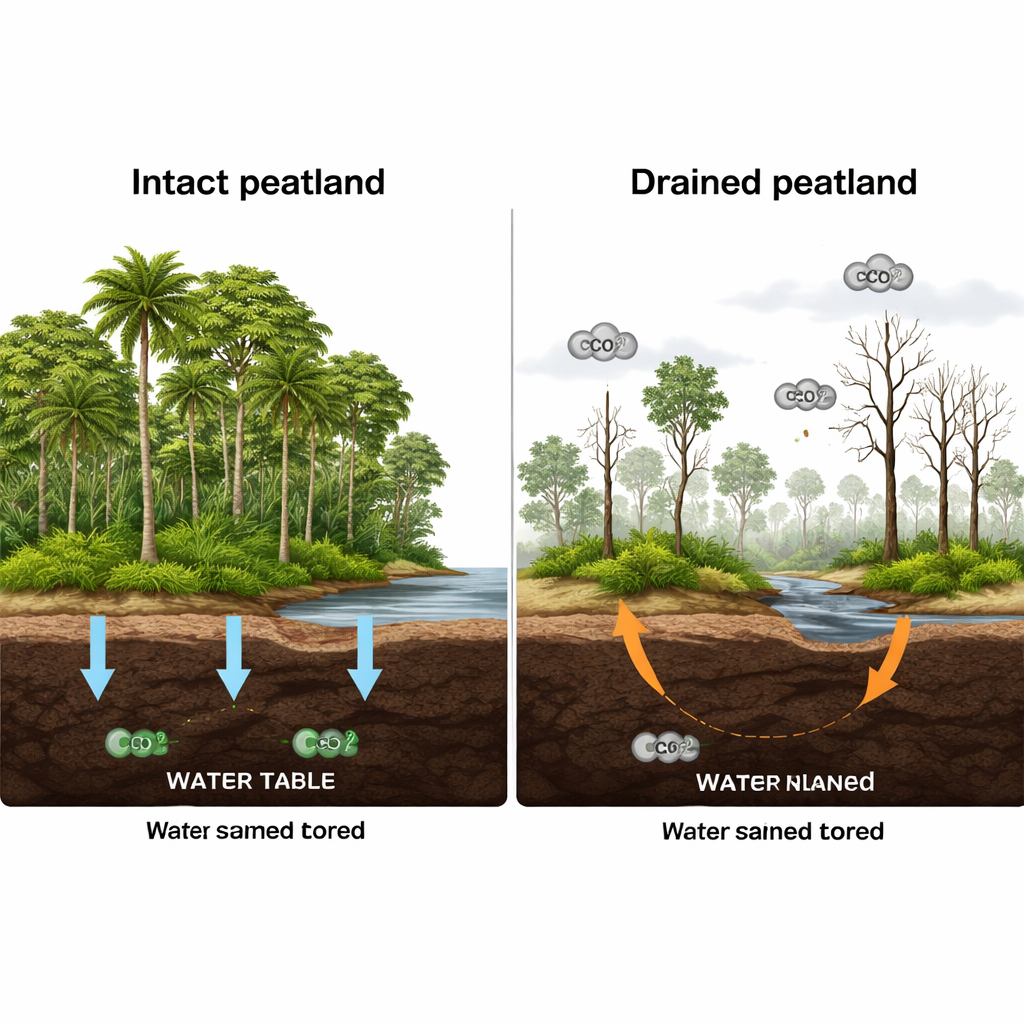
Over the last 4,000 years, both inland and coastal peatlands experienced a natural decline in carbon accumulation. As peat domes grew higher and hydrology changed, the rate of new carbon burial dropped by about one-fifth compared with the mid-Holocene peak. Spread over Kalimantan’s 4.5 million hectares of peat, this long, gentle slowdown equates to a modest reduction of about 0.68 million tons of carbon stored per year. The real shock comes from comparing this slow, natural change to recent human impacts. Drainage canals for plantations, land clearing, and repeated fires lower water tables, speed up decay, and make peat burn. The authors estimate that drainage alone, over just 40 years of development, has caused annual losses of around 32.4 million tons of carbon—roughly 47 times the long-term natural decline in carbon sequestration.
Clues to past climates and future risks
Because peat builds up layer by layer, its age structure records how climate, sea level, and local geography shaped wetland formation over tens of thousands of years. The presence of very old inland peat in the upper Kapuas basin shows that parts of Borneo remained wet and forested even during the last ice age, when some scientists had proposed a dry "savanna corridor" across the region. Instead, these peatlands point to persistent waterlogged refuges that buffered climate swings and stored carbon across glacial–interglacial cycles. Coastal peatlands, in turn, highlight how rising seas and high groundwater levels helped create extensive carbon-rich wetlands during the Holocene.
What this means for climate and conservation
For nonspecialists, the punchline is stark: Kalimantan’s peatlands are ancient climate guardians that have quietly banked carbon for up to 40,000 years, but a few decades of drainage and fire are rapidly turning them into powerful carbon sources. The study shows that as long as peatlands stay wet, they can keep storing carbon, even if the rate naturally slows over millennia. Lower the water table, however, and centuries of stored carbon can be released in a human lifetime. Protecting intact peat forests and rewetting drained areas is therefore not just a local land-management issue—it is one of the most effective ways to curb greenhouse gas emissions and preserve a natural system that has stabilized Earth’s climate since long before recorded history.
Citation: Anshari, G.Z., Ruwaimana, M., Ritonga, R.P. et al. Peatland inception and development across Kalimantan, Indonesia. Sci Rep 16, 5496 (2026). https://doi.org/10.1038/s41598-026-35152-x
Keywords: tropical peatlands, carbon sequestration, Kalimantan Indonesia, land-use change, climate mitigation