Clear Sky Science · en
Machine learning-based heat flux estimation from high-speed video during saturated pool boiling over vertical tube
Making Nuclear Cooling Safer with Smarter Eyes
When a nuclear power plant shuts down in an emergency, it still produces heat that must be removed safely. Many new reactor designs rely on simple metal tubes sitting in large pools of water for this job. As water boils on these tubes, the pattern of bubbles reveals how much heat is being carried away. But measuring this heat precisely is difficult, expensive, and often slow. This study shows how high-speed video and artificial intelligence (AI) can watch those bubbles in real time and estimate heat flow with impressive accuracy, offering a new way to monitor and protect critical cooling systems.
Boiling Tubes at the Heart of Safety
In modern nuclear plants, passive safety systems are designed to work without pumps or external power. One key component is a bundle of vertical tubes submerged in a large water tank. Heat from the reactor travels through these tubes, causing the surrounding water to boil. The way bubbles form, grow, merge, and leave the surface is tightly linked to how effectively heat is removed. If heat flow becomes too high, the surface can suddenly overheat, threatening the integrity of the system. Traditionally, engineers rely on complex experiments and mathematical formulas to estimate this “heat flux,” but these methods are labor-intensive and can struggle when boiling becomes highly turbulent.
From Boiling Bubbles to Digital Footprints
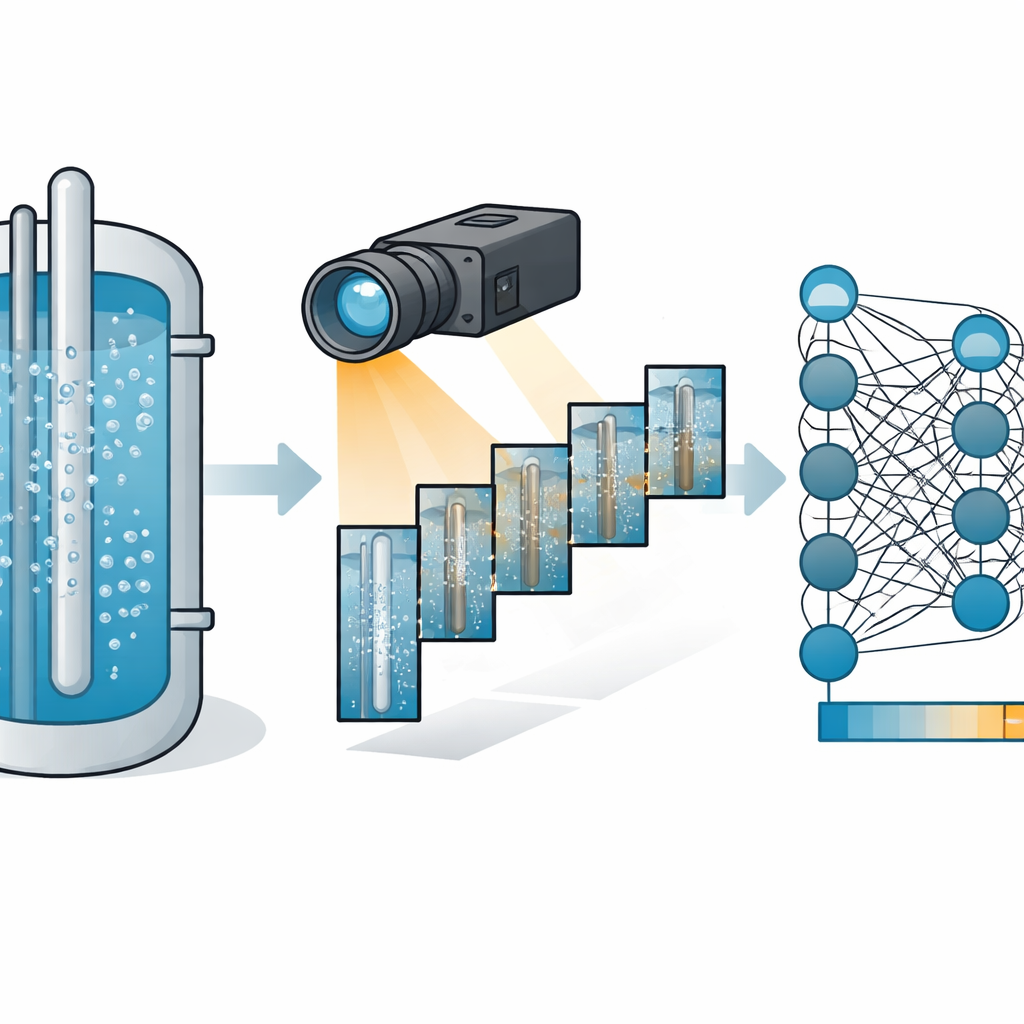
To tackle this challenge, the researchers built a dedicated laboratory setup that mimics the boiling conditions on a vertical tube in a reactor cooling system. A heated stainless-steel tube sits inside a transparent, water-filled vessel, surrounded by sensors that carefully track temperatures and electrical power. At the same time, a high-speed camera records the boiling at thousands of frames per second, later reduced to standard video speed for analysis. The team verified that their boiling behavior and heat-transfer data matched established experiments from other groups, ensuring that the footage and measurements truly represent real-world conditions.
Teaching AI to Read the Boil
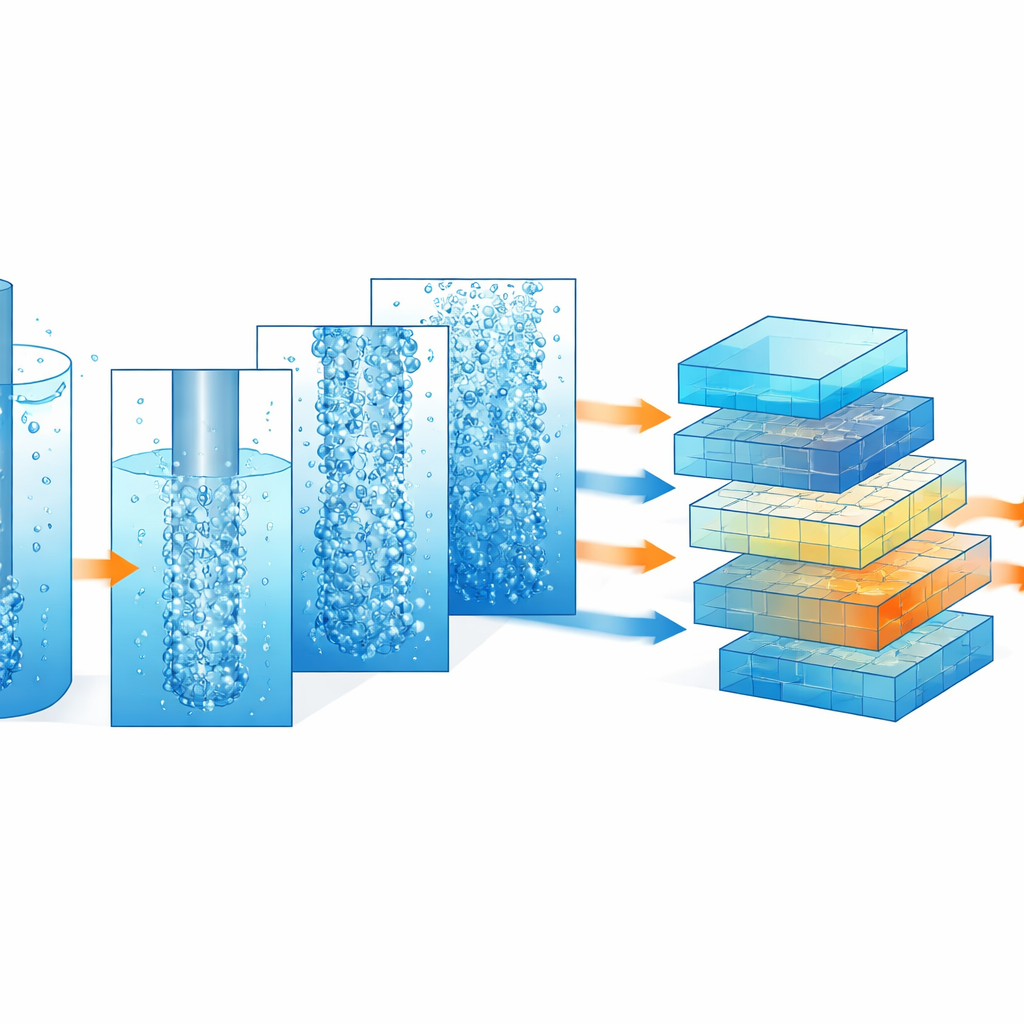
The core of the work is a computer-vision pipeline that turns raw video into heat estimates. Each video is chopped into short clips of 16 frames, capturing how bubbles change over fractions of a second. The researchers use a technique called optical flow to highlight where motion is strongest, focusing the AI’s attention on the most dynamic regions. These clips are then fed into a powerful video-analysis network known as I3D, originally trained on everyday human actions and adapted here to recognize different boiling intensities. Instead of manually measuring bubble sizes or counting nucleation sites, the network learns its own visual patterns that correlate with specific heat levels.
How Well the Smart System Performs
The dataset spans seven distinct heat levels, from gentle boiling to very vigorous bubbling. The authors split their video clips into training, validation, and testing sets to avoid overfitting and to fairly judge performance. After fine-tuning, the I3D model correctly classified the heat level for about 88% of the test clips, with an average prediction error in heat flux of roughly 6%. It performed especially well at lower and moderate heat levels, where boiling patterns are cleaner, and remained reasonably accurate even at higher levels, where bubbles interact and overlap chaotically. When compared with other popular 3D neural networks, I3D consistently delivered the best balance of accuracy and robustness.
Why This Approach Matters
Instead of replacing detailed physics models, this AI-guided method offers a new, non-intrusive way to monitor boiling in real time by simply “watching” the water. Because it relies on video rather than extra probes or complex large-scale test rigs, it could make safety assessments faster, cheaper, and more adaptable to different designs. In nuclear plants, where understanding heat removal can be the difference between a controlled shutdown and a serious accident, such a tool could help operators track safety margins more closely, especially during rare events like total power loss. Beyond nuclear energy, the same idea—using smart video analysis to read heat transfer from bubble patterns—could aid in designing safer and more efficient heat exchangers, refrigeration systems, and other technologies that quietly depend on boiling.
Citation: Sha, B.B., Thakare, K.V., Kar, S. et al. Machine learning-based heat flux estimation from high-speed video during saturated pool boiling over vertical tube. Sci Rep 16, 9038 (2026). https://doi.org/10.1038/s41598-026-35147-8
Keywords: pool boiling, heat flux estimation, nuclear safety, high-speed imaging, deep learning