Clear Sky Science · en
POP-YOLOv8: an object detection framework for partially occluded pedestrians in nighttime traffic environments
Why Seeing People in the Dark Matters
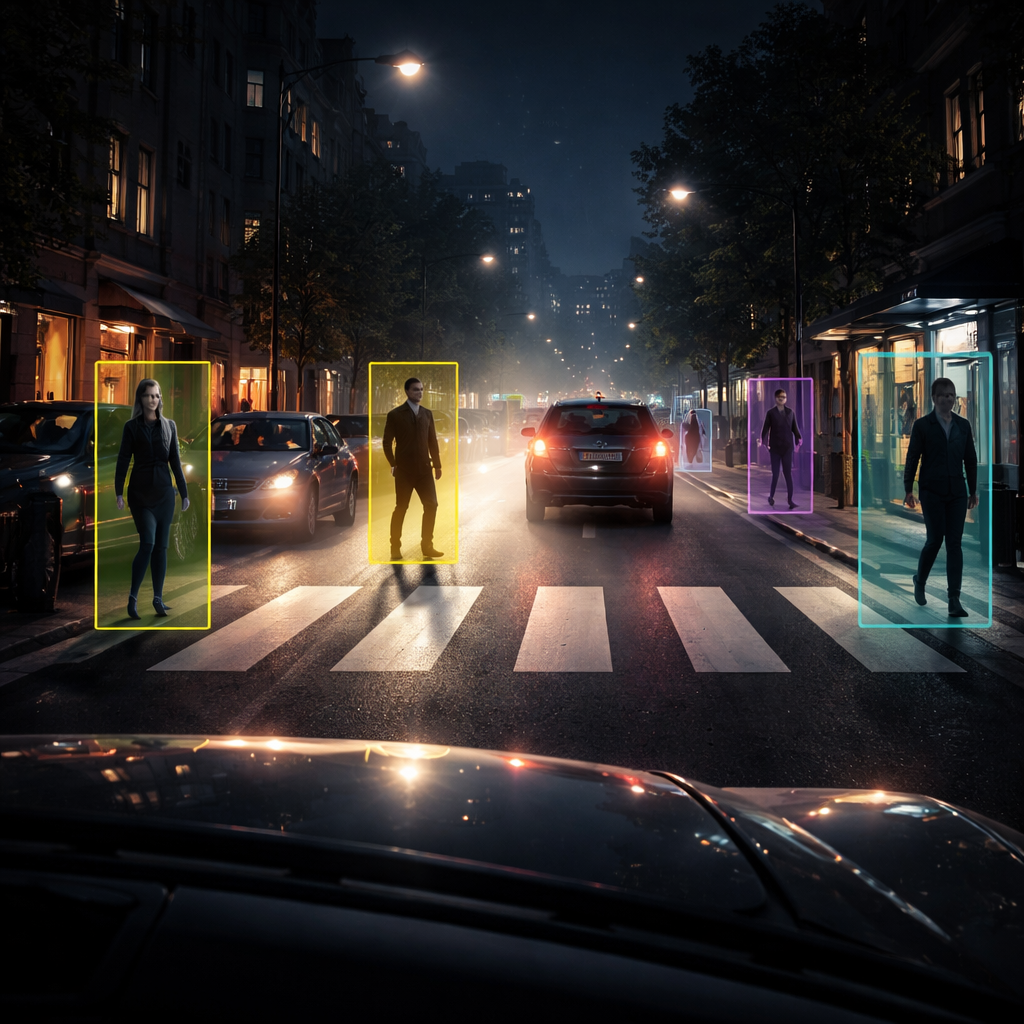
Driving at night is far more dangerous than driving in daylight, largely because it is harder to see people on or near the road. Headlights create glare and deep shadows, and pedestrians can be partly hidden behind parked cars or street furniture. This article presents POP-YOLOv8, a computer vision system designed to help vehicles spot partially hidden pedestrians in dark, busy streets more quickly and accurately, potentially reducing nighttime accidents.
The Hidden Dangers of Night Streets
Nighttime traffic scenes are visually messy. Streetlights, headlights, rain, and fog all reduce image quality and make people blend into the background. Standard pedestrian-detection algorithms often miss those who are far away, poorly lit, or partly blocked by other objects. The authors focus on one particularly risky case: pedestrians who are only partially visible in low light, such as someone stepping out from behind a parked car. They argue that a useful safety system must be both accurate and fast enough to run in real time on in-vehicle computers.
A Smarter Way to Spot People
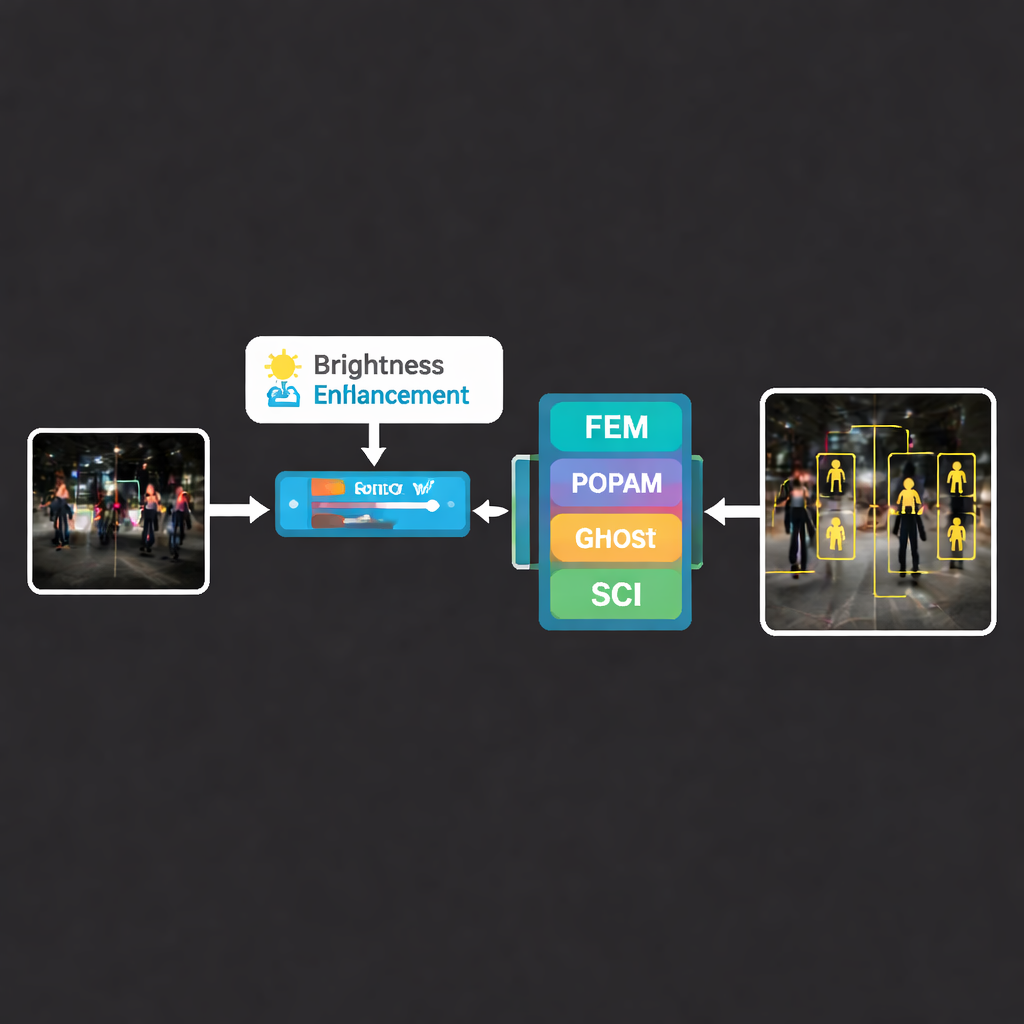
POP-YOLOv8 builds on a popular, fast detector known as YOLOv8n and adapts it to the challenges of night driving. First, a Feature Enhancement Module strengthens faint clues of partly hidden pedestrians by looking at the scene at several scales while keeping the computation manageable. Next, a specialized attention block, the Partial Occlusion Pedestrian Attention Module, teaches the network to concentrate on the most relevant parts of an image—such as a visible shoulder or leg—while downplaying clutter like road markings or shop signs. Together, these pieces help the system keep track of people even when only parts of their bodies are visible.
Lighter, Faster, and Brighter
To stay practical for real cars, the model must not only see well but also run quickly on limited hardware. The researchers therefore replace some of the heavy calculations with "Ghost" modules, which generate useful features using cheaper operations and reduce redundant computations. In parallel, they tackle the root problem of darkness itself. A brightness enhancement component based on a Self-Calibrated Illumination network cleans up and brightens the incoming camera images before detection, using a mix of full- and half-precision math to balance image quality with speed. Extra design touches, such as efficient channel attention and residual connections, help preserve fine details like pedestrian outlines while keeping the processing pipeline stable.
Putting the System to the Test
The team trains and evaluates POP-YOLOv8 on BDD100K, a large driving dataset that includes thousands of nighttime scenes with varied weather and lighting. They run careful "ablation" tests, adding each new module in turn to see how much it helps. The feature-enhancement and attention blocks each raise detection accuracy, especially for partially hidden pedestrians, though they initially slow the model. The Ghost-based modules then win back much of the lost speed while pushing accuracy even higher. When compared with several well-known detectors—including Faster R-CNN and later YOLO versions—POP-YOLOv8 achieves a better balance of precision and frame rate in night scenes, and it performs especially well on brightened images where the enhancement is mild rather than extreme.
What This Means for Safer Nights
For non-specialists, the takeaway is straightforward: POP-YOLOv8 is a tuned-up vision system that helps cars "see" people more reliably in dark, cluttered streets, even when those people are partly hidden. By combining brightness correction, selective focus on important image regions, and more efficient internal wiring, the model detects pedestrians more accurately than several leading alternatives while still running fast enough for real-time use. Although further work is needed to shrink its computing costs for small devices, systems like POP-YOLOv8 move automated driving closer to recognizing the most vulnerable road users when it matters most—on poorly lit roads at night.
Citation: Liu, H., Zhang, Z. & Feng, B. POP-YOLOv8: an object detection framework for partially occluded pedestrians in nighttime traffic environments. Sci Rep 16, 4841 (2026). https://doi.org/10.1038/s41598-026-35146-9
Keywords: nighttime pedestrian detection, autonomous driving safety, object detection, low-light image enhancement, computer vision