Clear Sky Science · en
A probabilistic framework for effective battery energy storage sizing in microgrids with demand response
Why smarter batteries matter for local power
Across the world, neighborhoods, campuses, and remote towns are turning to small, self-managed power systems called microgrids. These microgrids can combine rooftop solar panels, small wind turbines, and diesel generators to keep the lights on. Batteries are the glue that helps all these pieces work smoothly, storing extra clean energy for later. But deciding how big a battery should be is surprisingly tricky and expensive to misjudge. This study introduces a new way to estimate the “right size” of a battery for a microgrid that is both reliable and affordable, even when sunshine, wind, and electricity prices are constantly changing.
How a modern neighborhood powers itself
In the microgrid studied here, several energy sources share the job of meeting the community’s electricity needs. Solar panels produce power when the sun shines, wind turbines spin when the wind cooperates, and diesel generators can fill in the gaps. A battery bank can soak up surplus energy when it is cheap or plentiful and release it later when demand rises or the sun and wind fade. On top of that, some customers agree to shift or trim their usage in exchange for financial rewards, a practice known as demand response. Together, these pieces create a flexible local power system that can draw from the main grid when necessary but increasingly stands on its own. 
Why guessing battery size is not enough
Choosing a battery that is too small leaves the microgrid exposed to price spikes and sudden demand, while oversizing wastes money on storage that rarely gets used. The problem is made harder by uncertainty: clouds can sweep in, winds can die, and market prices can jump up or down in ways that are hard to predict. Many earlier studies treated these inputs as fixed, using single “best guess” values. Others used heavy statistical simulations, running thousands of scenarios to capture randomness, but at the cost of long computation times. The authors argue that microgrid planners need a middle path: a method that respects uncertainty but is fast and practical enough to use in real design work.
A faster way to explore many futures
The researchers combine two ideas into a single planning tool. The first is a statistical shortcut called a point estimation method, which replaces huge numbers of random scenarios with a carefully chosen small set that still captures the typical and extreme behaviors of solar, wind, demand, and price. The second is an optimization routine called the equilibrium optimizer, which searches for the most cost-effective way to schedule generators, batteries, power exchanges with the main grid, and voluntary demand reductions. By nesting the optimizer inside the statistical shortcut, the framework can quickly estimate how different battery sizes would perform across many plausible futures, while keeping computation manageable.
Letting customers and batteries work together
The microgrid model does more than just juggle machines; it also includes people. Some customers are more willing than others to reduce or shift their usage when asked, and the system pays them incentives that must fit within a limited budget. The framework weighs the benefits of paying customers to use less power against the benefits of charging and discharging the battery. In tests on a small grid with solar, wind, three diesel units, and three types of customers, the method finds that adding only a modest battery—about one kilowatt-hour of capacity—minimizes the expected daily operating cost when all major uncertainties are accounted for. Larger batteries, in this particular setup, bring diminishing returns and can even raise overall costs once their purchase and upkeep are included. 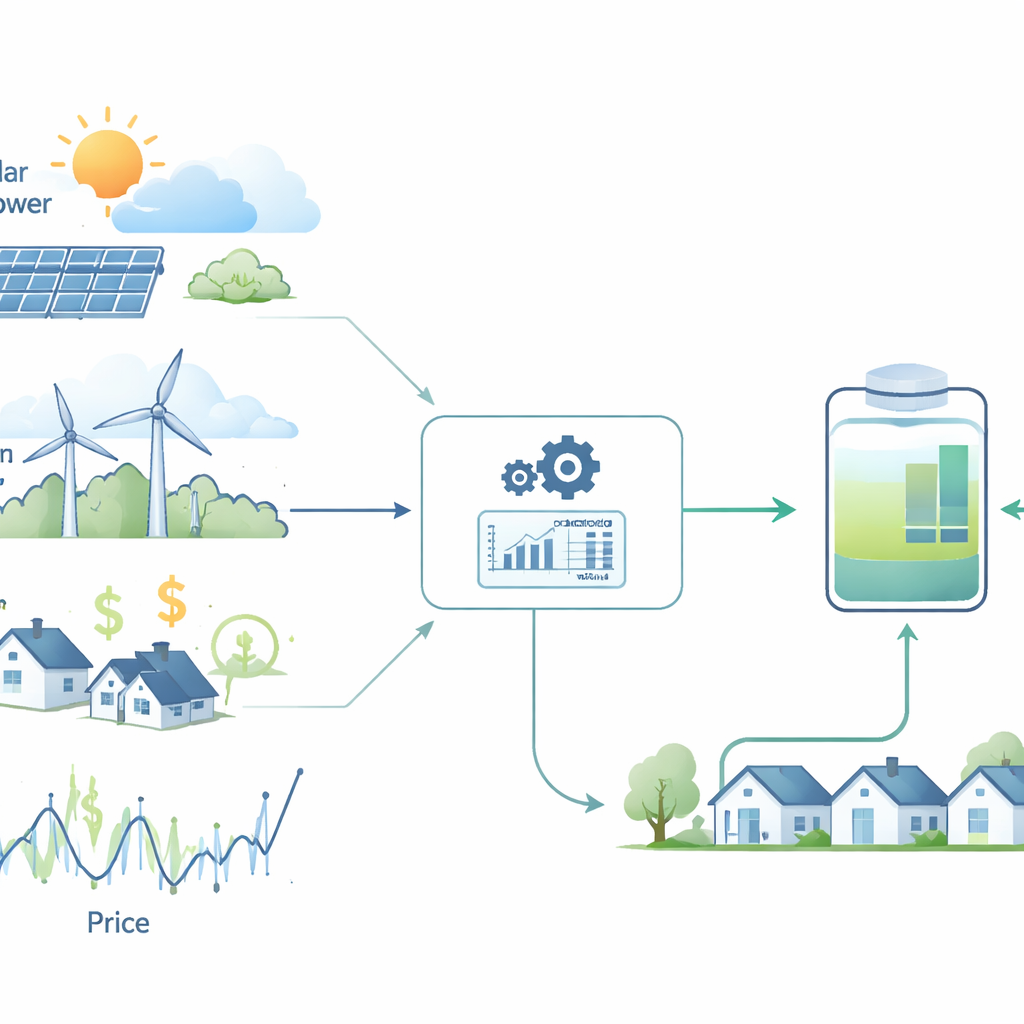
What this means for real-world microgrids
From a layperson’s point of view, the key message is that more battery is not always better. By carefully blending quick statistical estimates with smart search routines, the authors show that it is possible to home in on a battery size that balances cost, reliability, and customer comfort under unpredictable conditions. Their framework points to an efficient “sweet spot” for storage rather than simply oversizing it for safety. In the long run, approaches like this can help communities design microgrids that get the most out of clean energy sources, make fair use of customer flexibility, and avoid overspending on equipment that offers little extra benefit.
Citation: Alamir, N., Kamel, S., Megahed, T.F. et al. A probabilistic framework for effective battery energy storage sizing in microgrids with demand response. Sci Rep 16, 9094 (2026). https://doi.org/10.1038/s41598-026-35145-w
Keywords: microgrid, battery storage, renewable energy, demand response, energy management