Clear Sky Science · en
Soil carbon, micronutrients and microbiological dynamics under cash crop-based cropping systems in semi-arid National Capital Region of India
Why what’s beneath the field matters
Farmers and policymakers often focus on crop yields above ground, but this study looks at what’s happening below the surface in the soils that feed those crops. In a fast‑growing region near India’s National Capital, scientists compared how five popular cash‑crop rotations shape soil carbon, tiny but vital nutrients like zinc and iron, and the thriving community of microbes that keep soils alive. Their findings help explain which farming patterns build healthier, more resilient soils—and which may quietly run them down.
Five ways to grow, one shared landscape
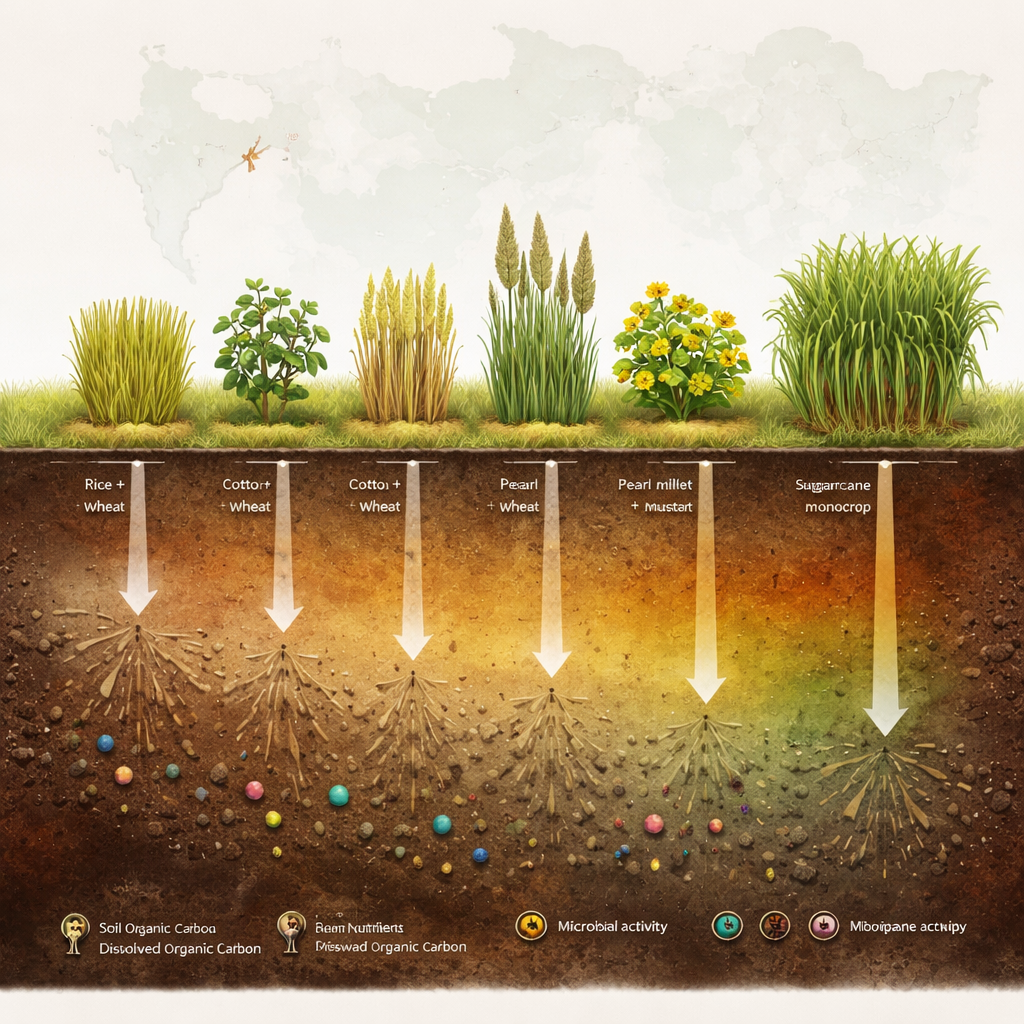
The researchers worked in Palwal district of southern Haryana, a semi‑arid area with hot summers, cool winters, and modest rainfall. They sampled the top 15 centimeters of soil from 100 farmers’ fields that had followed the same system for at least a decade. The five systems were: rice–wheat, cotton–wheat, pearl millet–wheat, pearl millet–mustard, and continuous sugarcane. Each system had its own pattern of fertilizer use, manure additions, irrigation, and waterlogging or dryness. By measuring carbon forms, plant‑available micronutrients, and biological activity, the team could see how day‑to‑day farm choices had reshaped the soil over time.
Soil “savings accounts” of carbon
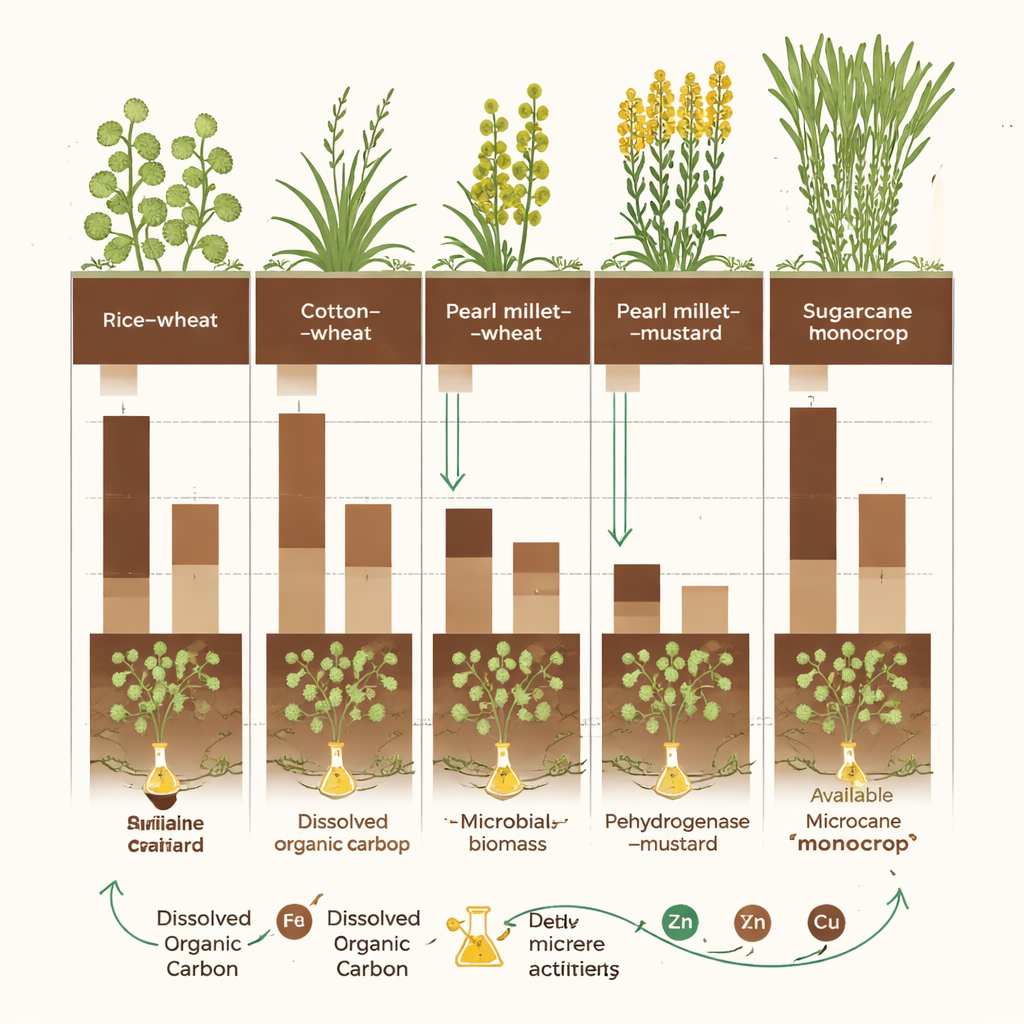
Carbon in soil acts like a savings account for fertility, storing nutrients, improving structure, and helping hold water. The rice–wheat fields stood out with the highest soil organic carbon—about 29% more than the pearl millet–wheat system and well above pearl millet–mustard. Flooded rice paddies and regular manure additions slow the breakdown of plant residues, so more carbon remains locked in the soil. Sugarcane soils also stored substantial carbon, helped by heavy leaf fall and roots left in place for several years. A lighter, more mobile form called dissolved organic carbon was especially high in sugarcane soils, indicating a steady flow of fresh, easily used food for microbes. In contrast, the pearl millet–mustard system tended to have the lowest carbon stocks and less of this readily available fraction.
Hidden vitamins: micronutrients and microbes
Plants need trace amounts of metals such as iron, zinc, manganese, and copper—akin to vitamins in a human diet. Here, again, rice–wheat soils generally fared best. They held significantly more plant‑available iron, zinc, and manganese than the other systems, helped by lower soil acidity, flooding, and higher organic matter, which all keep these elements in forms roots can reach. Copper was the exception: it was most available in pearl millet–mustard soils, where less organic matter leaves more copper in free, usable pools. The team also measured microbial biomass (the living mass of soil microbes) and an enzyme called dehydrogenase, a marker of how actively those microbes are cycling nutrients. Rice–wheat soils had the most active microbial life, with sugarcane not far behind, while pearl millet–mustard again lagged.
Patterns that separate healthy soils from tired ones
To make sense of many measurements at once, the scientists used statistical tools that group fields by their soil “fingerprints.” These analyses clearly separated rice–wheat and sugarcane soils from the pearl millet‑based and cotton–wheat systems. A handful of traits—especially soil organic carbon, dissolved organic carbon, microbial biomass, and soil reaction (pH and salts)—did most of the work in distinguishing systems. Fields rich in carbon tended also to be rich in microbes and in available zinc, iron, and manganese, underlining how tightly soil life and nutrient supply are linked. Even with lower fertilizer use, long‑term sugarcane monocropping produced soils that, biologically, looked surprisingly similar to those under rice–wheat.
What this means for farmers and food security
For non‑specialists, the message is straightforward: the way crops are rotated and managed can either build or drain the underground engine that supports agriculture. In Palwal, rice–wheat gives soils the richest mix of carbon, microbes, and key micronutrients, and sugarcane performs better than many dryland options. But rice–wheat also guzzles water and has known long‑term drawbacks like falling groundwater and soil degradation. The authors argue for blending the strengths of different systems—using better residue management, organic inputs, diversified rotations, and less soil disturbance—to keep the benefits for soil life and nutrients while easing pressure on water and the environment. Healthy soils, they conclude, are the foundation for sustainable harvests in India’s semi‑arid heartland.
Citation: Preeti, Sheoran, S., Prakash, D. et al. Soil carbon, micronutrients and microbiological dynamics under cash crop-based cropping systems in semi-arid National Capital Region of India. Sci Rep 16, 4855 (2026). https://doi.org/10.1038/s41598-026-35142-z
Keywords: soil health, cropping systems, soil carbon, micronutrients, soil microbes