Clear Sky Science · en
Water recovery of drying waste using a thermoelectric cooler and PV/T assisted
Turning Drying Waste into Fresh Water
In many rural areas, farmers struggle with two problems at once: how to preserve food without burning expensive fuel, and how to secure enough clean water. This study presents a new solar-powered system that tackles both challenges together. It dries fruits and vegetables using the sun, and at the same time captures the water that evaporates from the food and the surrounding air, turning it into drinkable water—essentially converting “drying waste” into a valuable resource.
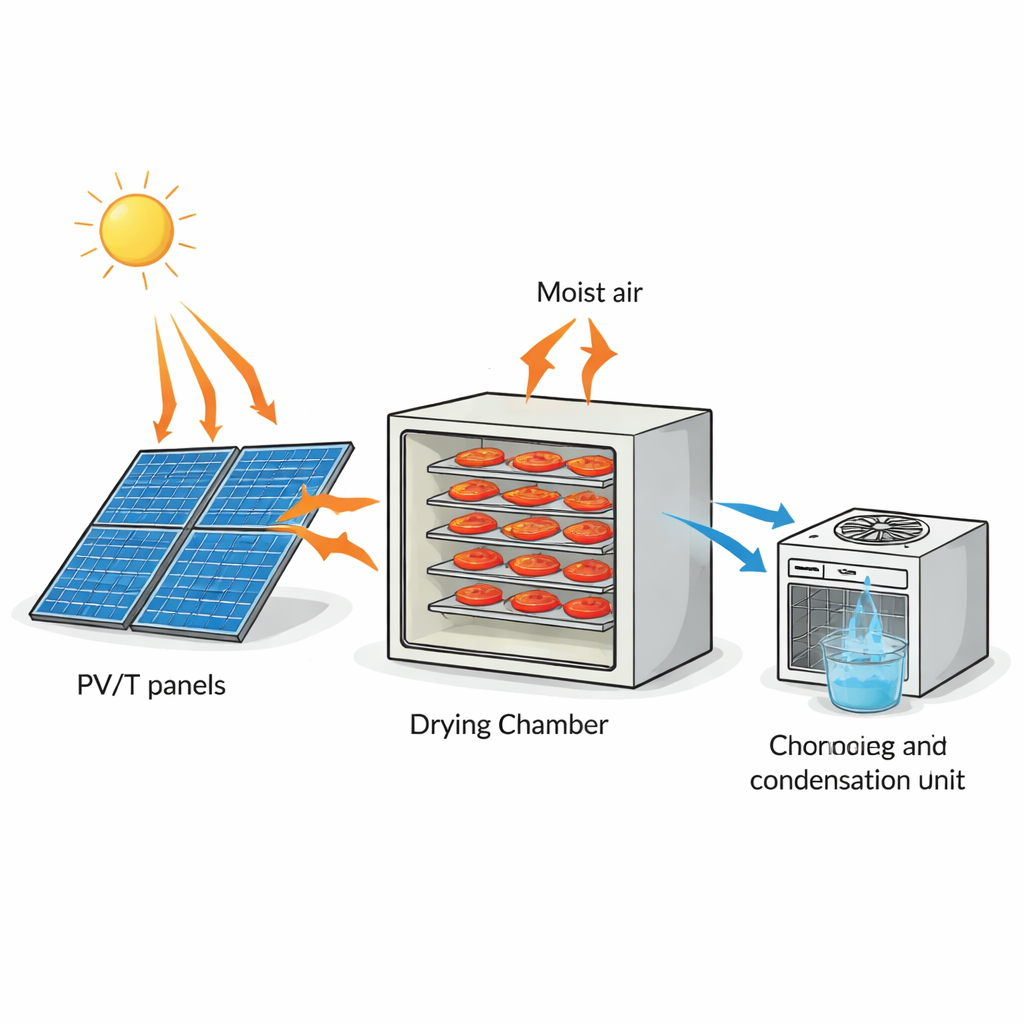
A Sun-Powered Drying and Drinking Machine
The heart of the setup is a hybrid solar panel called a photovoltaic/thermal (PV/T) collector. Unlike a standard solar panel that only makes electricity, this one also captures heat from the sun. The electricity runs small fans and cooling modules, while the captured heat warms air that is blown into a compact, well-insulated drying box filled with trays of sliced tomatoes. As warm, dry air passes over the slices, it pulls out moisture, preserving the food for safe storage with no need for fossil fuels.
How the System Catches Invisible Water
In a normal dryer, the damp air leaving the chamber is simply vented to the outdoors, wasting all the water and the energy used to evaporate it. Here, the outgoing moist air is routed through a special channel equipped with thermoelectric coolers—solid-state devices that get hot on one side and cold on the other when powered by electricity. The hot side’s waste heat is fed back toward the drying process, while the cold side chills the moist air below its dew point. As the air cools, water vapor condenses into droplets on cold surfaces and is collected in a container. The researchers call this combined approach “From Drying to Drinking,” or D2D, because no energy or mass is purposely thrown away.
Inside the Test: Tomatoes, Airflow, and Sunshine
The team built and tested the system in New Damietta City on Egypt’s Mediterranean coast, a region with moderate sunlight and relatively humid air—useful for water recovery. Two PV/T panels warmed the air in a shallow channel beneath them and powered four small fans. The heated air flowed into a 40-centimeter cube drying chamber holding three layers of tomato slices. Sensors tracked temperatures, humidity, air speed, and solar intensity throughout the day. Under typical conditions, the dryer operated between about 30 and 53 °C, averaging around 40–43 °C—gentle enough to protect food quality while still removing moisture efficiently.
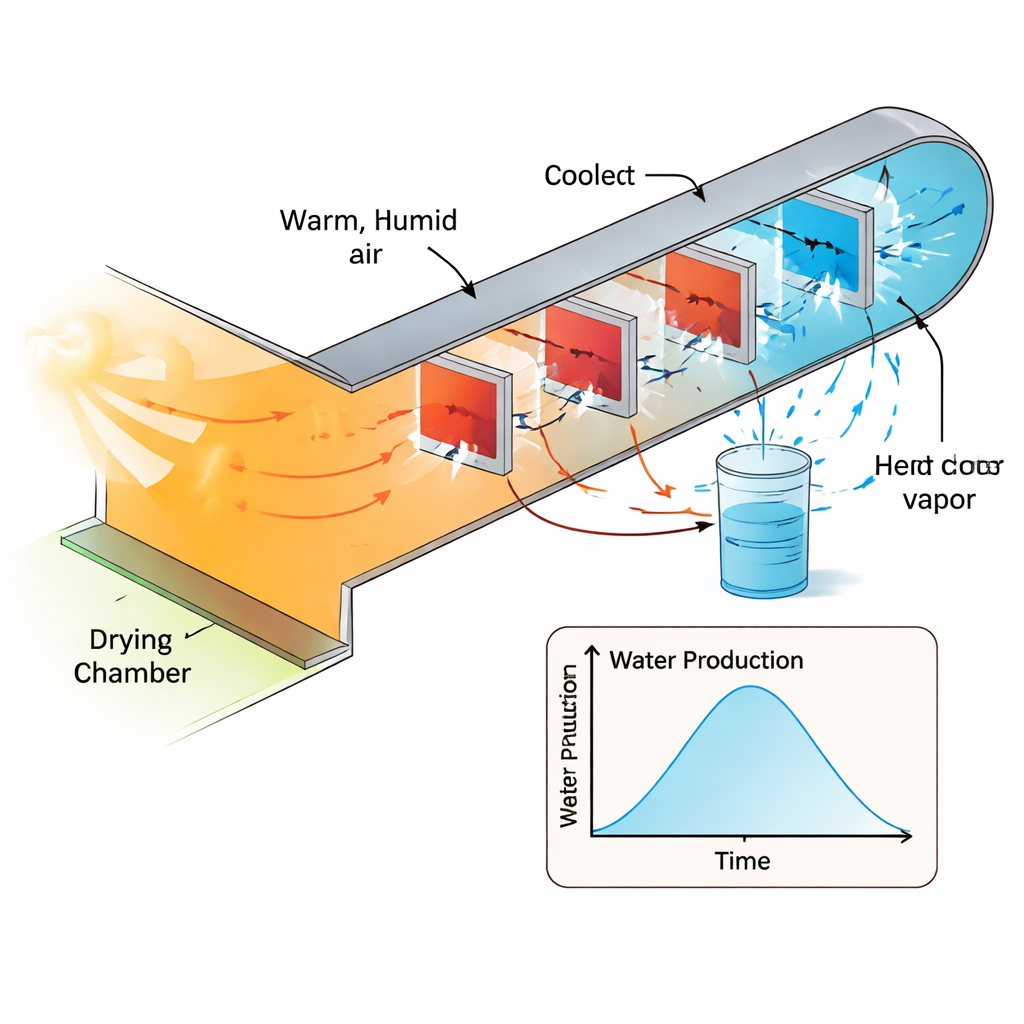
How Much Energy and Water Were Saved
Over an eight-hour sunlit period, the system dried one kilogram of fresh tomatoes, cutting their moisture from over 900 grams of water per kilogram to about 100 grams per kilogram—safe for storage and transport. At the same time, the water recovery unit captured roughly 3.9 liters of clean water, a mix of moisture released from the tomatoes and water drawn from the surrounding air. The solar hardware performed strongly: thermal efficiency (the share of sunlight turned into useful heat) reached about 53%, electrical efficiency peaked near 17%, and the combined efficiency of heat plus power topped 70%. The thermoelectric coolers worked with a moderate efficiency, but their smart placement allowed the same devices to both assist drying and condense water, squeezing more value out of each watt of solar energy.
Why This Matters for Farmers and Communities
To a non-specialist, the key message is simple: this technology uses sunshine to dry food and make water at the same time, with little waste. By recycling heat and capturing water that would normally disappear into the air, the system reduces reliance on fuel, lowers climate-warming emissions, and offers a new source of safe water—especially important in dry or off-grid regions. While further development and scaling are needed, this “drying-to-drinking” concept points toward future farms and small food businesses that can preserve harvests, secure water, and cut pollution using only the power of the sun.
Citation: Elbrashy, A., El-fakharany, M.K., Al-Sood, M.A. et al. Water recovery of drying waste using a thermoelectric cooler and PV/T assisted. Sci Rep 16, 4087 (2026). https://doi.org/10.1038/s41598-026-35137-w
Keywords: solar drying, water recovery, hybrid PV/T, thermoelectric cooling, sustainable agriculture