Clear Sky Science · en
Uncovering the mechanisms of Jingui Shenqi pill alleviates type 2 diabetic osteoporosis using a combined network pharmacology and metabolomics approach
Why diabetes can quietly weaken bones
Most people know that type 2 diabetes can damage the heart, eyes and kidneys. Far fewer realize that it can also quietly eat away at the skeleton, raising the risk of painful fractures. This study explores how a classic Chinese herbal formula, Jingui Shenqi Pill, might protect bones in the setting of diabetes, and uses modern tools to uncover how it works at the molecular level.
Ancient formula meets a modern bone problem
Diabetic osteoporosis is a condition in which long-term high blood sugar and disturbed fat metabolism weaken bone structure. Standard treatments mainly focus on lowering glucose and slowing bone loss, but they often fall short and can have side effects. Jingui Shenqi Pill, a centuries-old mixture of eight herbs, has been used in China to treat both diabetes and fragile bones. Earlier clinical work suggested it improves bone density and blood sugar, but its inner workings remained unclear. The authors set out to test the pill in animals and cells, and then map its active ingredients and biological targets using cutting-edge chemistry and data analysis.
Protecting bones and metabolism in diabetic mice
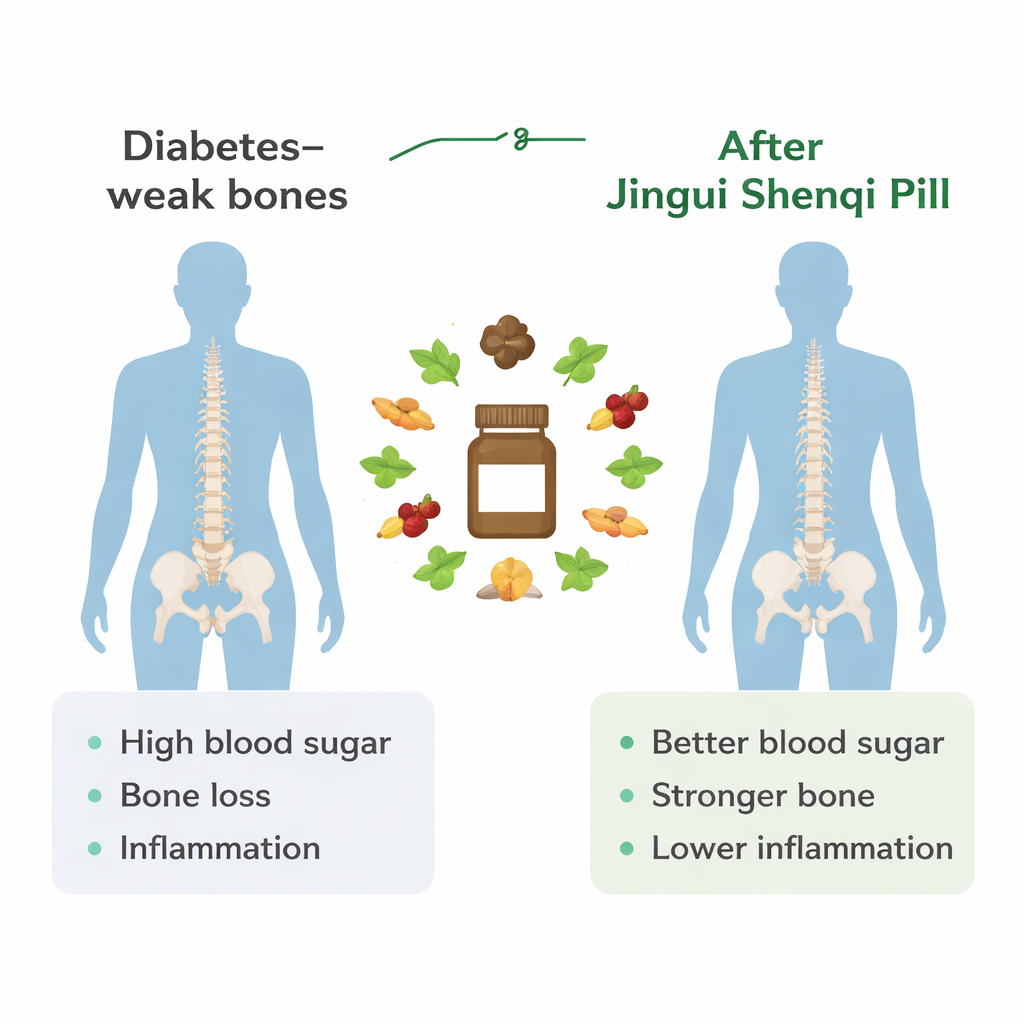
The team used a special mouse strain that develops type 2 diabetes when fed a high-fat diet. These mice had high blood sugar, abnormal blood fats and clear signs of bone damage: thinner, more widely spaced bone struts and enlarged marrow cavities in the femur. After four weeks of treatment with Jingui Shenqi Pill, the diabetic mice showed lower fasting glucose, better glucose tolerance and a healthier blood fat profile. Microscopic staining and 3D X-ray scans revealed that their bone architecture markedly improved: bone volume and thickness went up, gaps between trabecular struts narrowed, and overall bone mineral density increased. Blood markers of bone turnover also shifted in a favorable direction, indicating less bone breakdown and more bone formation.
Helping bone-building cells in a sugary environment
To see what happens at the cellular level, the researchers exposed bone-forming cells (osteoblasts) to high glucose in the lab, mimicking the diabetic environment. High sugar reduced these cells’ survival, blunted their ability to mature and form mineralized nodules, and altered key proteins that balance bone building and bone breakdown. When the cells were treated with serum from animals that had received Jingui Shenqi Pill, the damage was largely reversed. The cells grew better, showed higher activity of alkaline phosphatase (a marker of bone formation), formed more calcium deposits, and increased levels of proteins that favor bone building while reducing those that promote bone-resorbing cells.
Digging into signals, pathways and small molecules
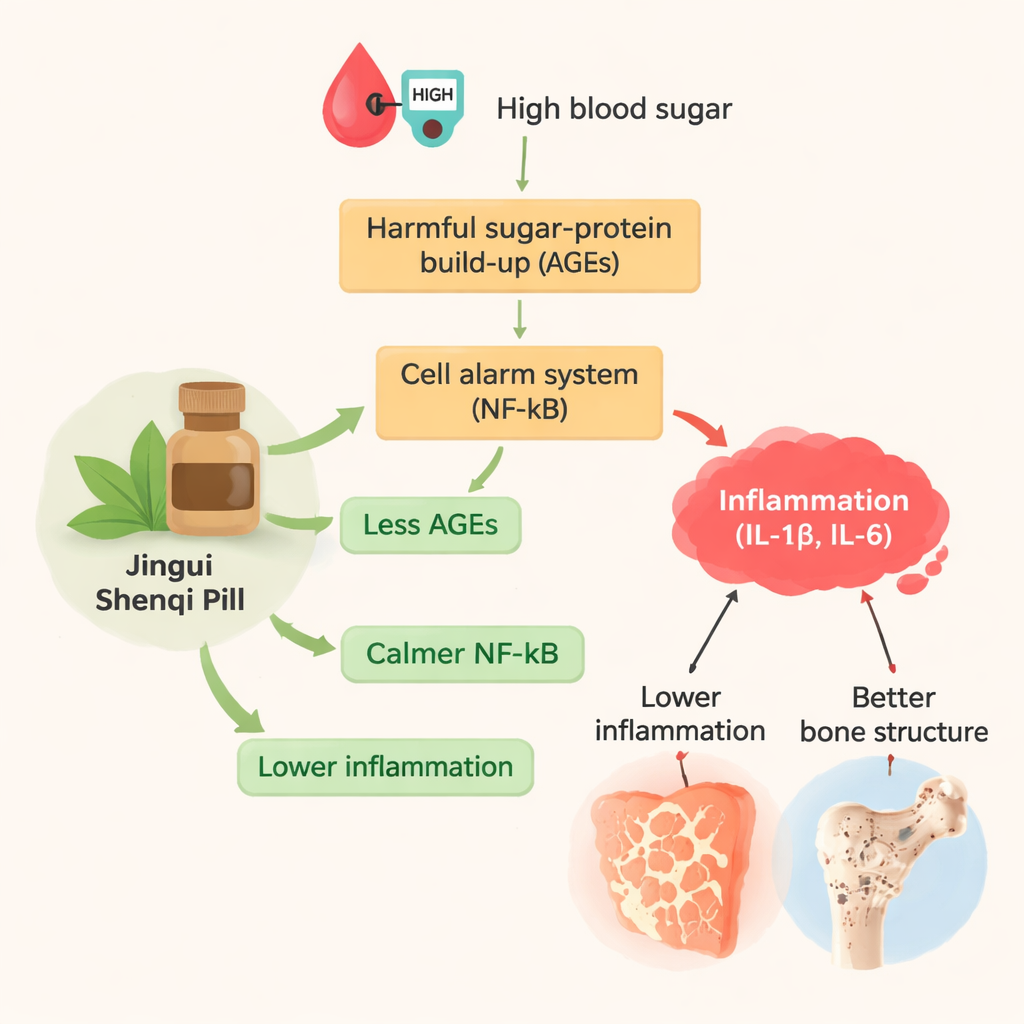
Because Jingui Shenqi Pill contains many compounds, the team used advanced mass spectrometry to catalog its chemical makeup and combined this with “network pharmacology” — a method that links plant compounds to known human protein targets and pathways. They identified 143 active ingredients and 152 overlapping targets related to diabetic osteoporosis. Many of these targets clustered in pathways that control inflammation, cell stress and metabolism, including an axis in which harmful sugar-protein complexes (called AGEs) activate a cell alarm system known as NF-κB, which then drives inflammatory messengers such as IL-1β and IL-6. In mice, broad profiling of blood metabolites showed that diabetes disturbed lipids, amino acids and sugar-related molecules, whereas Jingui Shenqi Pill shifted these patterns back toward normal, especially in pathways related to amino sugars and tryptophan. Follow-up experiments in bone cells confirmed that the pill lowered AGEs, dampened NF-κB activation and reduced IL-1β and IL-6, supporting the idea that calming inflammation and correcting metabolic noise are central to its action.
What this means for people with diabetes and weak bones
For a lay reader, the key message is that this traditional herbal pill appears to tackle diabetic bone loss on several fronts at once: it improves blood sugar and fat balance, directly supports the cells that build bone, and quiets inflammatory signals that erode bone strength. While more work is needed in human patients, the study shows how ancient remedies can be probed with modern tools to reveal multi-layered effects. Jingui Shenqi Pill emerges not as a simple pain reliever, but as a complex regulator that may help protect the skeleton from the long-term wear and tear of type 2 diabetes.
Citation: Zhang, Y., Huang, Y., Liu, X. et al. Uncovering the mechanisms of Jingui Shenqi pill alleviates type 2 diabetic osteoporosis using a combined network pharmacology and metabolomics approach. Sci Rep 16, 4890 (2026). https://doi.org/10.1038/s41598-026-35129-w
Keywords: diabetic osteoporosis, type 2 diabetes, Jingui Shenqi Pill, bone health, traditional Chinese medicine