Clear Sky Science · en
Differential interference of body- and non-body-related representational conflicts on error and performance monitoring in flanker tasks
Why your own body helps your brain avoid mistakes
Every day your brain must choose the right action while ignoring distractions: stepping off a curb as a bike whizzes by, or hitting the correct key on a crowded keyboard. This study asks a deceptively simple question with big implications for attention, driving, sports, and even mental health: does your brain resolve conflicts more easily when the confusing information involves your own body—such as pictures of hands—rather than abstract symbols like letters or pictures of leaves?
How scientists create controlled mental traffic jams
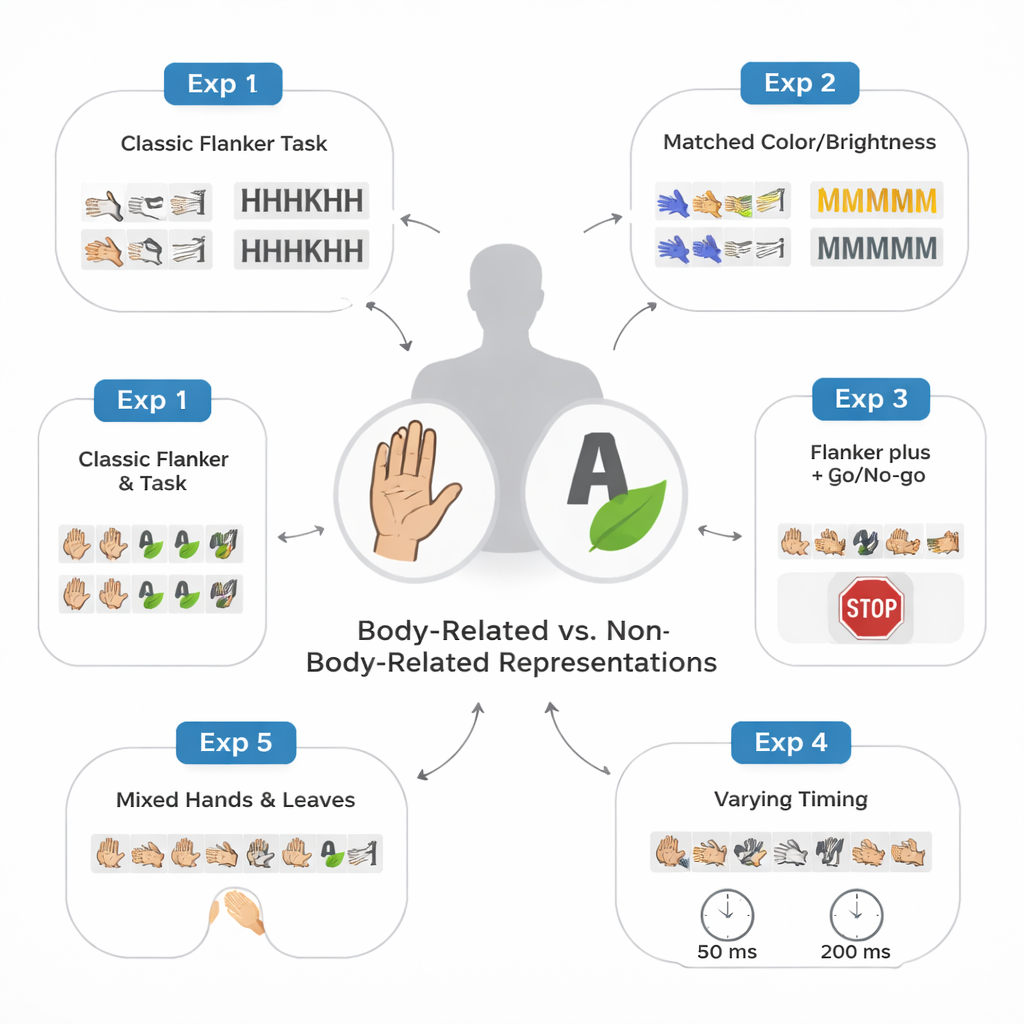
To probe this, the researchers used variations of a classic “flanker task.” Volunteers saw rows of five images on a screen, such as a central target hand flanked by other hands, or a central letter flanked by other letters. Sometimes the flankers matched the target (congruent trials), and sometimes they signaled the opposite response (incongruent trials), creating a kind of mental traffic jam as two action plans competed. Participants had to respond quickly and accurately to the center image only, while the scientists measured how much slower and less accurate they became when the surrounding images sent conflicting signals.
Five experiments, one repeating pattern
The team ran five separate experiments, each tweaking the task to rule out simple explanations. In the first, they compared hand images with letters in a straightforward flanker setup and found that incongruent hand trials disrupted performance less than incongruent letter trials. In other words, when the conflict was about bodies (hands) rather than symbols (letters), people handled the clash more smoothly. The second experiment carefully matched the hands and letters for basic visual features such as brightness, contrast, and color, so that body-related and non-body stimuli were equally visible. The body advantage remained, showing it was not just a matter of one set of images being easier to see.
Turning up and down the difficulty of conflict
Next, the researchers tested whether this body-related benefit would hold when the brain’s control system was pushed harder or made easier. In Experiment 3, they added “no-go” trials where participants had to withhold a response, boosting the need for careful monitoring and inhibition. Hands still produced smaller interference than letters, and in some conditions people were better at stopping themselves when the critical stimulus was a hand. In Experiment 4, they briefly showed the distracting flankers and removed them before the target appeared, reducing their ability to interfere. Even under this lighter mental load, conflicts involving hands remained easier to resolve than those involving letters, and the timing manipulations showed that interference grew when distractors had more time to influence processing.
When bodies compete with the world around them
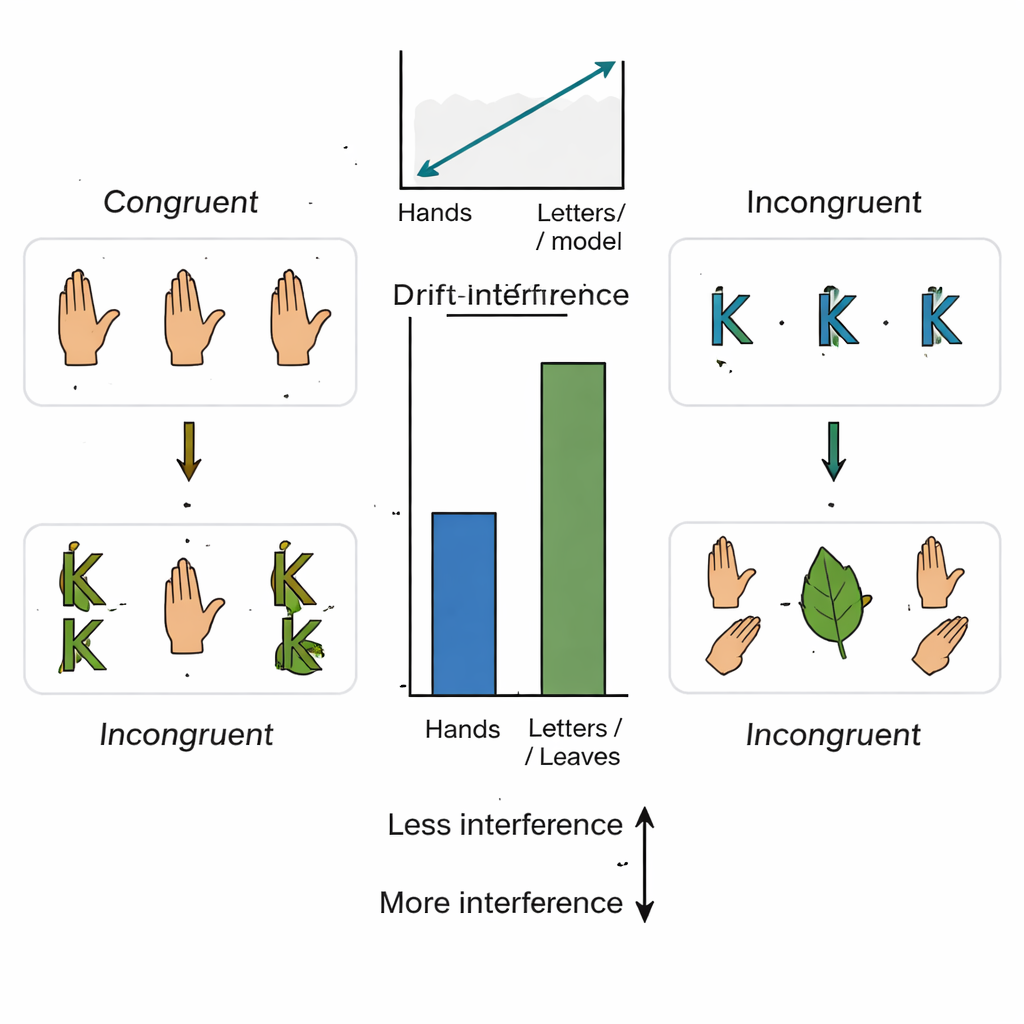
Finally, Experiment 5 mixed body-related and non-body-related content. The targets were either hands or leaves, and the flankers could be the same or the other category. Here, the researchers could ask a more pointed question: are hands special as targets, as distractors, or both? They found that leaves surrounding a hand target disrupted performance more than hands surrounding a leaf target. Additional analyses suggested a double advantage for bodies: hand targets were processed more efficiently, and hand flankers were somewhat less disruptive than leaf flankers. Across all experiments, a mathematical model of decision making supported this picture, showing that evidence built up more efficiently when resolving conflicts that involved hands.
What this means for everyday attention and control
Put simply, the study shows that the brain’s error-detection and conflict-resolution system works more efficiently when the competing information is about the body. Body-related images seem to tap into rich, well-practiced networks that integrate perception, movement, and attention, allowing the system to sort out conflicting signals with less cost in time and accuracy. This suggests that our internal model of the body is not only essential for moving and feeling, but also for keeping behavior on track when the environment sends mixed messages. Such insights could help design safer interfaces, training tools, and clinical tests that harness the natural priority our brains give to the body.
Citation: Fusco, G., Scandola, M., Spitaleri, M. et al. Differential interference of body- and non-body-related representational conflicts on error and performance monitoring in flanker tasks. Sci Rep 16, 4850 (2026). https://doi.org/10.1038/s41598-026-35124-1
Keywords: cognitive interference, flanker task, body representation, performance monitoring, attention control