Every year, the seafood industry throws away mountains of shrimp and crab shells. These leftovers are rich in chitin, a natural substance that can be turned into strong, thin sheets called "nanopaper." This study explores how two different ways of processing chitin change the look and strength of these sheets, and shows how waste from our dinner plates could become the basis for future eco‑friendly packaging and coatings.
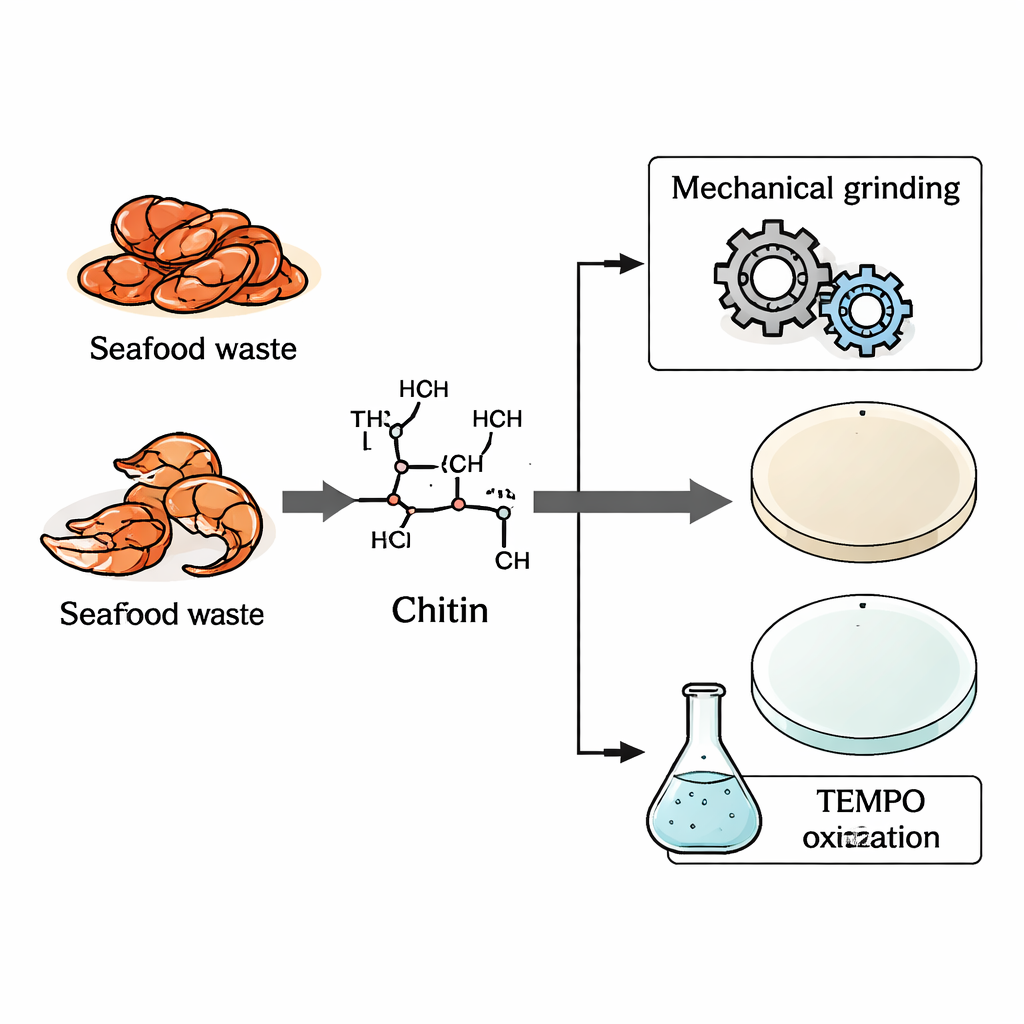
From Seafood Waste to High-Tech Material Figure 1.
Chitin is the second most common natural polymer on Earth, found in shellfish shells and the cell walls of fungi. It is naturally biodegradable, biocompatible, and can even slow the growth of microbes, making it a promising green material. The researchers started with chitin extracted from shrimp shells and broke it down into extremely fine fibers—about a thousand times thinner than a human hair. They used two main approaches: pure mechanical grinding, which physically tears the material apart, and a chemical route called TEMPO oxidation, which adds charged groups to the fiber surface and helps the fibers separate more easily in water.
Two Routes, Two Very Different Nanopapers
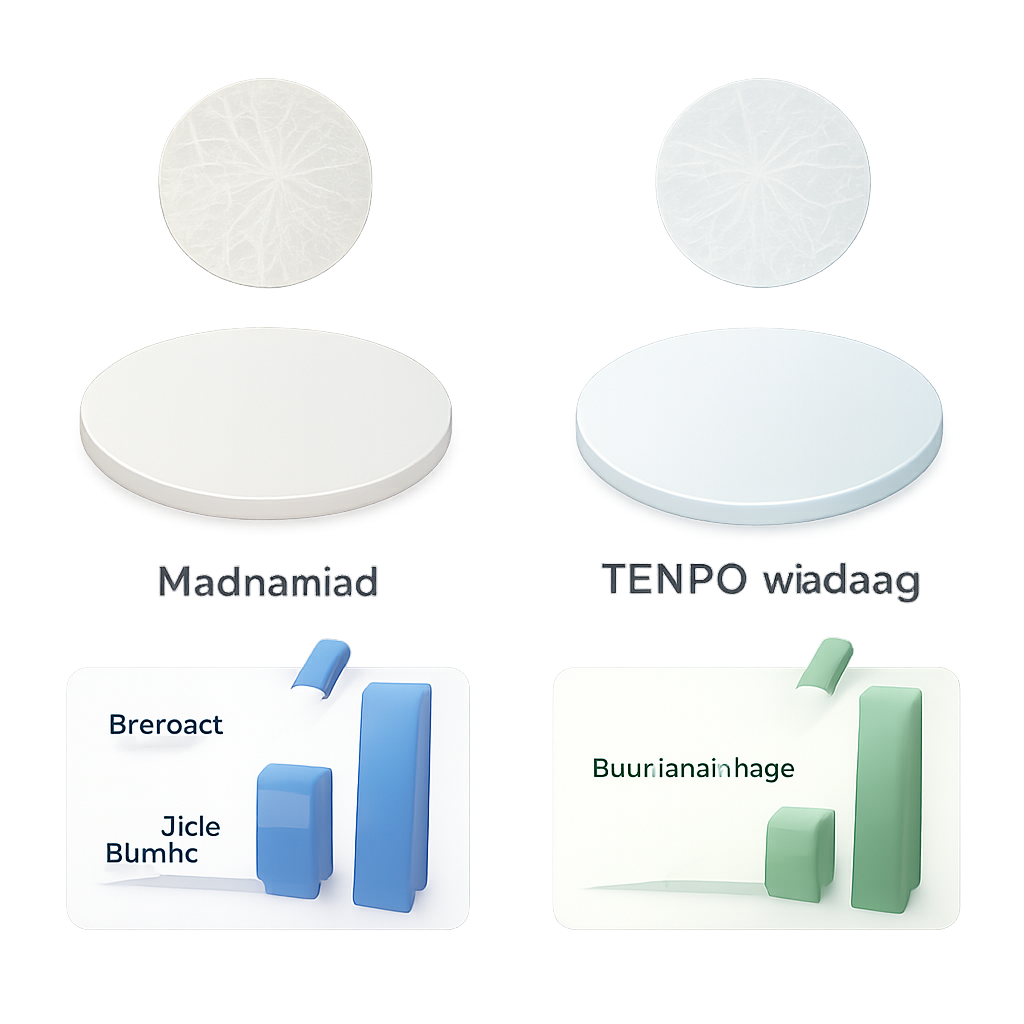
Even though both methods begin with the same chitin, they create nanofibers with very different structures. Under the microscope, mechanically treated fibers look like a tangled web with thicker strands that sometimes clump together. In contrast, TEMPO‑oxidized fibers appear finer and more evenly spread out, forming a smoother, more uniform network. When these fibers are filtered and dried into sheets, the differences become visible to the naked eye: mechanical nanopaper is more opaque, while TEMPO‑oxidized nanopaper is almost glass‑like, reaching about 92% light transmission compared with roughly 60% for the mechanically made sheets.
Balancing Clarity and Strength Figure 2.
The team measured how well the sheets let light through and how much force they could withstand before breaking. The more open, evenly spaced structure of the TEMPO‑oxidized fibers allows light to pass with less scattering, which explains the high transparency. However, this comes at a cost: the added chemical groups weaken some of the natural hydrogen bonds that help hold chitin chains tightly together. As a result, TEMPO‑oxidized nanopaper showed lower tensile strength and stiffness than the mechanically produced sheets. The mechanically made nanopaper, with its slightly higher crystallinity and stronger bonding between fibers, could handle nearly twice the pulling force before breaking and also had a higher resistance to stretching.
What the Invisible Structure Tells Us
To look deeper, the researchers used X‑ray diffraction and infrared light analysis to probe how orderly and chemically changed the fibers were. Both types of nanopaper kept a high level of crystallinity, meaning their internal building blocks remained neatly arranged, which helps with strength. The key difference was that the TEMPO process introduced new carboxylate groups on the fiber surfaces, which increased their charge and helped them disperse in water, but also slightly disrupted the tight packing and bonding between chains. This subtle change in chemistry explains why one sheet becomes clearer but weaker, while the other stays stronger but more cloudy.
Choosing the Right Sheet for the Right Job
For a non‑specialist, the main message is that there is no single "best" chitin nanopaper—its value depends on the job it needs to do. If you want a strong, stiff, biodegradable film for protective or structural uses, the mechanically produced nanopaper is better. If you need a clear, plastic‑like film for see‑through, eco‑friendly packaging, displays, or light‑managing coatings, the TEMPO‑oxidized nanopaper is more suitable. By understanding how processing choices change the hidden structure of chitin, this work shows how we can fine‑tune materials made from seafood waste to replace some of today’s petroleum‑based plastics.
Citation: Mohammadlou, A., Dehghani Firouzabadi, M. & Yousefi, H. Comparison of the properties of nanopaper from chitin nanofibers prepared by mechanical and TEMPO-oxidized methods.
Sci Rep16, 5483 (2026). https://doi.org/10.1038/s41598-026-35116-1