Clear Sky Science · en
The smallest tetrapod from the Middle Triassic of South America: a new procolophonoid parareptile from the Ladinian of Southern Brazil
A Tiny Skull with a Big Story
Imagine holding the entire skull of an ancient land‑dwelling vertebrate between the tips of your fingers. In southern Brazil, paleontologists have uncovered just such a fossil—a skull less than one centimeter long from the Middle Triassic Period, over 240 million years ago. This miniature creature, named Sauropia macrorhinus, offers a rare glimpse into how small-bodied reptiles lived and evolved in the shadow of the mass extinction that nearly wiped out life at the end of the Permian, just before dinosaurs began to dominate Earth.
A Window into a Recovering World
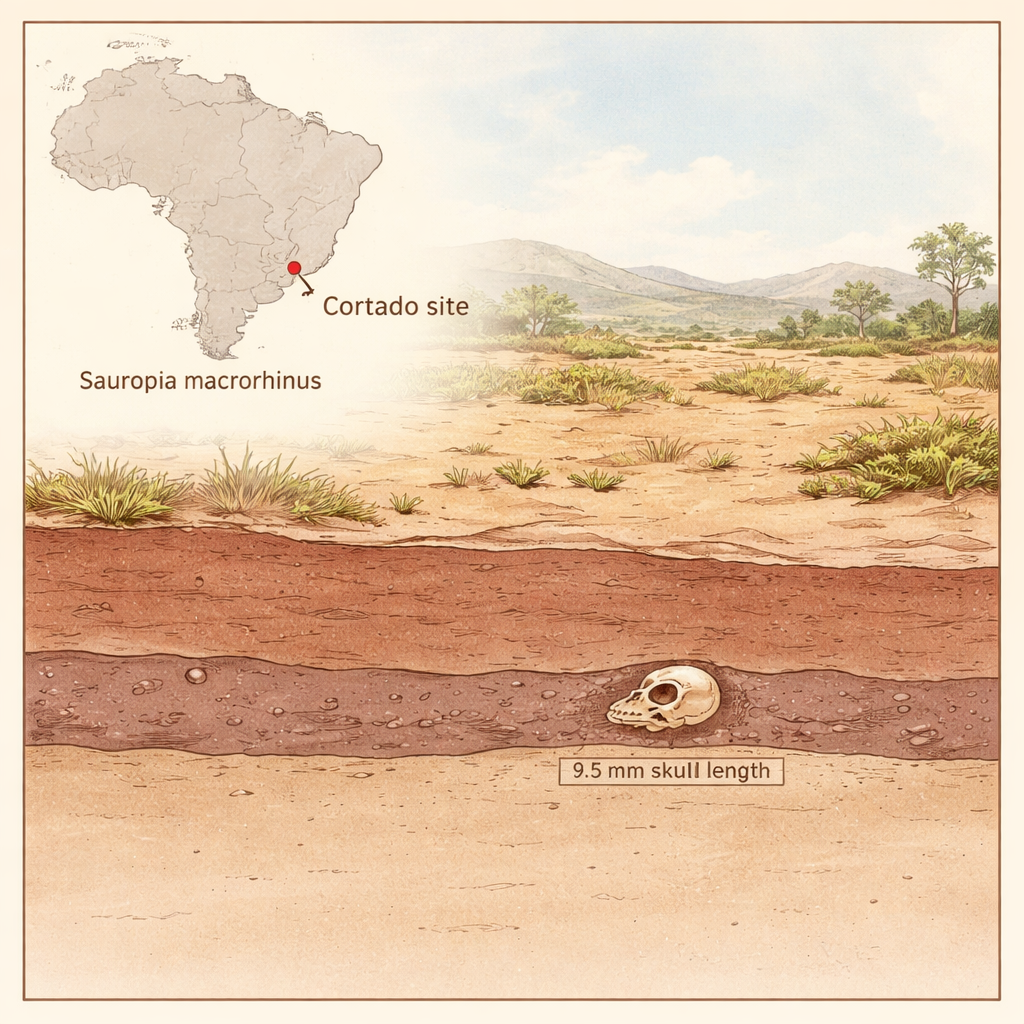
The Triassic Period was a global rebuilding project. After the greatest mass extinction in Earth’s history, ecosystems slowly refilled with new and surviving species. Among the survivors were parareptiles, a side branch of early reptiles that would eventually die out, leaving no direct descendants today. In South America, fossils of these animals from the Middle Triassic are extremely scarce. The discovery of Sauropia macrorhinus in the Cortado site of southern Brazil fills an important gap, showing that very small land vertebrates were part of these recovering communities and helping scientists reconstruct what terrestrial life looked like before dinosaurs took center stage.
Finding and Scanning a Miniature Skull
The new species is known from a single, nearly complete skull and lower jaw preserved together. The fossil comes from rocks of the Santa Maria Formation, dated to the Ladinian age of the Middle Triassic. With a skull just 9.5 millimeters long, this animal is the smallest tetrapod (a four‑limbed vertebrate and its relatives) yet found in these deposits. Because the bones are tiny and partially covered by rock, the team used high‑resolution micro‑CT scanning to peer inside the specimen. They also created a detailed 3D digital model to study the skull from different angles, allowing them to describe its shape and tooth arrangement without damaging the fossil.
An Unusual Little Reptile
Sauropia macrorhinus belongs to a group called procolophonoids, small, lizard‑like reptiles that experimented with many ways of feeding, from plant‑eating to insect‑eating. This species has a combination of features that sets it apart from its relatives. Its skull is almost as wide as it is long, with a short, deep snout and a strikingly large nostril opening—so large that its scientific name literally means “big‑nosed young lizard.” The space between its eye openings is broad, and the side opening that housed the eye and part of the temple is unusually long, stretching nearly to the back of the skull. The front of the upper jaw bears three simple, cylindrical teeth, and the lower jaw forms a broad U shape, all traits that help distinguish it from other known species.
Placing a Tiny Skull on the Family Tree
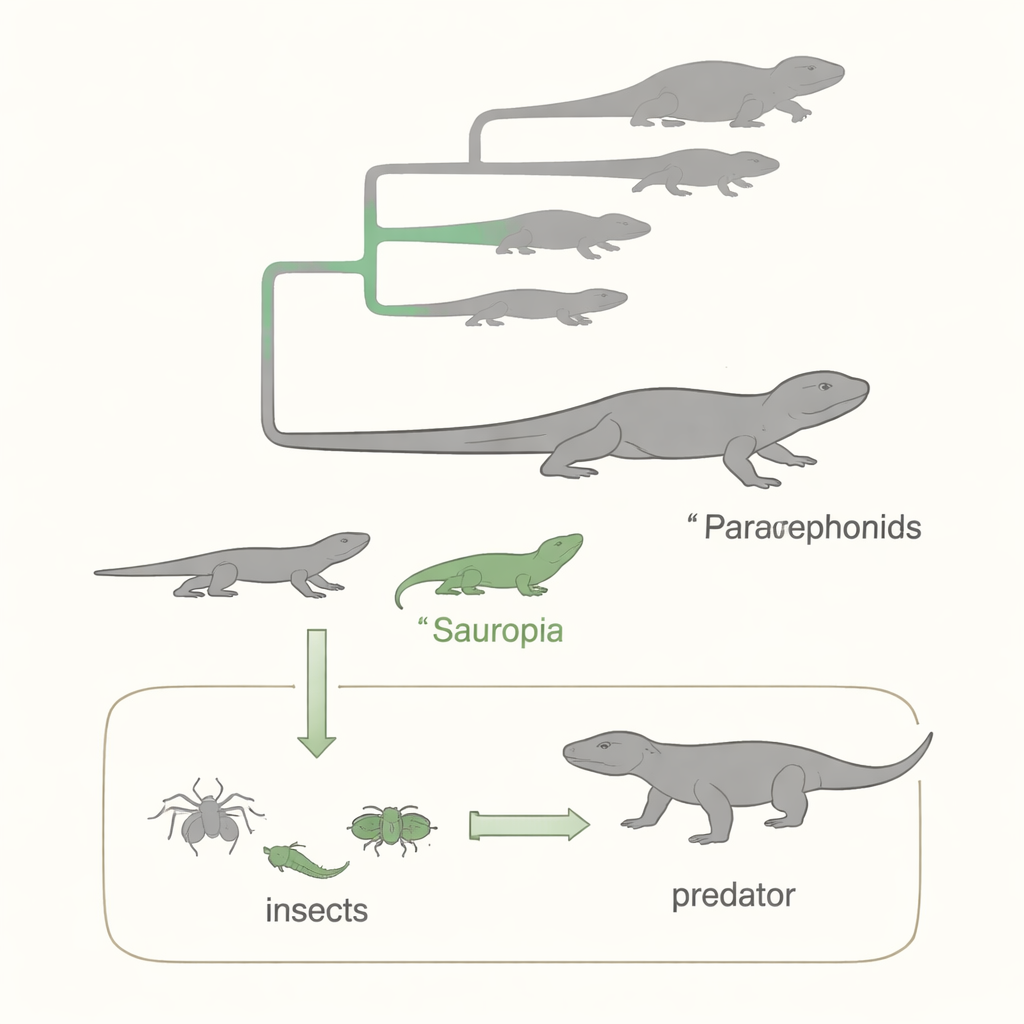
To figure out where this animal sits in the reptile family tree, the researchers added its characteristics to a large dataset of skull and tooth features for 43 species of related reptiles. Computer analyses repeatedly placed Sauropia macrorhinus near the base of the procolophonid branch—a diverse group of Triassic parareptiles—rather than with another closely related group known as owenettids. Some traits, such as the elongated nostril and front part of the upper jaw, resemble more primitive forms and owenettids, while others, like the deep snout and reduced number of front teeth, match procolophonids. The team cautions that the specimen is probably a very young individual, and juvenile skulls can differ significantly from adults, so its exact position remains tentative.
A Small Player in a Complex Food Web
Even with this uncertainty, the fossil reveals how rich and layered Middle Triassic ecosystems were. The size and simple, pointed teeth of Sauropia macrorhinus suggest it fed on insects and other tiny invertebrates. In turn, it would have been prey for small meat‑eating reptiles living alongside it, rather than for giant predators many times its size. The very existence of such a small animal, preserved in rocks older than the first dinosaurs, shows that Middle Triassic communities already included a variety of body sizes and diets. By adding a miniature hunter to the cast of characters, this discovery helps scientists understand how food webs were structured in the last pre‑dinosaur ecosystems and how life continued to diversify after Earth’s greatest crisis.
Citation: Müller, R.T., Roberto-da-Silva, L., Aurélio, P.L.P. et al. The smallest tetrapod from the Middle Triassic of South America: a new procolophonoid parareptile from the Ladinian of Southern Brazil. Sci Rep 16, 866 (2026). https://doi.org/10.1038/s41598-026-35114-3
Keywords: Triassic reptiles, parareptiles, procolophonids, fossil ecosystems, Sauropia macrorhinus