Clear Sky Science · en
In vitro evaluation of different implant systems and their influence on primary stability
Why this study matters for dental care
For anyone considering dental implants, one big worry is whether the new tooth will firmly attach to the bone and stay put over time. This study looks at three different ways of preparing the bone before placing an implant, focusing on weak, sponge-like bone similar to what is often found in the upper jaw. The researchers wanted to know whether newer, bone‑preserving techniques actually give a more secure first grip for the implant than traditional drilling.
Different ways to prepare the bone
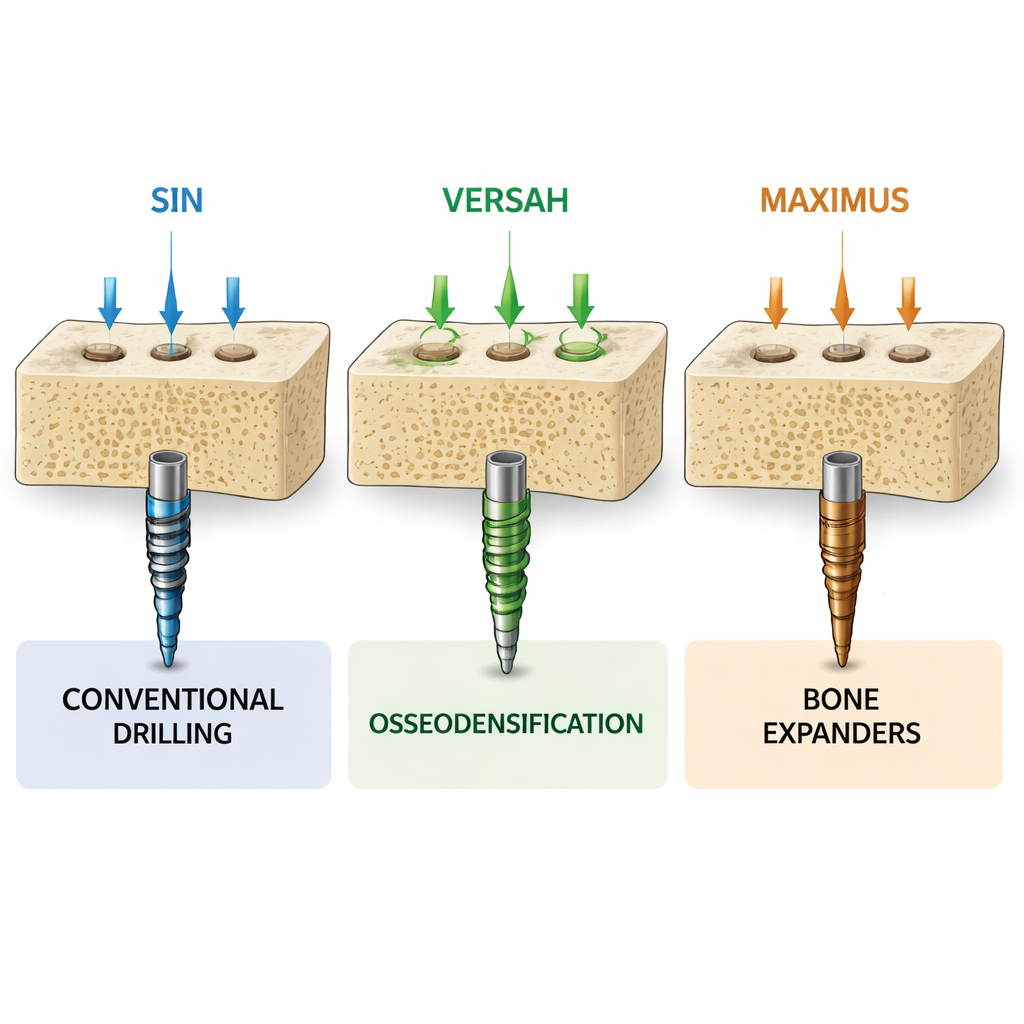
Before an implant is placed, a small channel must be created in the bone. The conventional method uses drills that remove bone to make space for the implant screw. Newer systems try to keep and gently compress the bone instead of cutting it away. In this experiment, the team compared three options, all used with the same type of implant: the regular drill set from the implant company (called SIN), a system that compacts bone while spinning in a special way (osseodensification, VERSAH), and a set of expanding tools that gradually stretch and thicken the bone (bone expanders, MAXIMUS). All are meant to improve the implant’s initial stability, especially in softer bone.
Testing on weak bone in the lab
To mimic low‑density human jawbone, the researchers used fresh bovine ribs, which have a similar loose, spongy structure. They followed each manufacturer’s drilling or expansion instructions to prepare the channels for the same size implant. Before inserting implants, they scanned the prepared bone with high‑resolution micro‑computed tomography, a kind of three‑dimensional X‑ray, to measure how much solid bone surface and volume surrounded the channel at three levels: near the top (cervical), the middle (body), and the tip (apical) of the planned implant. Then they placed the implants and measured how much twisting force was needed to fully seat each one, a standard clinical indicator of how firmly the implant is anchored at the moment of placement.
What the measurements revealed
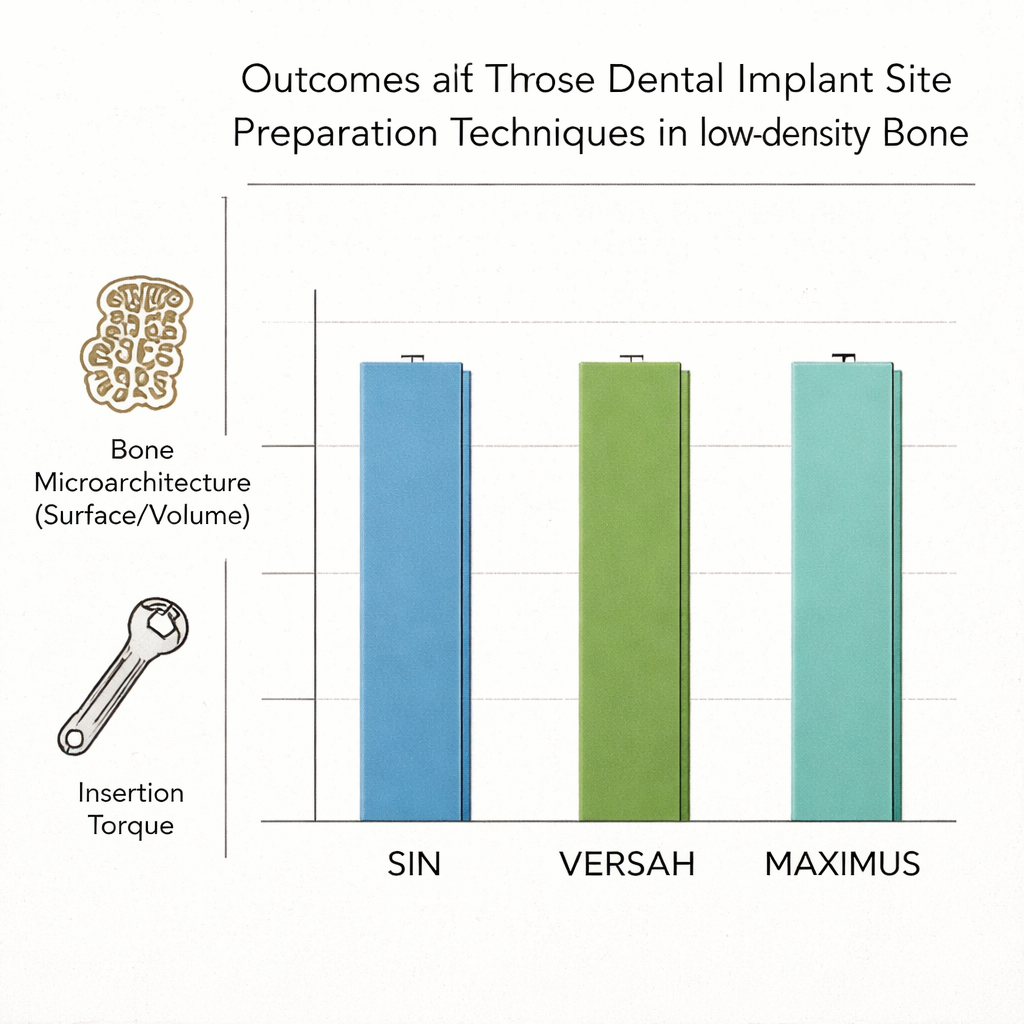
Surprisingly, despite the different ways these tools work, the detailed scans showed very similar bone patterns around the implant sites. The ratio of bone surface to bone volume did not differ significantly between the three techniques at any level along the channel. When the team looked at insertion torque, the bone expander system (MAXIMUS) gave the highest average numbers, followed by the osseodensification system (VERSAH) and then conventional drilling (SIN). However, these differences were not statistically meaningful: in other words, given the natural variability of the samples, the three groups could not be reliably separated from each other in terms of how tight the implants felt on insertion.
Limits of improving very soft bone
The findings suggest that when bone is extremely porous and weak, its natural structure may limit how much any drilling or compaction method can boost early stability. Although earlier studies in somewhat denser bone have reported clear advantages for osseodensification, this experiment indicates that in very soft bone the benefits may level off. Trying to squeeze or over‑tighten such fragile bone could even risk tiny fractures, which might harm long‑term healing. The authors argue that, in these challenging situations, factors like implant shape, how quickly the implant is loaded with chewing forces, and whether additional techniques such as grafting or bone building are used may be more important than the specific choice of drill system alone.
What this means for patients
For patients with weak jawbone—common in the back of the upper jaw or in people with reduced bone quality—this study suggests that no single drilling or expansion system can fully overcome the limits of the existing bone. All three tested methods produced similar initial stability for implants under these conditions. That does not mean newer tools are useless, but it does mean that your dentist or surgeon must consider your bone quality, implant design, and overall treatment plan together, rather than relying on a special drill to guarantee success. In short, when bone is very soft, careful planning and realistic expectations may matter more than the brand or style of the bur used to prepare the implant site.
Citation: Neto, O.A., Câmara, J.V.F., Schestakow, A. et al. In vitro evaluation of different implant systems and their influence on primary stability. Sci Rep 16, 1297 (2026). https://doi.org/10.1038/s41598-026-35112-5
Keywords: dental implants, osseodensification, bone density, implant stability, drilling techniques