Clear Sky Science · en
Quantum secure image encryption using hybrid QTRNG and QPRNG
Why hiding pictures is getting harder
Photos and videos now travel constantly between phones, hospitals, satellites and cloud servers. Today’s encryption methods keep those images safe—so long as attackers only have ordinary computers. As powerful quantum computers emerge, many of our current locks could be picked. This research explores how to use quantum physics itself to build new kinds of “keys” that can protect images even against future quantum attacks.
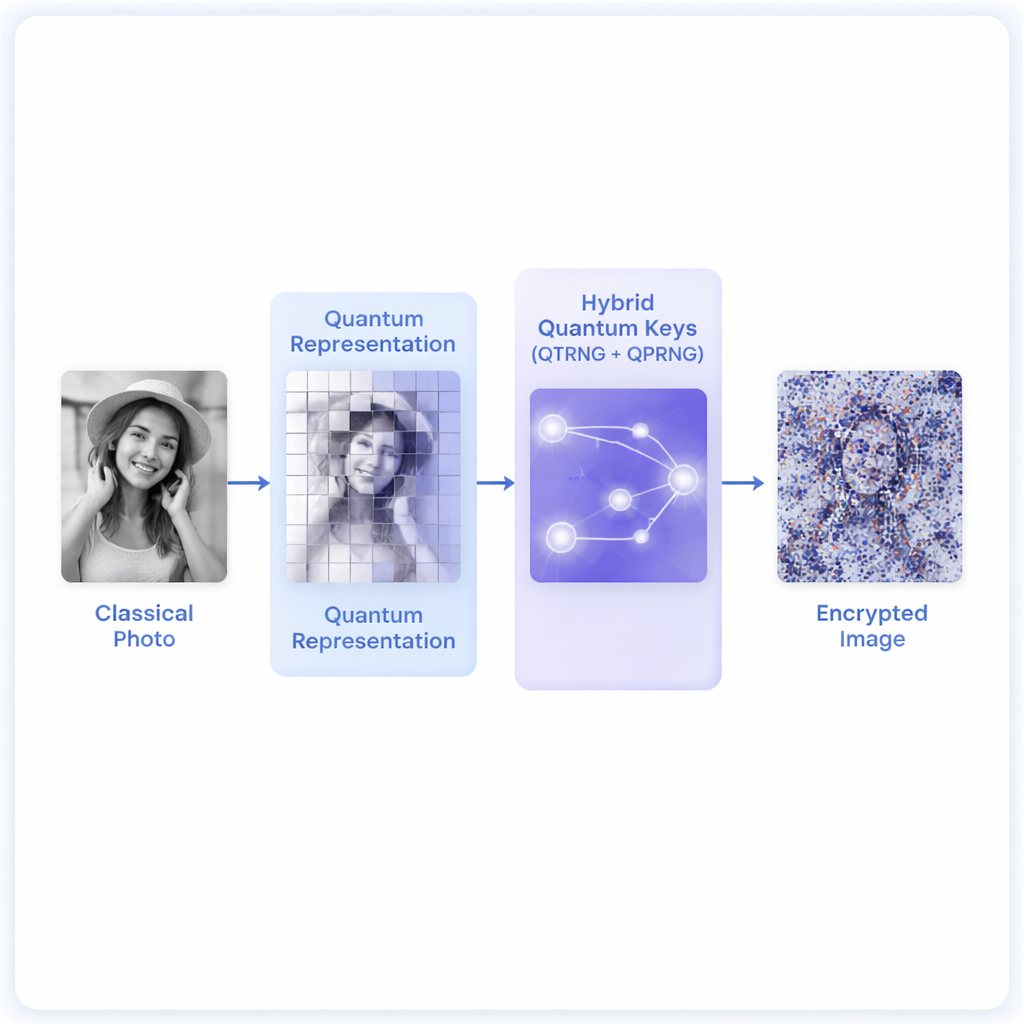
Turning pictures into quantum form
To use quantum tricks on images, the authors first convert an ordinary grayscale picture into a format that quantum hardware can understand. Instead of storing each pixel as a number in a file, the image is re‑encoded so that each pixel’s brightness and position live in a collection of qubits. This scheme, called NEQR, lets a quantum circuit hold all pixel values at once in a huge superposition. That makes it possible to process the entire image in parallel, using a relatively small number of qubits, and later recover a normal picture by measuring them.
Two kinds of quantum randomness
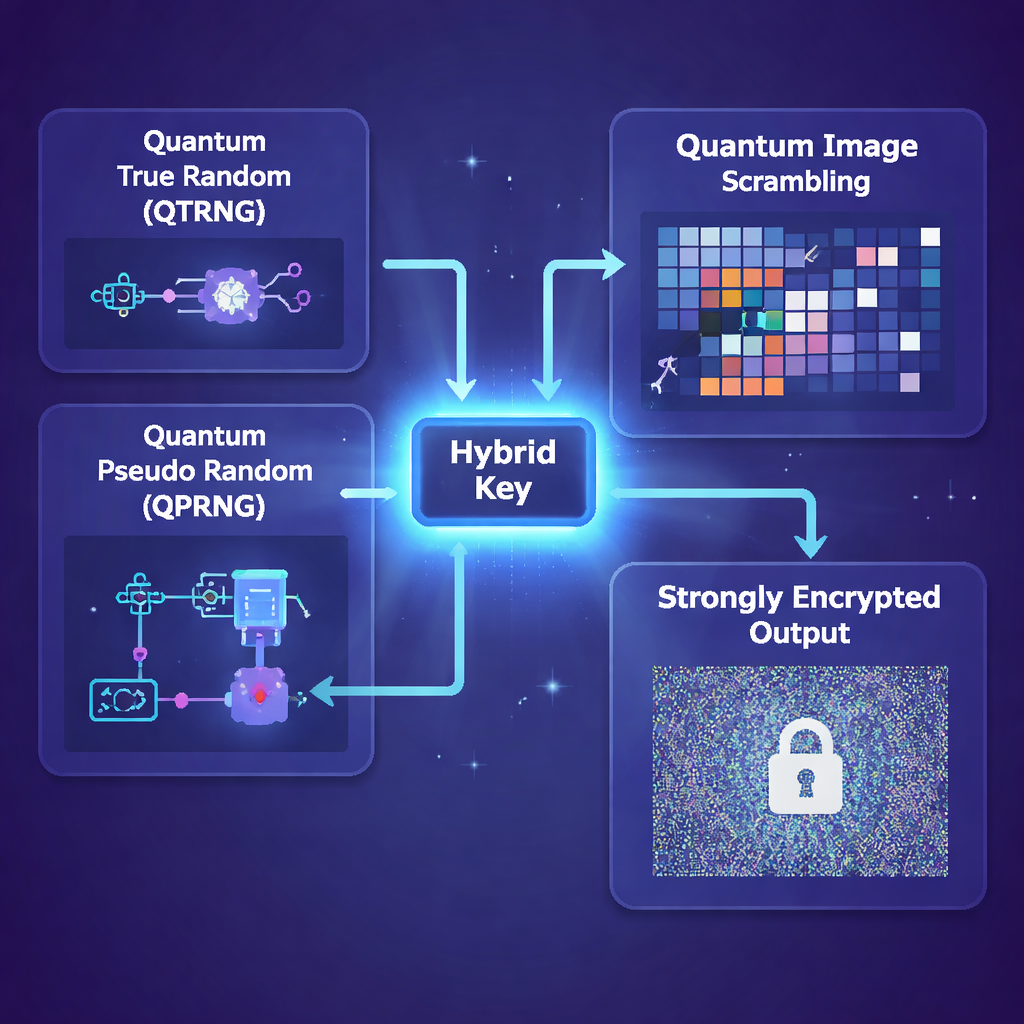
Good encryption lives or dies on good randomness. The paper studies two quantum ways to produce random bits. The first is Quantum True Random Number Generation (QTRNG). Here, qubits are put into a perfect 50–50 superposition and then entangled so that their outcomes are deeply linked in ways no classical system can mimic. When these qubits are measured, the string of 0s and 1s is fundamentally unpredictable, rooted in the intrinsic uncertainty of quantum mechanics. The second method, Quantum Pseudo Random Number Generation (QPRNG), uses fixed sequences of quantum gates to churn out complex, seemingly random bit patterns that can be reproduced exactly if you repeat the same circuit.
Blending unpredictability and control
The heart of the work is a hybrid generator, QHRNG, that marries these two approaches. First, a truly random seed is produced with the QTRNG circuit. That seed is then loaded into a second quantum circuit built from Clifford gates that spread, twist and entangle the information across many qubits. The result is a long bitstream that inherits the deep unpredictability of the true quantum seed, but also the efficiency and scalability of the pseudo‑random circuit. Extensive statistical checks, including standard NIST randomness and entropy tests, show that this hybrid source passes more tests, with higher margins, than either true‑only or pseudo‑only quantum generators.
Scrambling images with quantum keys
Once the hybrid key is ready, it drives a quantum image cipher. The original picture is divided into small blocks, converted into the NEQR quantum format, and then mixed with the key bits using quantum equivalents of familiar operations like XOR. Additional quantum steps shuffle bits inside each pixel and swap qubit positions, so that small changes spread rapidly across the entire image. A selective Quantum Fourier Transform further smears pixel information into wave‑like patterns that are extremely hard to reverse without the exact gate sequence and key. Finally, measuring the qubits yields an encrypted image that looks like pure noise; decryption runs all the steps in reverse, using the same hybrid key, to recover the original picture.
Putting quantum security to the test
The authors do more than theory: they run their random generators and image cipher both on ideal simulators and on a real IBM superconducting quantum chip. They then hammer the resulting key streams and encrypted images with a battery of tests used in modern cryptography. Measures such as how much encrypted images change when a single input pixel or key bit is flipped, how evenly pixel values are spread, and how well the randomness stands up to formal NIST checks all point in the same direction. The hybrid QHRNG‑based scheme consistently shows higher entropy, stronger resistance to various attack models and better behavior under noise than earlier quantum or classical image encryption methods.
What this means for everyday data
For non‑specialists, the key message is that the same quantum effects that threaten today’s encryption can also be turned into powerful defenses. By combining a small dose of irreducible quantum chance with a structured quantum circuit, the authors design keys that are extremely hard to guess yet practical to generate on near‑term hardware. Their quantum image cipher shows that such keys can protect visual data even if eavesdroppers gain access to future quantum computers or noisy communication channels. While still at the research stage, this hybrid approach sketches a path toward quantum‑ready locks for medical scans, satellite images and other sensitive pictures that will need to stay secret in the decades to come.
Citation: Gururaja, T.S., Pravinkumar, P. Quantum secure image encryption using hybrid QTRNG and QPRNG. Sci Rep 16, 5151 (2026). https://doi.org/10.1038/s41598-026-35111-6
Keywords: quantum image encryption, quantum random number generator, hybrid QTRNG QPRNG, post-quantum security, secure image transmission