Clear Sky Science · en
Micro-cavity–induced optical resonance for performance enhancement in ultra-thin CdTe photovoltaic devices
Why thinner solar cells matter
Solar panels are getting better every year, but they still rely on relatively thick layers of semiconductors that use scarce or toxic elements. Cadmium telluride (CdTe) is one of the most successful thin-film solar materials, yet making it truly ultra-thin usually means sacrificing efficiency. This study explores how to keep CdTe layers extremely thin—cut to about half their usual thickness—while still capturing nearly the same amount of sunlight, using a clever trick from optics called a micro-cavity.
Turning a solar cell into a light trap
Instead of treating the solar cell as a simple stack of films, the author designs it as a tiny optical resonator, or micro-cavity. In this design, two partially reflecting layers face each other with the active CdTe region in between, forming a Fabry–Pérot cavity. Light entering the device bounces back and forth many times, setting up standing waves at certain colors. Where these waves are strongest, the electric field inside CdTe is amplified, so even a very thin layer can absorb as much light as a much thicker one. 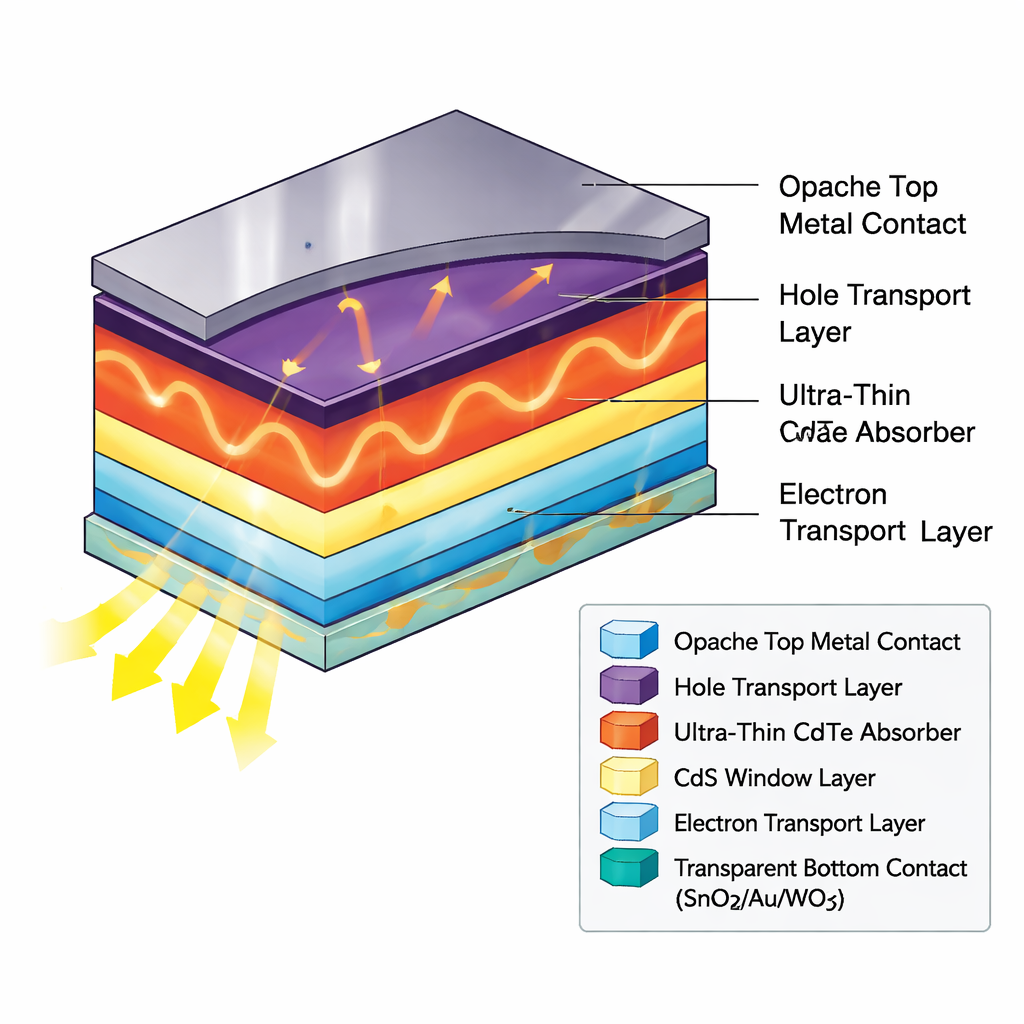
Building a transparent mirror at the bottom
To create this optical cavity without blocking incoming sunlight, the study replaces the usual transparent conducting oxide with a more sophisticated “dielectric–metal–dielectric” sandwich made of SnO2, gold (Au), and WO3. The thin gold film acts like a semi-transparent mirror and electrical contact, while the surrounding oxide layers tune how light is reflected and guided. Together they form a transparent bottom contact that doubles as one mirror of the cavity, while the usual top metal contact serves as the other mirror. The structure is carefully modeled so that its thicknesses and refractive indices align to strengthen the light field inside the ultra-thin CdTe layer rather than in the surrounding layers.
Finding the sweet spot for thickness
Before adding the cavity, the researcher first optimizes a conventional CdTe cell using detailed optical calculations (Transfer Matrix Method) and electrical simulations (SCAPS-1D). This step shows that a CdTe thickness of about 240 nanometers, combined with a 10-nanometer molybdenum oxide (MoO3) layer, gives the best trade-off between absorbing light and letting charge carriers move without too many losses. Thicker CdTe adds little extra absorption but increases recombination, while thinner layers start to miss significant portions of the solar spectrum. This optimized “cavity-free” device then serves as the baseline for judging what the micro-cavity adds.
How the micro-cavity boosts light capture
With the SnO2/Au/WO3 mirror added, the same 240-nanometer CdTe layer behaves very differently. Simulations show sharp absorption peaks where resonant modes form, especially in the deep-red and near-infrared region around 700–800 nanometers, close to CdTe’s band edge where it normally absorbs weakly. Electric-field maps reveal bright “hot spots” inside the CdTe at these wavelengths, proving that the cavity traps and intensifies light exactly where the material needs it most. Average reflectance in the visible range drops by roughly one fifth compared to the standard design, meaning less light is simply bounced away at the surface. 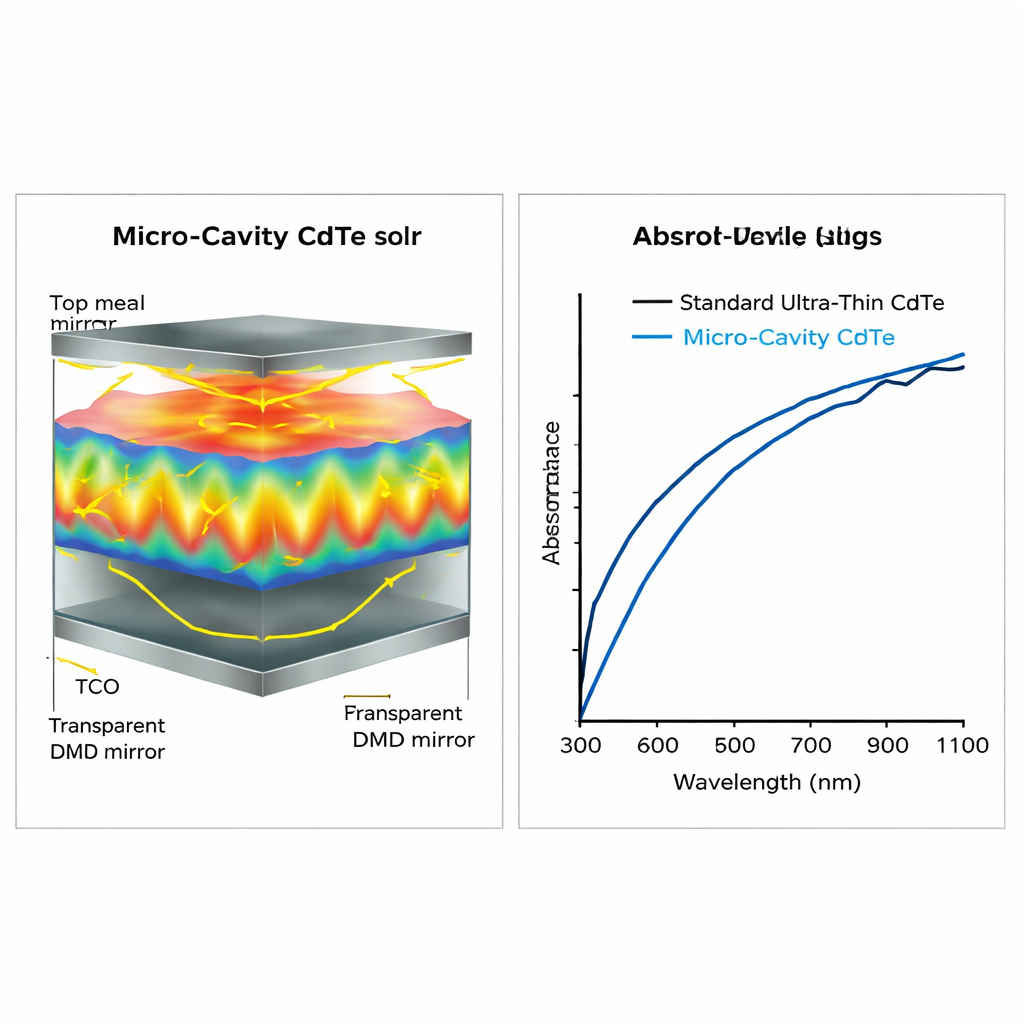
From more photons to more current
This stronger light trapping translates directly into electrical gains. The calculated photocurrent density for the micro-cavity device rises by about 9% compared with the optimized cavity-free cell, even though the CdTe thickness is unchanged. In fact, the micro-cavity cell with a 240-nanometer CdTe layer harvests roughly as many photons as a conventional design would need about 480 nanometers of CdTe to achieve. At the same time, key electrical metrics such as open-circuit voltage and fill factor remain high, showing that the optical tricks do not undermine charge collection. The result is an ultra-thin CdTe solar cell that preserves high performance while using significantly less absorber material.
What this means for future solar panels
For a non-specialist, the main message is that careful optical design can make a thin solar cell behave like a much thicker one. By turning the device into a kind of optical echo chamber, the study shows it is possible to cut CdTe usage roughly in half while keeping strong light absorption and electrical output. That not only reduces costs and material demand for scarce tellurium, but also supports safer, more sustainable solar technologies. The same micro-cavity strategy could be adapted to semi-transparent, bifacial, or tandem solar cells, where controlling where and how light is absorbed is just as important as the choice of semiconductor itself.
Citation: Cokduygulular, E. Micro-cavity–induced optical resonance for performance enhancement in ultra-thin CdTe photovoltaic devices. Sci Rep 16, 4824 (2026). https://doi.org/10.1038/s41598-026-35105-4
Keywords: ultra-thin CdTe solar cells, optical micro-cavity, dielectric metal dielectric, light trapping, thin-film photovoltaics