Clear Sky Science · en
Effects of age and forest enclosure on sun bear rehabilitation assessed through keeper ratings
Why saving sun bears needs more than good intentions
Across Southeast Asia, many sun bears are rescued from the illegal pet and wildlife trade and brought to rehabilitation centres with the hope that they can one day return to the forest. But deciding when a bear is truly ready for life in the wild is surprisingly hard. This study asks a practical question with big consequences for conservation: how can keepers quickly judge whether rescued sun bears are still building the survival skills they need—or quietly losing them—while living in forest enclosures?
Watching bears through their keepers’ eyes
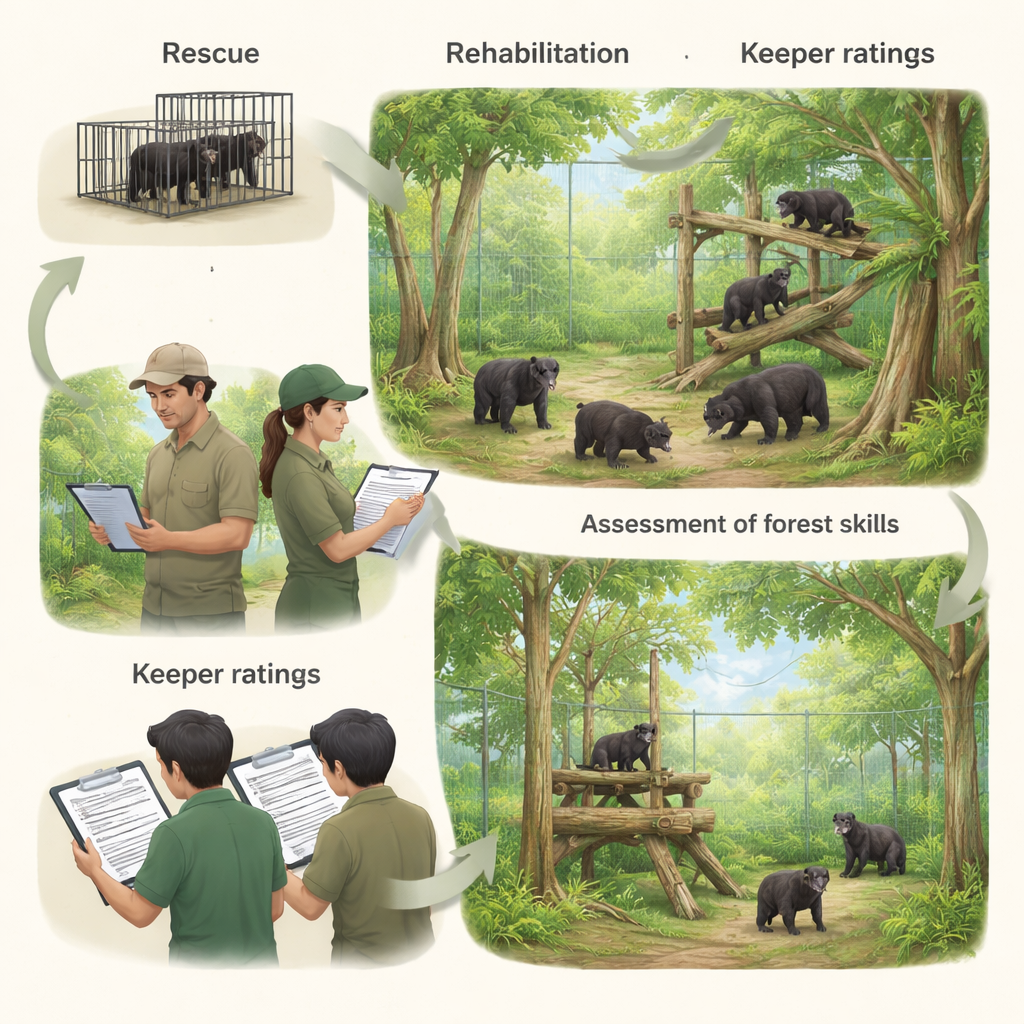
Closely following every bear all day in a dense forest enclosure is nearly impossible. Instead, the researchers worked with staff at the Bornean Sun Bear Conservation Centre in Sabah, Malaysia, to turn keeper knowledge into data. They adapted a detailed questionnaire—originally designed for rehabilitated orangutans—so that keepers could rate how often each of 20 sun bears climbed trees, built nests, foraged, interacted with other bears, or showed certain personality traits. Each behaviour was scored on a simple five-point scale from “almost never” to “very often,” in both English and Malay, and the same bears were rated twice, six weeks apart, to check how consistent the ratings were.
Checking that ratings match real behaviour
To find out whether these questionnaires truly reflected what the bears did, the team also spent months observing 13 of the bears from viewing platforms overlooking their forest enclosures. Using regular scan samples and video recordings, they noted when bears climbed, how high they went, when they built nests and how sturdy those nests were, and how they moved and explored the enclosure. They then compared these direct observations with the keeper ratings. For several key items—such as how often a bear climbed, how good a climber it was judged to be, and how often it built and used solid nests—the ratings lined up strongly with what the observers saw. This showed that, for a carefully chosen set of questions, keeper opinions could serve as a reliable shortcut to labour‑intensive field observation.
Age, time in enclosures, and personality
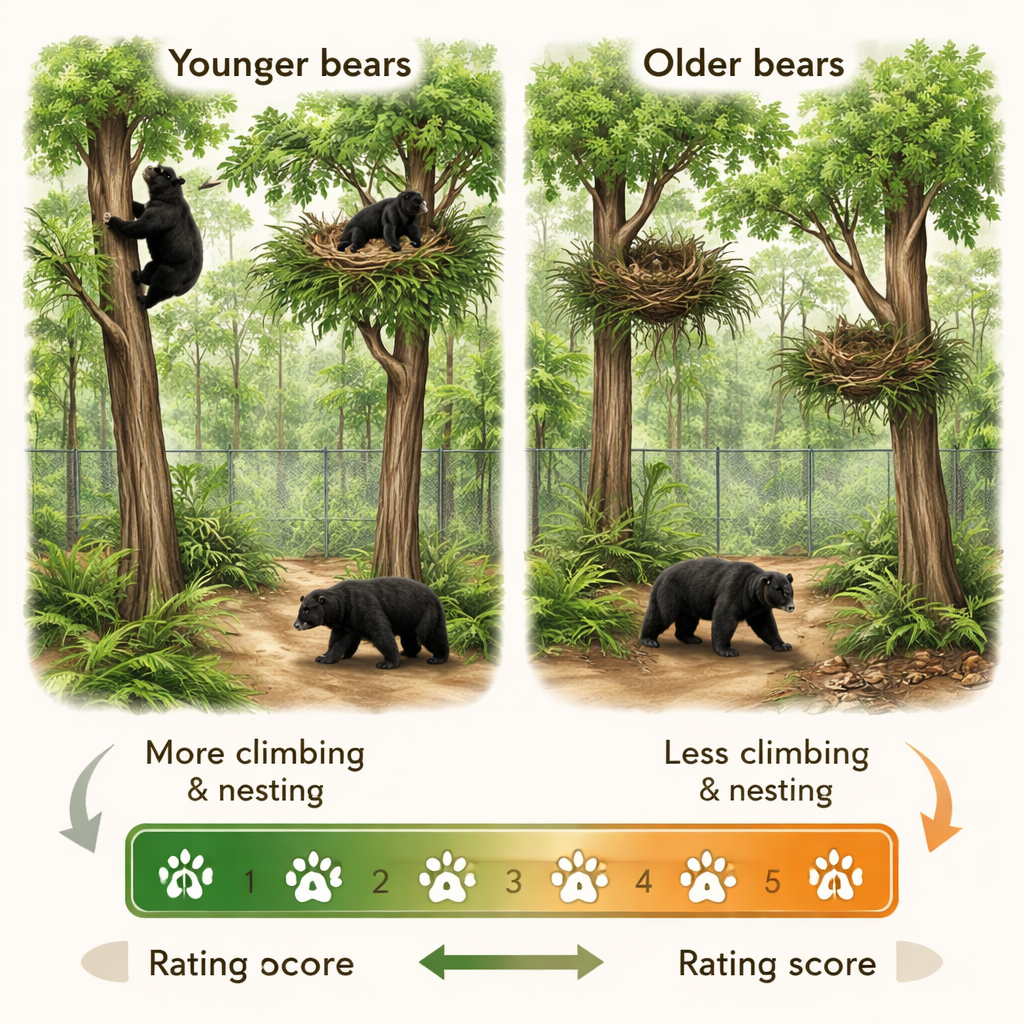
With this validated subset of questions, the researchers next asked what predicts good forest skills in rehabilitation. They looked at factors such as each bear’s age, how long it had spent in the forest enclosure, how much time it likely spent with its mother before being rescued, its sex, and how exploratory it was judged to be. Statistical models revealed several striking patterns. Younger, subadult bears climbed more often and with better skill than older adults. By contrast, nest building was not driven by age but by how long bears had been in the same forest enclosure: the more years they spent there, the less often they built nests and the poorer the nest quality became. This decline did not seem to be due to a lack of suitable trees, suggesting that long stays in a familiar enclosure may lead to boredom or reduced motivation to practise this vital behaviour.
Why females and explorers stand out
The study also found that female sun bears built nests more often, and of higher quality, than males. Although scientists do not yet know exactly why, this may relate to the fact that in the wild only females rear cubs, so reliable nests could be especially important for them. Another pattern emerged in the bears’ personalities: individuals rated as more exploratory—those that roamed their enclosure and engaged with new features—were also more likely to build nests. This hints that curiosity may help bears discover and practise the skills they will need after release, though the authors caution that more work is needed to confirm this link.
What this means for putting bears back in the wild
For wildlife managers tasked with deciding which rescued bears to release, the message is both hopeful and sobering. On the one hand, a relatively simple, low‑cost questionnaire can give trustworthy information about critical skills like climbing and nest building, allowing centres to monitor progress without constant direct observation. On the other hand, the findings suggest that younger bears, especially exploratory females, may be the best candidates for release, and that keeping bears too long in the same forest enclosure could quietly erode their nesting abilities. The study does not yet capture the earliest years of life, when cubs first learn these skills, but it offers a practical framework for using keeper insight and behaviour tracking to make sun bear rehabilitation more evidence‑based—and more likely to succeed.
Citation: Saunders, L., Chong, E.Q.E., Tuuga, A. et al. Effects of age and forest enclosure on sun bear rehabilitation assessed through keeper ratings. Sci Rep 16, 4990 (2026). https://doi.org/10.1038/s41598-026-35101-8
Keywords: sun bear rehabilitation, wildlife reintroduction, animal behaviour, keeper ratings, conservation management