Clear Sky Science · en
Innovative impact of artificial intelligence and management in rural revitalization under fuzzy based decision-making approach
Smart tools for stronger villages
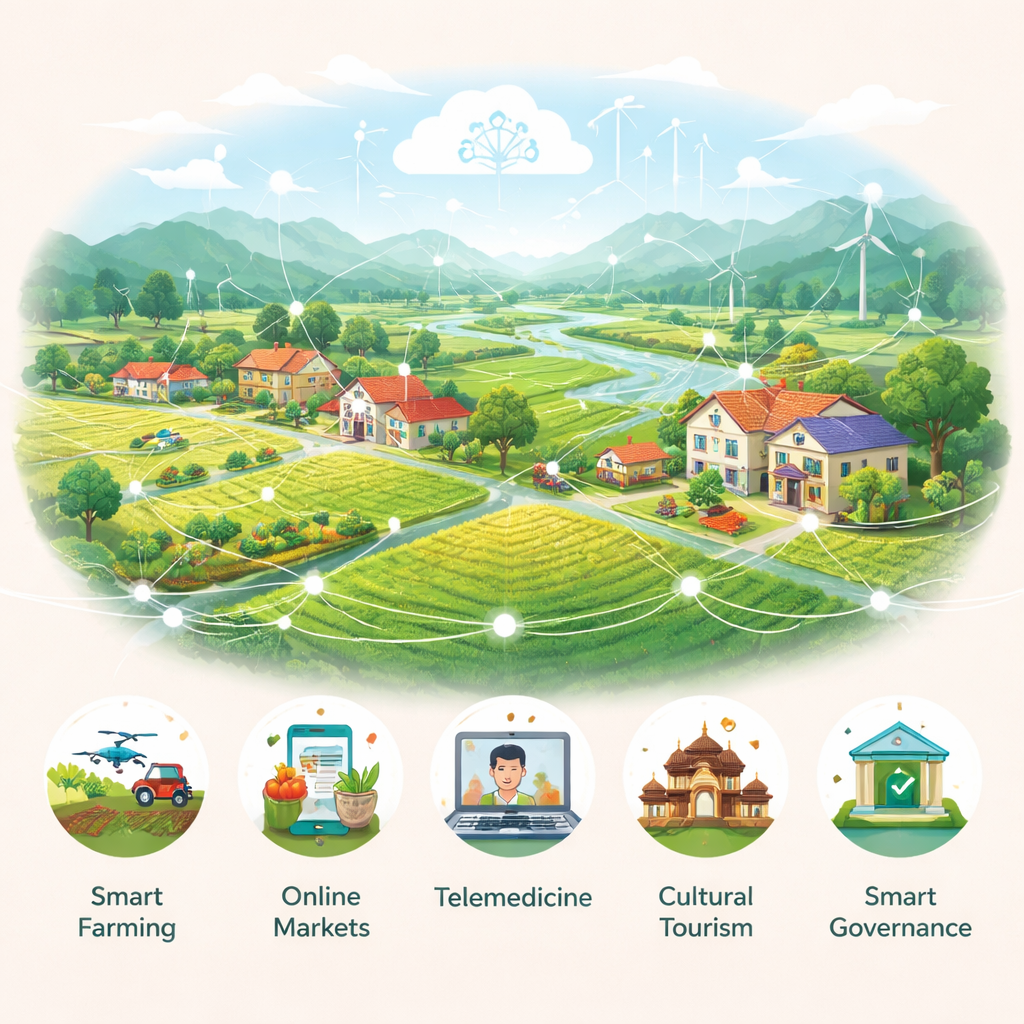
Across the world, many rural communities are trying to escape a cycle of low incomes, shrinking populations, and underused resources. This study explores how artificial intelligence (AI) and modern management can be combined to help villages choose the smartest development paths—such as smart farming, rural e‑commerce, and telemedicine—when money is limited and the future is uncertain. It proposes a new way to compare these options that is designed to work with messy, hesitant human judgments instead of assuming that experts always agree or have perfect data.
Why choosing the “best” rural plan is so hard
Rural revitalization is not just about raising crop yields or building a road. Leaders must weigh economic benefits, technology readiness, social welfare, cultural identity, environmental impact, and project costs—all at once. Different experts value these goals differently, and they often feel unsure: for example, a program may be “almost good” economically but “somewhat risky” technologically. Traditional decision methods usually force this rich, fuzzy thinking into crisp numbers, which can hide hesitation and lead to rankings that shift easily when assumptions change. The authors argue that a more flexible, human‑like way of handling vague opinions is needed to guide AI‑driven development in villages.
A fuzzier but clearer way to handle expert opinion
The paper builds on a mathematical idea called Pythagorean fuzzy sets, which let each option be described not only by how strongly experts support it, but also by how strongly they oppose it—and how hesitant they are in between. Instead of a single score, each assessment contains a “yes” degree, a “no” degree, and an implied “I’m not sure” part. These pieces are then combined using Dombi aggregation operators, a flexible family of formulas whose sensitivity can be tuned to reflect how strongly criteria and expert views interact. This approach is married to an existing ranking method known as MARCOS, which compares each candidate strategy to an ideal one (best on all counts) and an anti‑ideal one (worst on all counts) to produce a final, compromise‑based ordering.
Testing the method on real rural AI choices
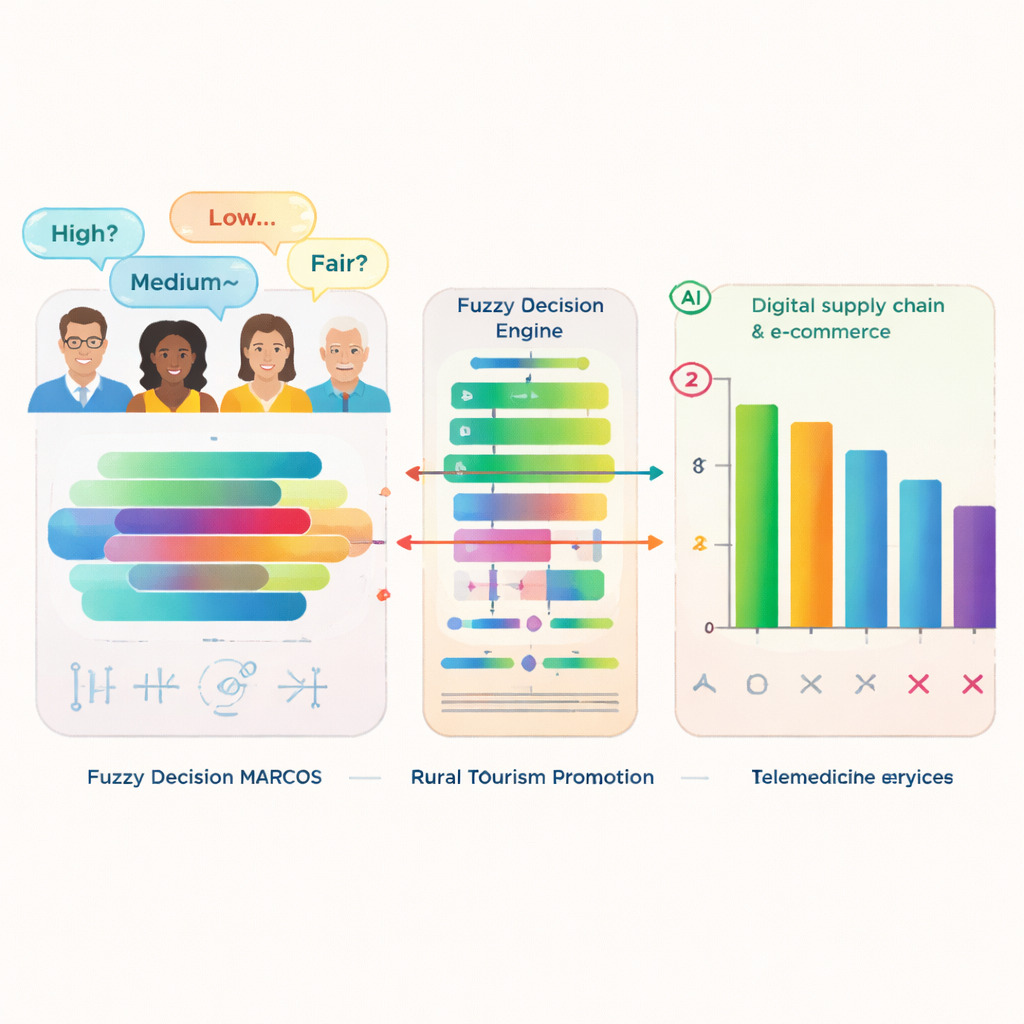
To show how the framework works, the authors study five realistic AI‑based strategies for a rural area: smart agriculture, a digital supply chain and e‑commerce platform, AI‑supported healthcare and telemedicine, intelligent cultural tourism, and smart governance tools for local administration. A panel of experts scores each strategy against six key criteria: economic benefit, technological feasibility, social impact, cultural preservation, environmental sustainability, and cost. Their ratings, expressed in everyday terms such as “very good” or “medium,” are converted into Pythagorean fuzzy numbers and fed into the MARCOS procedure. The method calculates how close each strategy comes to the ideal mix of high income, strong technology, social gains, cultural care, green performance, and manageable costs.
What the rankings reveal for rural development
The resulting rankings show that the digital supply chain and e‑commerce option comes out on top, followed by smart governance, AI‑based healthcare, cultural tourism, and then smart farming in this particular case. This ordering reflects the weights the experts placed on different goals: economic benefit and technological readiness mattered most, while social and environmental aspects were still important and culture and cost played more moderate roles. In other words, the preferred strategy is one that can quickly raise incomes and plug rural producers into wider markets, while still supporting better services and long‑term sustainability. When the authors compare their framework with more conventional methods, they find highly similar rankings but with improved stability and a clearer explanation of how hesitation and trade‑offs shaped the outcome.
What it means for people living in villages
For lay readers and local decision‑makers, the main takeaway is that AI can indeed help rural communities—but choosing where to invest first matters greatly. The proposed fuzzy decision framework offers a structured, transparent way to sort through competing AI projects under uncertainty, revealing which combinations of economic gain, social progress, and environmental care are most realistic. Instead of treating expert judgments as exact facts, it respects doubt and disagreement and still arrives at a clear recommendation. Used well, such tools could help governments and village leaders direct scarce funds toward AI initiatives that deliver broad, lasting benefits for rural residents, from better market access to smarter public services and healthier environments.
Citation: Wang, M., Zhang, H. & Zhao, H. Innovative impact of artificial intelligence and management in rural revitalization under fuzzy based decision-making approach. Sci Rep 16, 5492 (2026). https://doi.org/10.1038/s41598-026-35098-0
Keywords: rural revitalization, artificial intelligence, multi-criteria decision making, fuzzy logic, rural e-commerce