Clear Sky Science · en
A compact dual-band antenna using a gap-coupled monopole branch for Wi-Fi 6/6E/7 applications
Why your Wi‑Fi needs better antennas
Home Wi‑Fi has quietly become critical infrastructure for everything from 4K streaming and cloud gaming to smart thermostats and factory sensors. The newest Wi‑Fi 6, 6E, and upcoming Wi‑Fi 7 standards promise faster and more reliable connections, but they also push routers, laptops, and IoT gadgets to work across a wider range of frequencies. That makes the tiny antennas hidden inside our devices much harder to design. This paper presents a compact antenna that can cover all these bands efficiently while staying small, flat, and cheap enough for everyday electronics.
Making more from a tiny circuit board
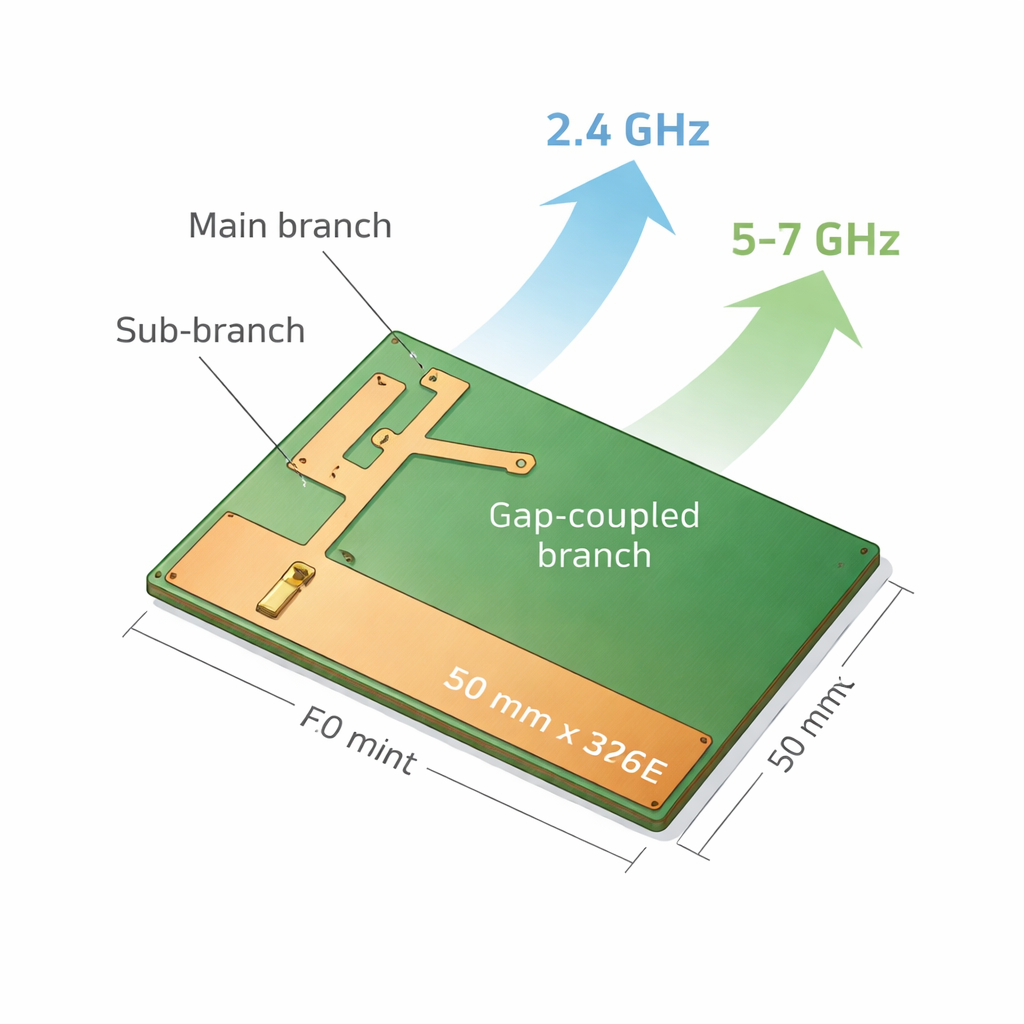
The authors focus on a challenge shared by phones, laptops, and smart devices: there is very little space for antennas, and the metal parts of the device often get in the way. Yet Wi‑Fi 6/6E/7 must handle both the familiar 2.4 GHz band and the newer, wider 5–7 GHz region opened for high‑speed links. Traditional approaches often require thick stacked structures, extra tuning parts, or complicated metal frames, all of which add cost and limit where the antenna can be placed. In contrast, the proposed design fits on a simple 50 mm by 30 mm printed circuit board, uses only one standard FR‑4 layer, and avoids any external matching circuitry.
Three simple metal branches, two wide bands
The heart of the design is a small monopole antenna—essentially a metal strip—that is split into three branches. The first, called the main branch, is tuned to act like a classic quarter‑wavelength radiator around 2.4 GHz, giving solid coverage of the lower Wi‑Fi band. The second, a sub‑branch running alongside the first, is adjusted to cooperate with the main branch at higher frequencies. Together they form combined paths that naturally produce resonances in the 5–6 GHz region. The third branch is separated from the main structure by a narrow gap. This gap behaves like a tiny built‑in capacitor, allowing energy to “jump” across at still higher frequencies and smoothing out the antenna’s response up to about 7.1 GHz.
How multimode behavior widens the highway
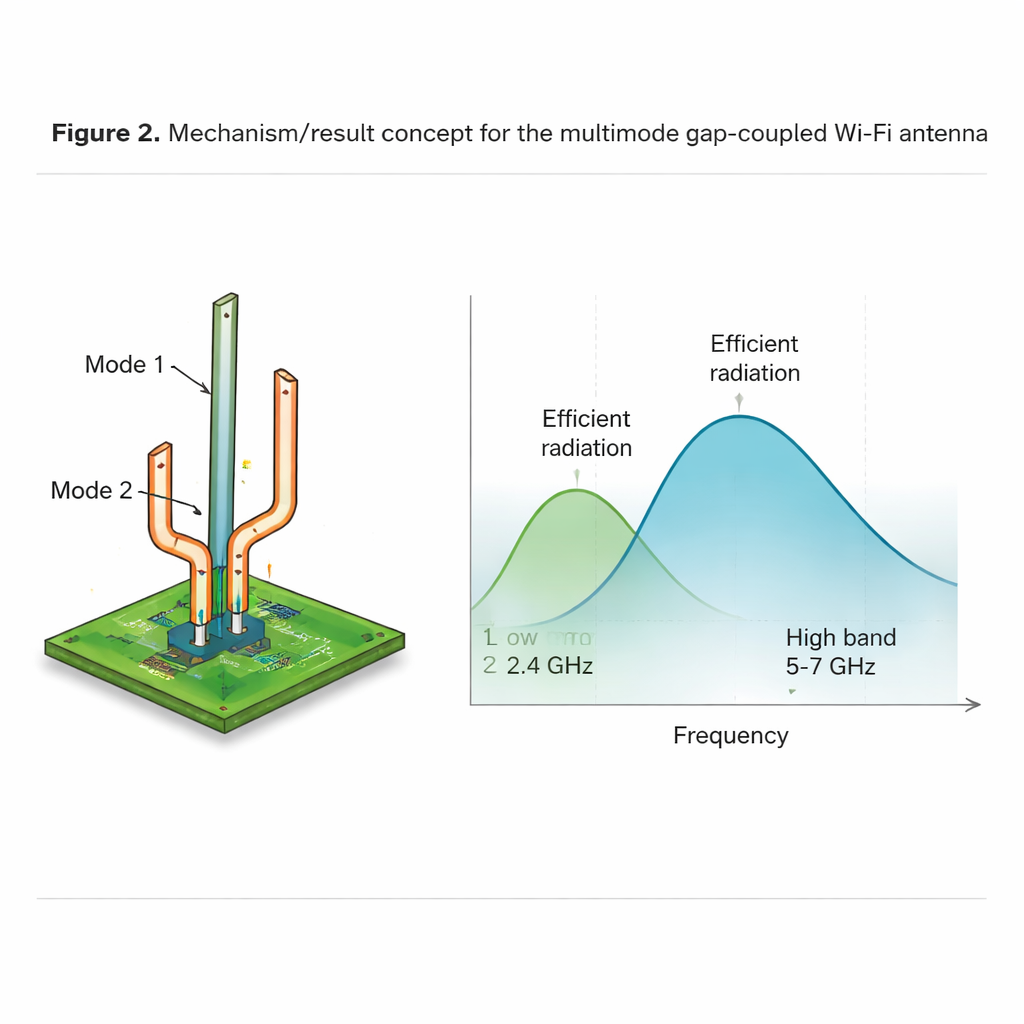
Instead of relying on a single sharp resonance like many basic antennas do, this design deliberately creates several overlapping resonance modes, each associated with one of the branches. The researchers analyze the antenna using both circuit diagrams and detailed computer simulations of surface currents. At lower frequencies, only the main branch carries strong current. As the frequency climbs into the 5–6 GHz range, current shifts onto the sub‑branch, creating the first high‑band mode. Above about 6 GHz, the gap‑coupled branch takes over, adding a second high‑band mode. Because these modes are aligned rather than isolated, the antenna maintains good matching over a very wide span, effectively turning a narrow single‑lane road into a multi‑lane highway for Wi‑Fi signals.
From simulation to real‑world performance
The team fabricated a prototype and measured its behavior in a professional anechoic chamber. The antenna successfully covered 2.24–2.68 GHz in the lower band and 5.12–7.04 GHz in the upper band, comfortably spanning all current Wi‑Fi 6E and planned Wi‑Fi 7 channels. Despite using a lossy FR‑4 circuit board and a small ground plane—conditions that usually hurt performance—the measured total efficiency reached about 70 % at 2.4 GHz and 67 % across the 5.15–7.125 GHz range. Radiation patterns remained roughly omnidirectional, meaning the antenna does not create narrow “hot spots” and is well‑suited to mobile devices that can be held or placed in any orientation.
What this means for future gadgets
To a non‑specialist, the key takeaway is that it is possible to build a single, flat, low‑cost antenna that handles both traditional and new Wi‑Fi bands without bulky hardware or complex tuning parts. By carefully arranging and spacing three simple metal branches, the authors harness multiple resonance modes and controlled gap coupling to achieve broad, efficient coverage from 2.4 up to just over 7 GHz. This kind of compact, wideband antenna can be integrated into small IoT modules, notebooks, vehicle cameras, and other wireless devices, helping them fully exploit the speed and capacity promised by Wi‑Fi 6E and Wi‑Fi 7.
Citation: Wi, S., Lee, H., Choi, J. et al. A compact dual-band antenna using a gap-coupled monopole branch for Wi-Fi 6/6E/7 applications. Sci Rep 16, 5331 (2026). https://doi.org/10.1038/s41598-026-35094-4
Keywords: Wi-Fi 7, dual-band antenna, gap-coupled monopole, IoT connectivity, wideband wireless