Clear Sky Science · en
Leveraging wearable haptics for guidance in virtual rehabilitation: effects on motor control from an immersive VR setting
Touch That Teaches Movement
For many people recovering from a stroke or other brain injury, regaining smooth arm and hand movements requires months of repetitive therapy. Virtual reality games can make this training more engaging, but they rarely tell the body how to move, only the eyes. This study explores a new idea: using a soft, wearable armband that “talks” to the skin through pressure and vibration while a person plays an immersive VR game, guiding their hand and arm as a therapist’s touch would.
A Game of Potions With a Hidden Purpose
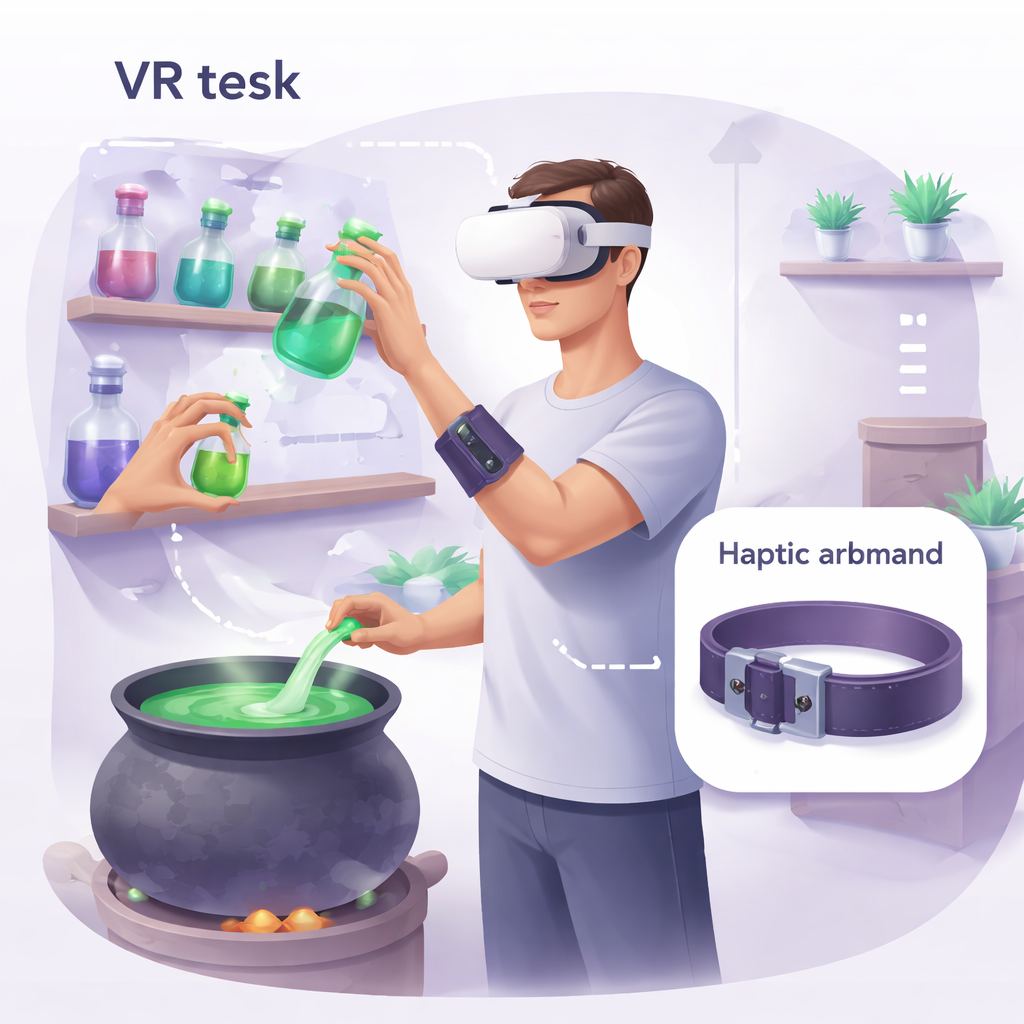
The researchers built an immersive VR “serious game” in which players act as wizard apprentices. Wearing a VR headset, they reach for virtual potion bottles on a shelf, grasp them, rotate their forearm to pour into a cauldron, then return the bottles to their place. Behind this playful story sit two classic rehabilitation movements: opening and closing the hand to grasp, and rotating the forearm (pronosupination), both crucial for everyday tasks like turning a doorknob or pouring a drink. Alongside the headset, players wore a light armband on the forearm, whose moving belt could gently squeeze or slide to provide tactile cues about how to adjust their motion.
How the Guiding Armband Works
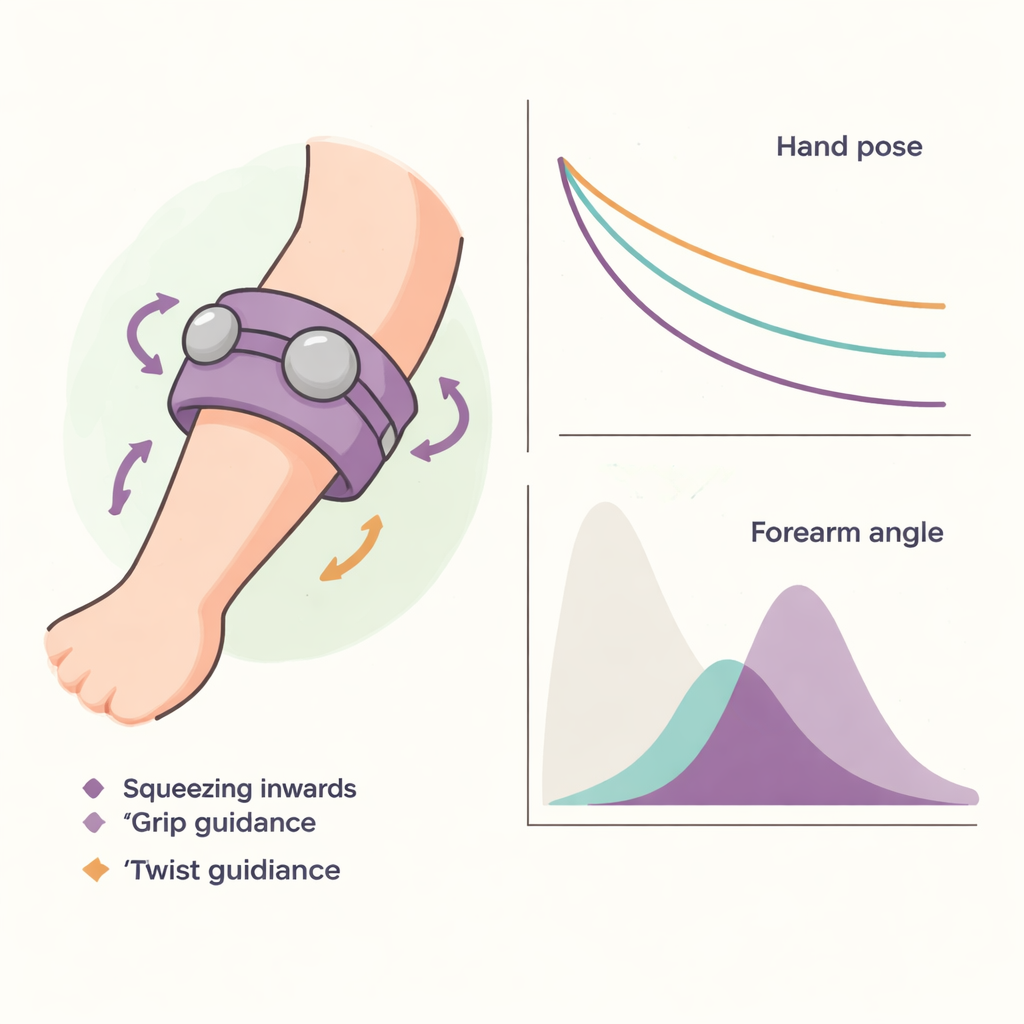
The armband contains two small motors that pull on a belt wrapped around the arm. By tightening the belt, it can mimic the feeling of a firmer grip; by sliding the belt sideways along the skin, it can suggest which way to twist the forearm. In some conditions, this feedback changed smoothly with the error in movement (continuous feedback). In others, the continuous signal was combined with vibrations whose strength reflected how far the user was from the desired hand shape or rotation angle. During the potion game, these cues were turned on during grasping and pouring phases, effectively adding a “touch channel” on top of the visual information already available in VR.
Sharper Movements With Less Guesswork
Twelve healthy adults played the game with and without haptic guidance while their arm movements and muscle activity were carefully measured. When the armband was active, especially in the combined pressure-plus-vibration mode, their hand shapes and forearm angles matched target values more closely and with less trial-to-trial variability than with vision alone. Participants converged more quickly toward the correct grasp and pouring angle and tended to repeat those movements more consistently. Importantly, their underlying patterns of muscle coordination largely stayed “natural,” suggesting the device refined how they moved without forcing them into awkward strategies.
Subtle Changes Inside the Muscles
The team also examined how the guidance affected biomechanics. With haptic cues, people did not dramatically change how far they moved their joints, but they did adjust speed, smoothness, and how pairs of muscles worked together. Continuous feedback alone led to slower, smoother motions, while the added vibration sometimes prompted quicker, more decisive corrections. Certain shoulder and forearm muscles showed altered activation and co-contraction, consistent with a body that is stabilizing joints to achieve more precise control. Yet the overall synergy patterns of muscle use remained stable, a sign that the tactile guidance supports rather than disrupts natural motor control.
First Steps Toward Home-Friendly Rehab
To explore real-world potential, the researchers ran a small pilot with two people living with chronic stroke. Even with only a brief introduction and no complex motion recording, both could complete the VR potion tasks using the armband. They reported low to moderate mental and physical effort, generally good comfort, and a willingness to use such a device as part of their rehabilitation. They also believed it could help improve their motor skills, hinting that the approach is acceptable to patients as well as technically feasible in a clinical setting.
What This Could Mean for Future Recovery
In simple terms, the study shows that adding smart touch cues to VR exercises can help people move their arms and hands more accurately and consistently, without overloading their vision or making the movements feel unnatural. While the work so far involves a small group and short sessions, it suggests a path toward home-based rehabilitation systems where a lightweight armband and VR headset together can provide not just fun games, but precise, therapist-inspired guidance. With further testing in larger patient groups and over longer periods, this kind of haptic-enriched VR could become a practical tool to extend high-quality motor training beyond the walls of the clinic.
Citation: Bonab, A.K., Camardella, C., Serra, F. et al. Leveraging wearable haptics for guidance in virtual rehabilitation: effects on motor control from an immersive VR setting. Sci Rep 16, 5513 (2026). https://doi.org/10.1038/s41598-026-35092-6
Keywords: virtual reality rehabilitation, wearable haptics, stroke recovery, tactile feedback, motor control