Clear Sky Science · en
Short-time thermal inactivation of surrogates of the public transport microbiome with a low-cost thermoresistometer
Why heating the air on your commute might matter
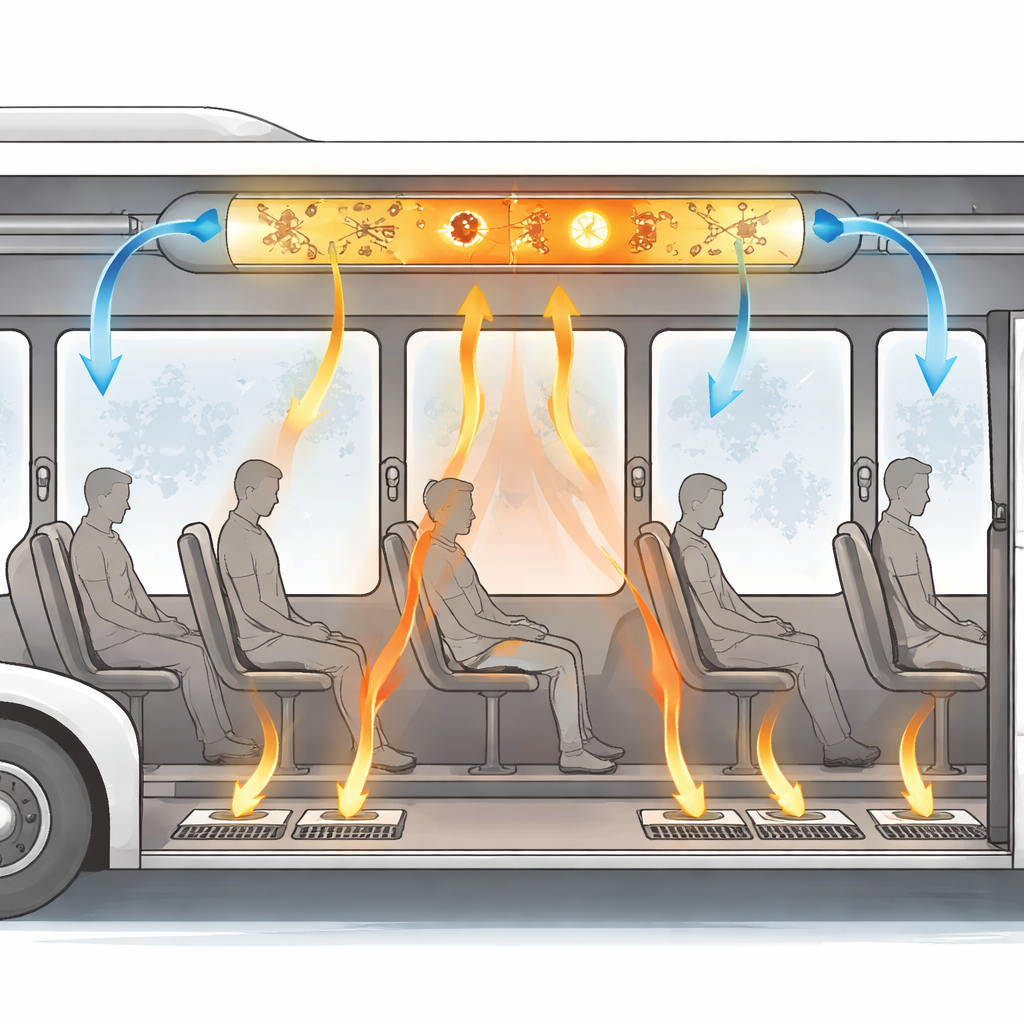
Anyone who has squeezed into a crowded bus or train in winter has probably wondered how many invisible germs are sharing the ride. This study explores a simple but powerful idea: could the same heat we already use to warm vehicles also help kill bacteria and viruses in the air, making public transport safer without major extra energy costs?
Germs that travel with us
Public transport is a meeting point not just for people, but for their microscopic hitchhikers. Earlier research has shown that buses, subways and airplanes carry a mix of harmless and potentially risky microbes, including relatives of hospital “problem bugs” known for resisting antibiotics. To study how heat might knock these riders out, the researchers chose three harmless bacterial strains that stand in for more dangerous species, plus a virus that is often used as a stand-in for viruses like norovirus and SARS-CoV-2. All are safe to handle in basic labs but behave similarly enough to give realistic clues about what heat can do to more troublesome pathogens.
Building a low-cost germ “stress tester”
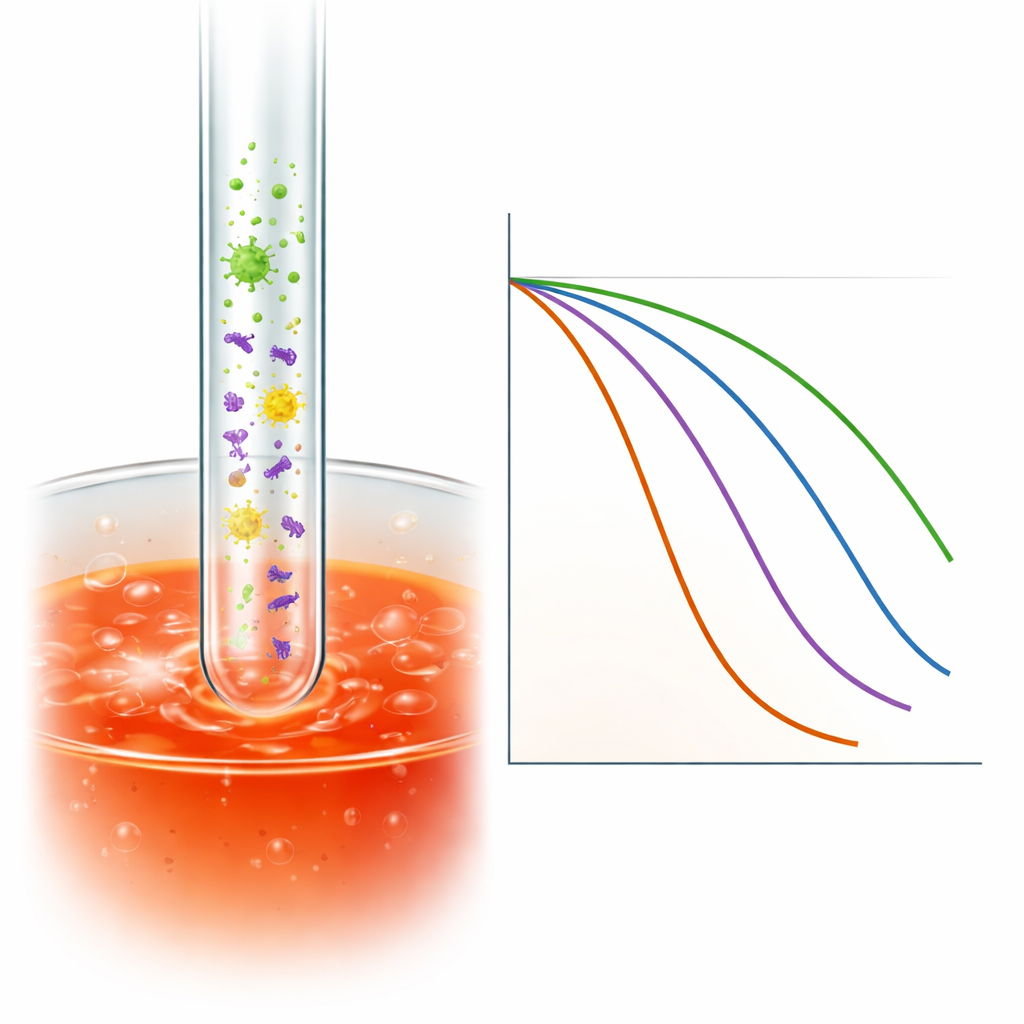
To find out how quickly heat can inactivate these microbes, the team needed a way to give them extremely short, precisely controlled bursts of high temperature. Existing machines that do this are often expensive or not optimized for split-second exposures. The researchers therefore built a simple, automated device from standard lab parts. Tiny glass tubes were filled with a microbe solution, sealed, clamped in a holder and then dipped into a carefully heated water bath for just 2 to 10 seconds before being rapidly cooled with room air from a fan. A hair-thin temperature probe inside a similar tube filled with water tracked how fast the contents actually heated and cooled, allowing the team to correct for any delay and know the true “time at temperature.”
How fast heat can finish off germs
After these brief thermal shocks at temperatures between 50 °C and 85 °C, the samples were opened and spread on growth plates so survivors could form visible colonies or plaques. By comparing how many grew before and after heating, the team calculated how long it takes to cut the population by tenfold—a standard measure called decimal reduction time. At the lowest temperatures, some microbes proved fairly tough, needing many seconds to see big drops. But as the temperature rose into the 70 °C range, survival times shrank to under a second for several organisms. At 85 °C, none of the tested bacteria or the virus surrogate could be detected after just 2 seconds of real exposure, meaning the treatment wiped out more than 99.9 percent of them within that blink-of-an-eye window.
Turning data into design hints
Using a well-known relationship between reaction speed and temperature, the researchers turned their data into simple formulas that predict how long these microbes should last at different heat levels. While there is some uncertainty—especially outside the temperatures they actually tested—the trends are clear: small increases in temperature give large gains in germ kill speed. For most of the organisms, raising the temperature from the low 60s to around 80–85 °C cuts the needed time from many seconds to less than one. One bacterial species was more stubborn than the others, but even it was fully inactivated at 85 °C in these ultra-short treatments.
What this could mean for everyday travel
This work does not yet build a ready-to-use “self-sterilizing” bus, and the experiments were done in liquid rather than moving air. Still, the results provide a valuable starting map for engineers: they show that, in principle, air or fluids passing through a hot zone for only fractions of a second could see large reductions in common public-transport microbes. In cold climates where strong heating systems are already needed, carefully designed ducts that briefly heat and then cool cabin air might clean it as they warm it, without a huge extra energy penalty. Before any such system is deployed, further studies must confirm that the same rapid inactivation happens for real pathogens in aerosol form and that the approach compares well to filters or other technologies. But for anyone who rides buses or trains, the message is simple: the heat keeping you comfortable in winter might one day also help keep you healthier.
Citation: Grübbel, H., Ly-Sauerbrey, Y., Arndt, F. et al. Short-time thermal inactivation of surrogates of the public transport microbiome with a low-cost thermoresistometer. Sci Rep 16, 1316 (2026). https://doi.org/10.1038/s41598-026-35087-3
Keywords: public transport microbiome, thermal disinfection, airborne pathogens, HVAC sanitation, microbial inactivation