Clear Sky Science · en
Effects of moderate-intensity aerobic exercise on coronary artery structure and function in type 2 diabetic rats
Why this research matters to everyday health
People with type 2 diabetes are much more likely to suffer heart attacks, in part because the small blood vessels that feed the heart slowly become stiff and narrowed. This study asks a practical question with big real-world implications: can a simple, steady exercise routine protect those heart vessels, even after diabetes has already taken hold? Using a rat model of type 2 diabetes, the researchers tested whether moderate, regular jogging-like activity could repair damage to the coronary arteries and improve how well they relax and carry blood.
How diabetes harms the heart’s own blood vessels
Type 2 diabetes is more than “high blood sugar.” It disrupts how the body handles both sugar and fats, and it stirs up low-level inflammation throughout the bloodstream. In the coronary arteries, which supply the heart muscle itself, this unhealthy internal environment sets off a chain reaction: inflammatory chemicals rise, the delicate inner lining of the vessels (the endothelium) stops working properly, and the smooth muscle in the vessel wall changes behavior. Over time, these cells lay down excess scar-like collagen, the vessel wall thickens, becomes less elastic, and the opening that blood flows through narrows. This combination of functional and structural damage helps explain why more than half of deaths linked to type 2 diabetes are due to cardiovascular disease.

Putting moderate exercise to the test in diabetic rats
To explore whether exercise can interrupt this vicious cycle, the team used male rats that were fed a high-fat diet and given a drug to mimic type 2 diabetes. The animals were split into four groups: healthy sedentary, healthy with exercise, diabetic sedentary, and diabetic with exercise. The exercise prescription was deliberately modest and realistic: after a short acclimation, rats in the exercise groups ran on a treadmill at a moderate pace, roughly 70–75% of their maximal capacity, for one hour a day, six days a week, over eight weeks. During and after this period, the researchers measured blood sugar, blood fats, insulin resistance, and several inflammatory markers, and they examined the coronary arteries under the microscope and with high-resolution laser imaging.
Exercise reshapes metabolism, inflammation, and vessel structure
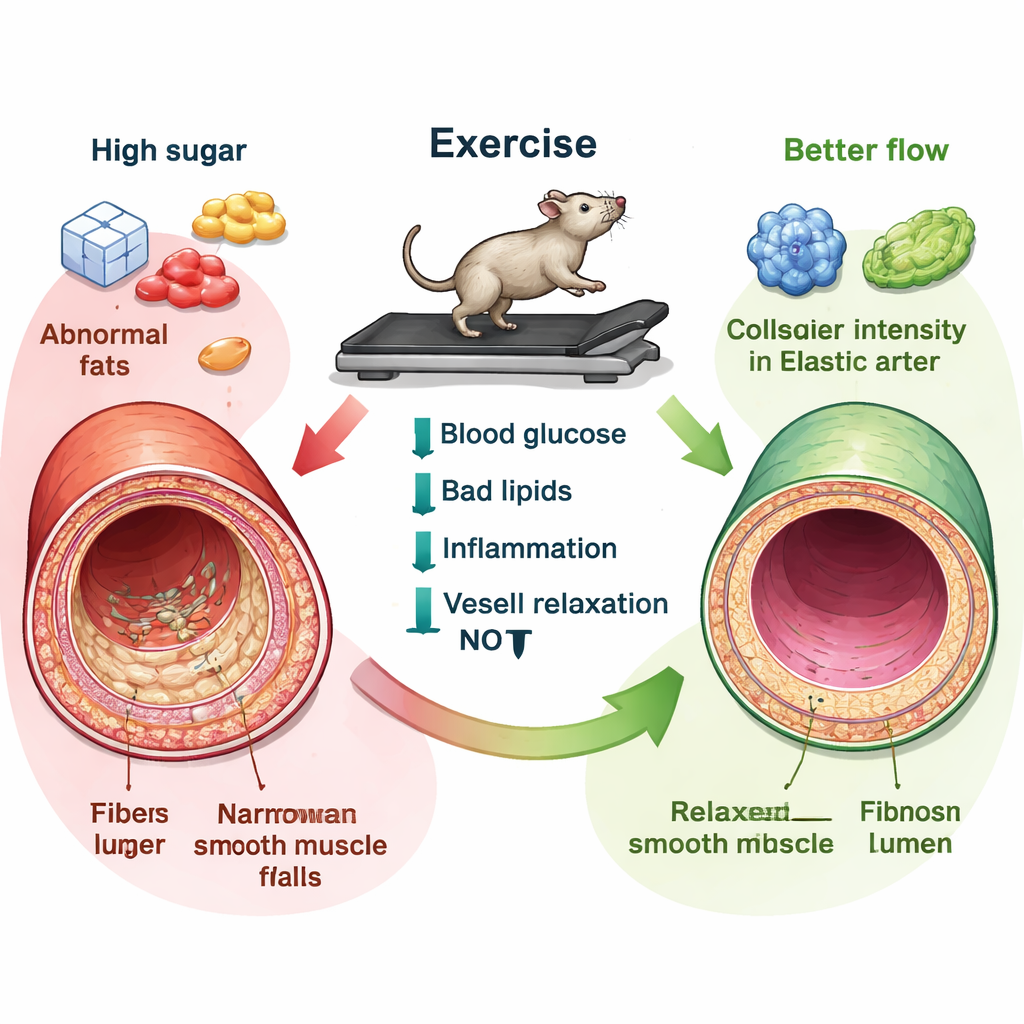
In sedentary diabetic rats, blood sugar and insulin levels were very high, cholesterol and triglycerides were markedly worse, and inflammatory substances such as TNF-α, IL-1β, and IL-6 were elevated compared with healthy controls. Their hearts were enlarged relative to body size, and their coronary arteries showed thickened inner layers, disorganized cells, and heavy collagen deposits, a sign of fibrosis. After eight weeks of moderate-intensity aerobic exercise, diabetic rats showed striking improvements: fasting and random blood sugar dropped, insulin resistance eased, cholesterol and triglycerides declined while “good” HDL cholesterol rose, and inflammatory markers fell toward normal. Inside the coronary arteries, the vessel wall became thinner, endothelial cells looked more orderly, and the balance between stiff collagen fibers and springy elastic fibers shifted back toward a healthier pattern.
Restoring the flexibility of heart vessels
Beyond appearance, the researchers tested how well the coronary arteries could actually relax, both through the endothelium and through the smooth muscle layer. In diabetic rats that did not exercise, the arteries were harder to relax in response to standard chemical signals, meaning they were less able to widen when needed. With moderate exercise training, these same coronary arteries became more responsive: they relaxed more strongly and at lower doses of the test agents, showing that both the inner lining and the muscle layer had regained much of their lost flexibility. These functional gains matched the improvements seen in metabolism and inflammation, suggesting that better blood chemistry and reduced inflammatory stress allowed the vessels to recover.
What this could mean for people with type 2 diabetes
For a lay reader, the takeaway is straightforward: in this animal model, a regular, moderate exercise routine did not simply lower blood sugar on a lab report; it actively reversed early scarring and stiffness in the heart’s own blood vessels and restored their ability to relax. While rats are not humans and the study only tested one exercise dose in males, the work supports a message already echoed in clinical research: sustained, moderate aerobic activity can protect the heart in type 2 diabetes by calming inflammation, improving sugar and fat control, and keeping coronary arteries more supple. In practical terms, consistent, manageable exercise may help delay or soften the vessel damage that often turns diabetes into heart disease.
Citation: Wang, D., Guo, Y., Yin, L. et al. Effects of moderate-intensity aerobic exercise on coronary artery structure and function in type 2 diabetic rats. Sci Rep 16, 4916 (2026). https://doi.org/10.1038/s41598-026-35082-8
Keywords: type 2 diabetes, aerobic exercise, coronary arteries, vascular fibrosis, inflammation