Clear Sky Science · en
Effect of powder metallurgy parameters on microstructure, mechanical, and bio-corrosion properties of Mg-alloys for biodegradable orthopedic implants
Why dissolving metal implants matters
When a broken bone is held together with metal plates or screws, those devices often have to be removed in a second surgery once healing is complete. Researchers are exploring metals that are strong enough to support the bone but then safely dissolve inside the body, eliminating extra operations. This article looks at a new way to make such “disappearing” magnesium-based implants stronger and more reliable by fine-tuning how the metal powder is processed before it is formed into devices.
Building a better disappearing metal
Magnesium is attractive for orthopedic implants because its stiffness and density are close to natural bone, so it shares load instead of stealing it, and the body can handle the magnesium ions it releases. On its own, however, ordinary magnesium breaks down too quickly in the body and can lose strength before the bone has healed. To overcome this, the authors designed an alloy made from magnesium mixed with zinc, calcium, and a small amount of manganese (written as Mg-30Zn-5Ca-3Mn). Each added element serves a purpose: zinc and calcium improve strength and bone compatibility, while low levels of manganese help control corrosion and gas production without making the metal brittle.
Shaping metal with powder and heat
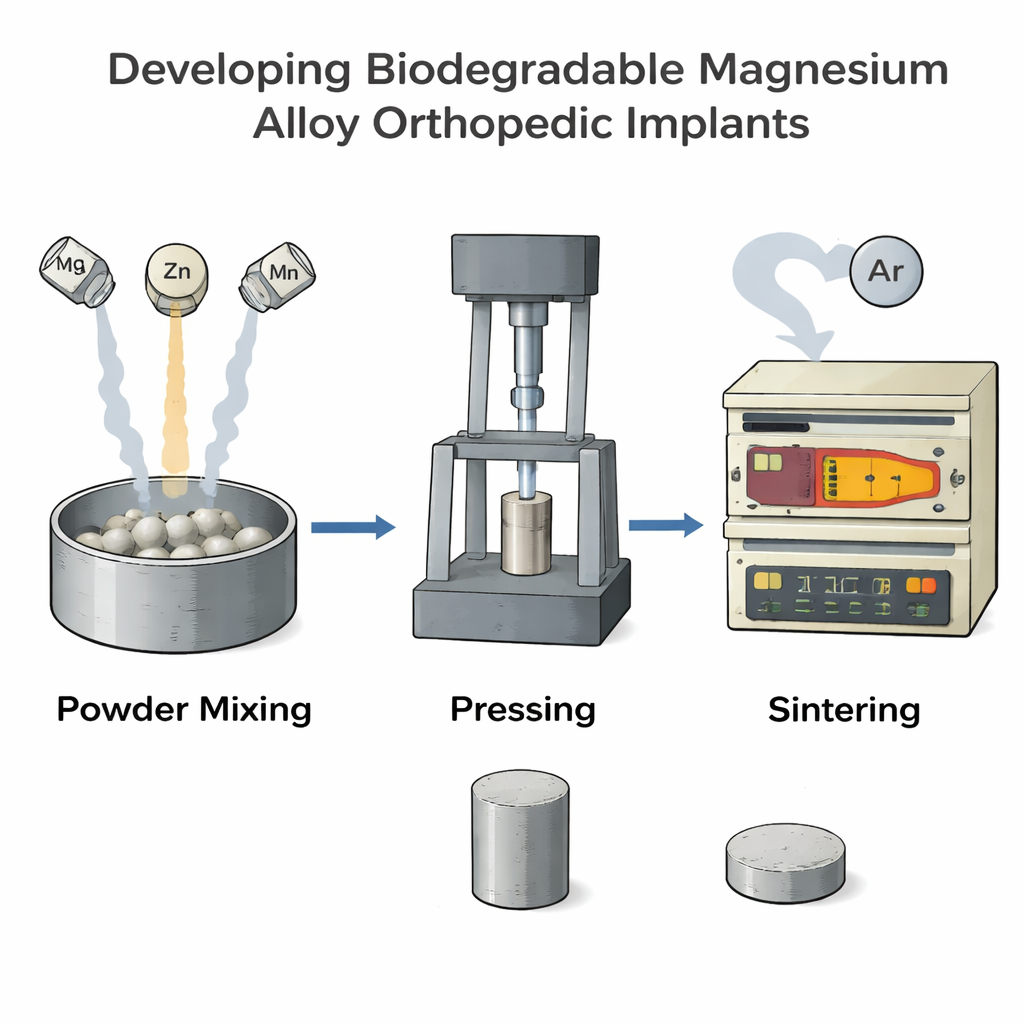
Instead of melting and casting the alloy, the team used powder metallurgy, a method that starts with fine metal powders. The powders were loaded into a high-energy ball mill, compacted under very high pressure into solid “green” cylinders, and then heated in a furnace under protective gas. Four processing knobs were adjusted in a planned set of 16 experiments: how long the powders were milled, how fast the mill rotated, how quickly the samples were heated, and how long they were held at temperature. The researchers then used X-ray diffraction to see how glass-like (amorphous) or crystal-like the internal structure was, performed hardness and tensile tests to measure strength, and immersed samples in simulated body fluid to track how fast they corroded.
How tiny structures control strength and decay
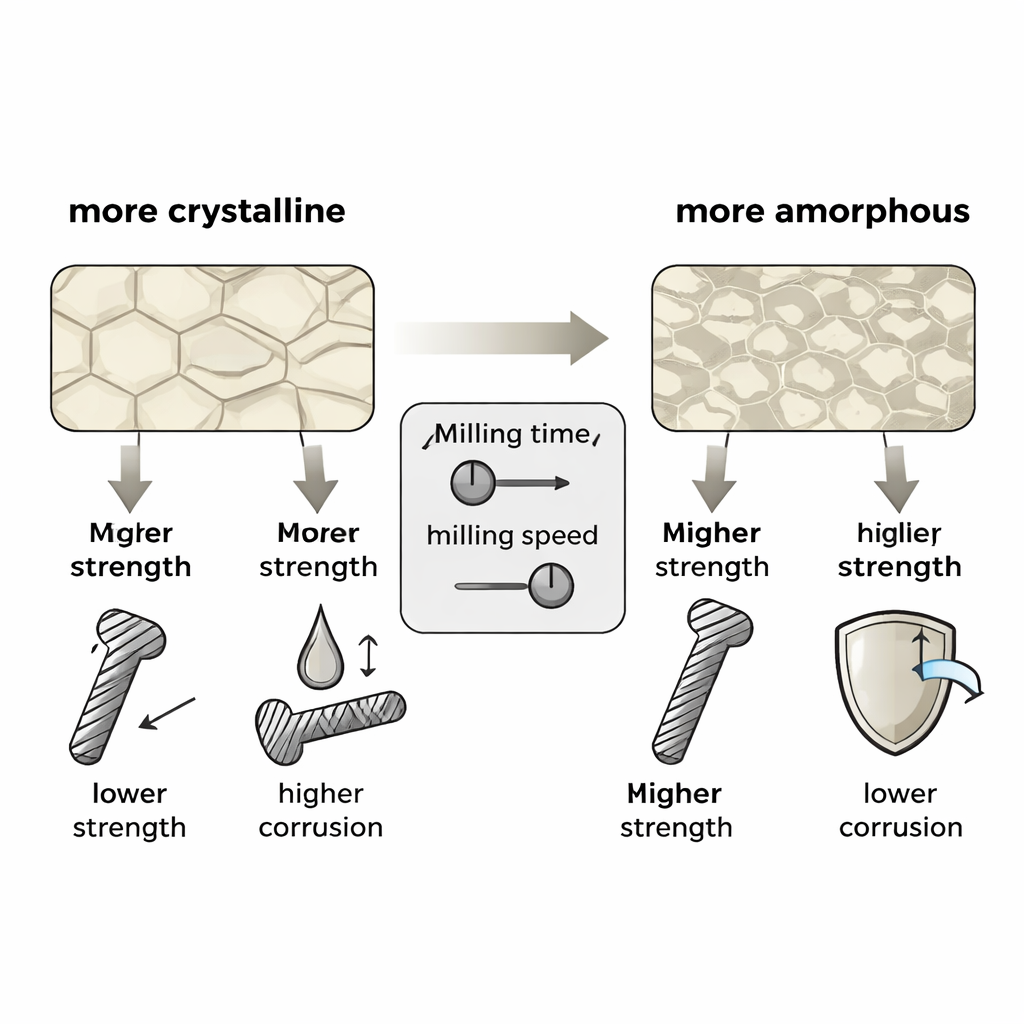
The X-ray measurements showed that the processing choices strongly changed the metal’s inner structure. Longer milling times and higher milling speeds broke up the crystals and helped create a mostly amorphous, or glassy, structure. Faster heating also helped preserve this glassy state, while slower, longer heating encouraged the growth of larger crystals. These changes were not just cosmetic: samples with more amorphous material reached higher hardness and tensile strength—up to about 553 megapascals, which is competitive with many conventional structural metals—while more crystalline samples were noticeably weaker.
Slower corrosion through smarter processing
The same structural changes also controlled how quickly the alloy dissolved in a liquid that mimics human blood plasma. Over ten days of immersion, corrosion rates ranged from about 0.23 millimeters per year for the least favorable processing conditions down to about 0.13 millimeters per year for the best ones. Alloys produced with long, fast milling and an optimized heating cycle corroded the slowest. Statistical analysis showed that milling time was by far the most influential factor for strength and corrosion, with milling speed also important; the exact heating schedule played a smaller role. In other words, how vigorously and how long the powders are mixed matters more than how long they sit in the furnace.
What this means for future bone repair
For non-specialists, the central message is straightforward: by carefully tuning how magnesium alloy powders are milled and heated before forming an implant, engineers can “dial in” both strength and how fast the metal safely dissolves in the body. The study identifies a processing recipe that produces a mostly glassy internal structure, combining high strength and hardness with a relatively slow, controlled corrosion rate—features that are promising for temporary bone screws and plates that support healing and then vanish, sparing patients an extra surgery.
Citation: Gonfa, B.K., Jiru, M.G. & Esleman, E.A. Effect of powder metallurgy parameters on microstructure, mechanical, and bio-corrosion properties of Mg-alloys for biodegradable orthopedic implants. Sci Rep 16, 4925 (2026). https://doi.org/10.1038/s41598-026-35078-4
Keywords: biodegradable implants, magnesium alloys, orthopedic devices, powder metallurgy, corrosion control