Clear Sky Science · en
Machine learning-derived stage-specific design rules for metal-organic framework selection in seasonal hydrogen storage
Why smarter hydrogen storage matters
As we add more wind and solar power to the grid, we need ways to store huge amounts of energy for weeks or months. Turning extra electricity into hydrogen and storing it underground is one promising answer. But when that hydrogen is brought back up, it is mixed with natural gas, and cleaning it up can be expensive. This study shows how artificial intelligence can help scientists choose better porous materials that lower those cleanup costs, making large‑scale hydrogen storage more practical and affordable.
Storing hydrogen in old gas fields
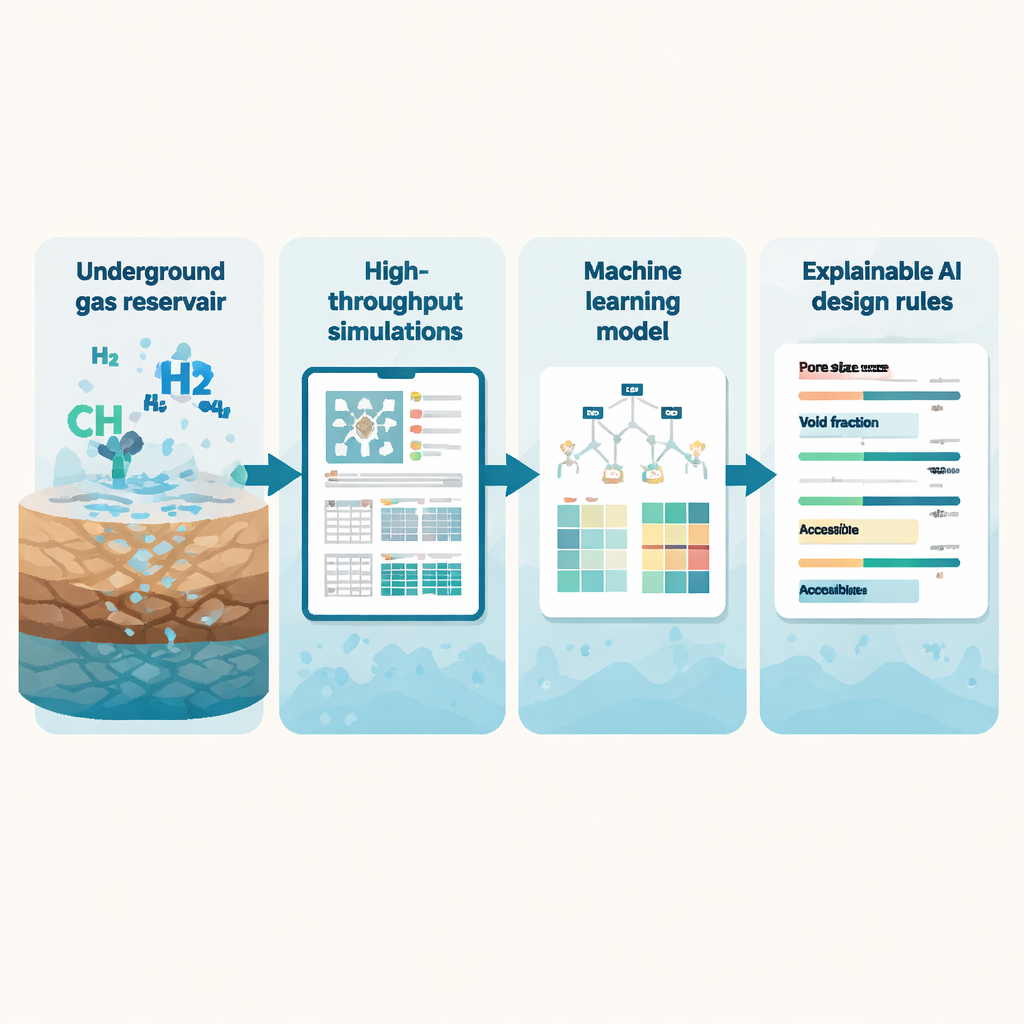
One attractive way to store hydrogen seasonally is to inject it into empty natural gas reservoirs deep underground. Over time, the pressure in the reservoir falls and more methane (the main component of natural gas) seeps into the hydrogen, so the withdrawn gas becomes both lower pressure and dirtier. Before this gas can be used in fuel cells or pipelines, it must pass through a purification unit called pressure‑swing adsorption, where a solid material holds back methane and lets cleaner hydrogen pass. The challenge is that most studies test these materials under simple, fixed conditions, such as equal parts hydrogen and methane at a single pressure, which does not reflect how real underground storage behaves across an entire withdrawal season.
Porous crystal sponges as gas filters
The materials examined here are metal‑organic frameworks (MOFs), a family of crystal “sponges” with an intricate network of nanoscale pores. Their performance depends strongly on pore features such as how much empty space they contain, how open that space is, and how wide the narrowest passages are. The authors started from a curated database of more than 8,000 experimentally made MOFs and filtered it down to 712 structures that could be reliably simulated. For each one, they calculated seven geometric descriptors that capture pore size, shape, and openness, then used detailed molecular simulations to predict how each MOF takes up hydrogen and methane at four realistic stages of reservoir withdrawal, from 60 bar and 98% hydrogen down to 25 bar and 65% hydrogen.
Letting machine learning read the patterns
From these simulations the team built a large dataset linking each MOF’s geometry to its ability to preferentially adsorb methane over hydrogen—a key measure of how well it can purify the gas. They then tested twenty different machine‑learning methods to predict this selectivity. A model known as CatBoost gave the most accurate and reliable predictions. To avoid building a “black box,” the researchers applied explainable AI tools that not only predict performance but also rank which geometric features matter most and show how changing each feature shifts methane–hydrogen separation under the changing pressures and gas mixtures of the storage cycle.
How the best pore shapes change over time
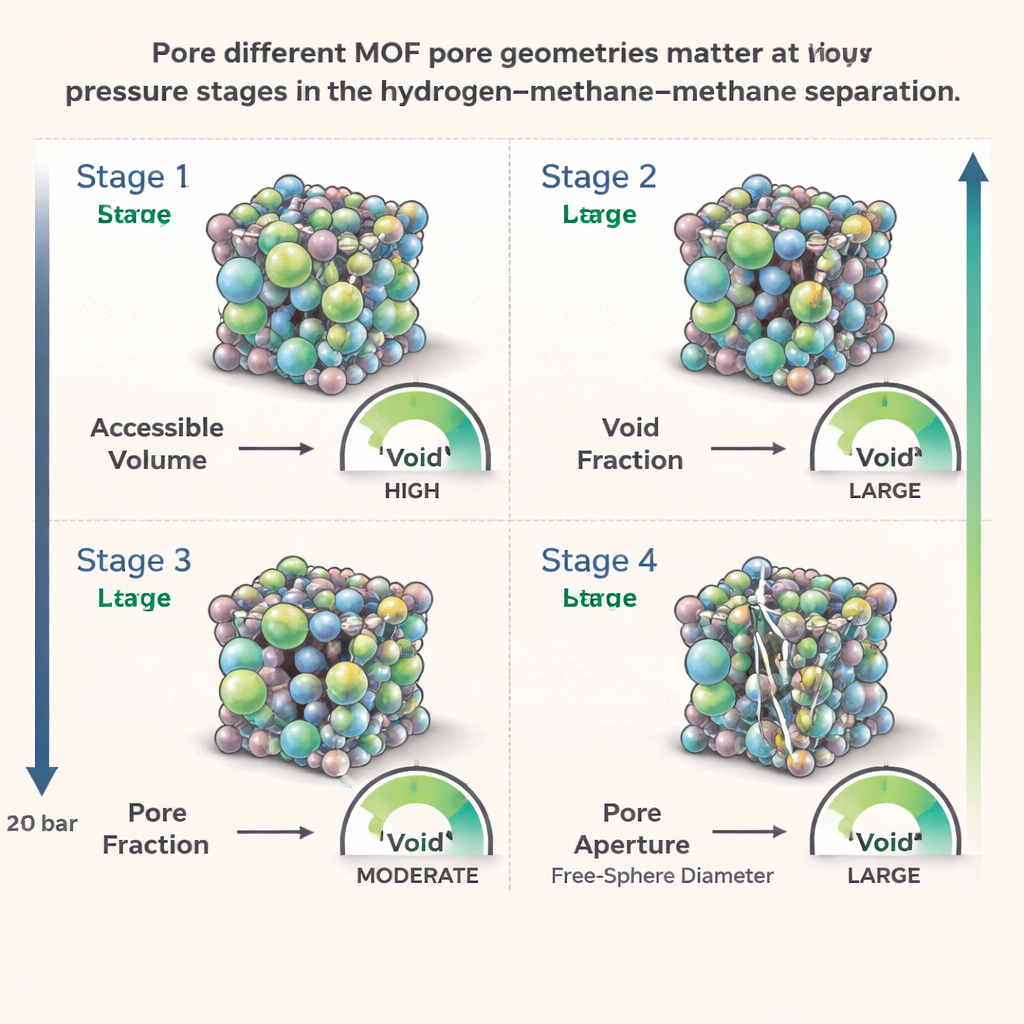
The analysis reveals that no single pore recipe works best from start to finish. At the earliest, highest‑pressure stage, performance is dominated by how much accessible pore volume the MOF offers—essentially, how many adsorption sites it can provide for methane. As pressure falls and the gas becomes richer in methane, the key factor switches to the void fraction, which measures how open the framework is overall; this remains most important through the middle stages. By the lowest‑pressure stage, however, separation is controlled mainly by the size of the channels that molecules must pass through: a measure called the largest free‑sphere diameter, closely related to the pore aperture. The authors go further by mapping out not just single “sweet spots” but whole regions of pore sizes and void fractions that yield similarly good performance, giving chemists multiple structural targets rather than a single rigid design.
Turning design rules into practical guidance
For each of the four withdrawal stages, the study translates AI insights into concrete geometric ranges: specific windows of pore volume, openness, and passage size that minimize hydrogen loss while removing methane. It also identifies real MOFs from existing experimental databases that already lie near these targets, showing that the design rules point to practical, buildable materials. In plain terms, the work provides a stage‑by‑stage recipe for what the “holes” inside these crystal sponges should look like as underground pressure and gas quality change. That information can guide chemists toward better adsorbents and help engineers design more efficient purification units, bringing cost‑effective, seasonal hydrogen storage in old gas fields closer to reality.
Citation: Lee, R.W., Patil, A.S. & Zhang, Y. Machine learning-derived stage-specific design rules for metal-organic framework selection in seasonal hydrogen storage. Sci Rep 16, 4964 (2026). https://doi.org/10.1038/s41598-026-35073-9
Keywords: hydrogen storage, metal-organic frameworks, machine learning, gas separation, underground reservoirs