Clear Sky Science · en
Histological and genetic changes induced by extracorporeal shockwave therapy after rotator cuff repair in a rat model with tears
Why this shoulder study matters
Rotator cuff tears in the shoulder are a common cause of pain and disability, especially in middle-aged and older adults. Even after successful surgery, the repaired tendon sometimes fails to heal firmly back to the bone, leading to repeat tears and more operations. This study explored whether a non-invasive treatment called extracorporeal shockwave therapy (ESWT) can nudge healing tissue to grow in a stronger, more organized way—offering clues that could someday help patients keep their shoulder repairs intact.
Fixing tiny shoulders to answer a big question
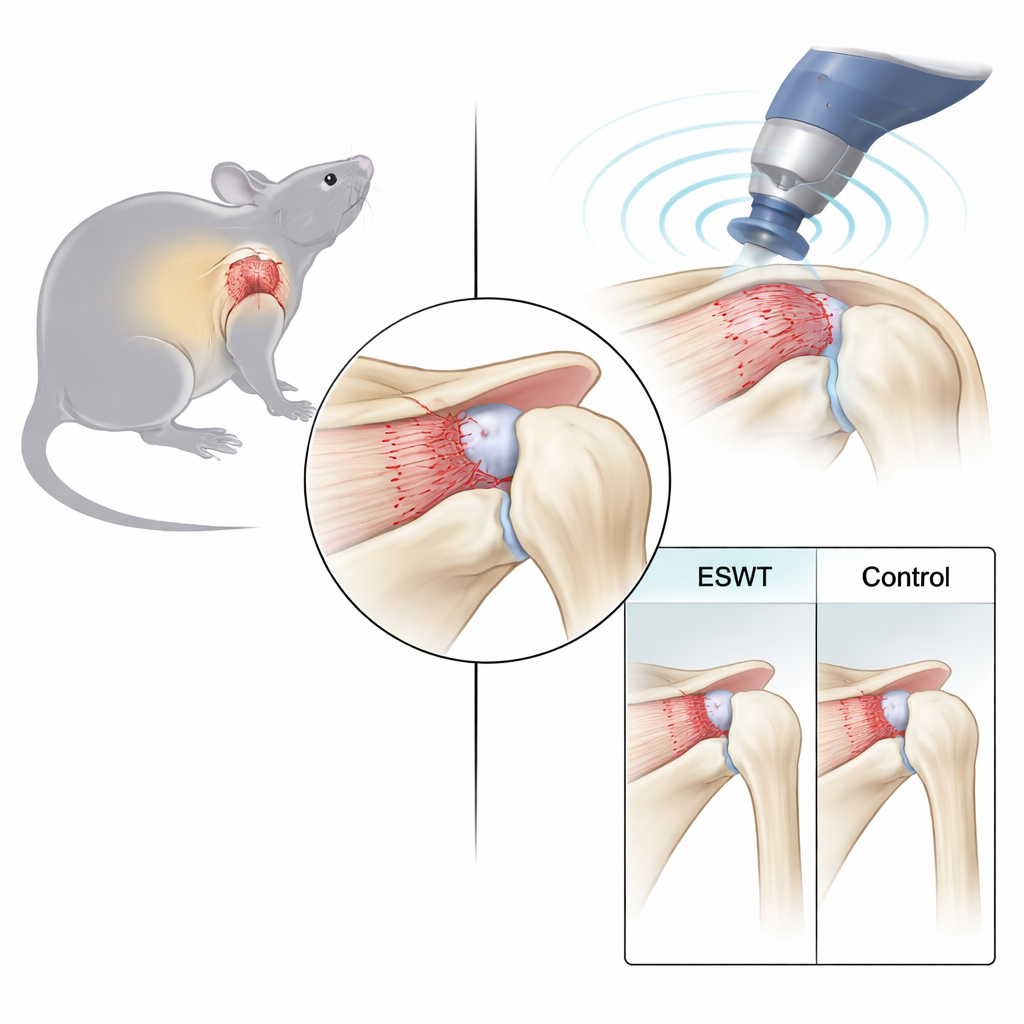
To investigate this, researchers used a well-established rat model that mimics long-standing rotator cuff tears in humans. They detached the supraspinatus tendon—the same tendon often torn in people—from the shoulder bone in 22 rats and waited three weeks so the injury would behave like a chronic tear. Then they surgically reattached the tendon to the bone. One week after this repair, half of the animals received ESWT focused on the repair site, while the others received a sham treatment with the device turned off. Four weeks later, the team examined the repaired tendon-to-bone junction under the microscope and analyzed key genes involved in tendon healing.
What the healing tissue looked like
When the researchers compared tissue samples, the ESWT group showed a more mature and orderly repair zone. Under standard staining, cells in the control animals were crowded and disorganized, and the transition line between tendon and bone was blurred. In contrast, ESWT-treated shoulders had fewer cells that were better aligned—an appearance more similar to normal, uninjured tissue. Using a special stain viewed under polarized light, the team also saw that ESWT-treated tendons contained more of the strong, rope-like collagen type I and less of the weaker collagen type III. Measurements confirmed that collagen fibers in the ESWT group were more parallel and better oriented, a hallmark of stronger, more resilient tendon tissue.
How the healing signals changed
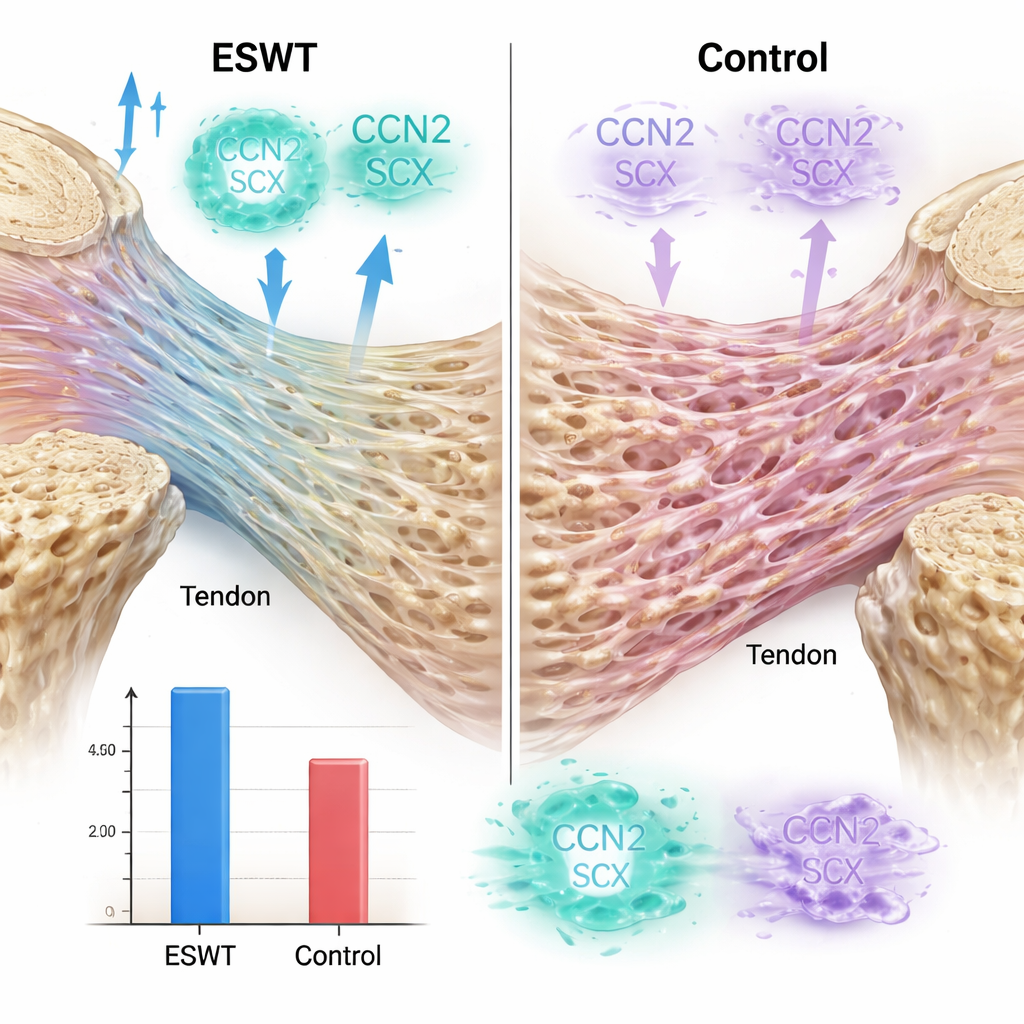
The scientists also looked at messenger RNA levels, a readout of which genes are actively driving repair. They focused on four genes linked to tendon and cartilage formation. Two of these, CCN2 (also known as connective tissue growth factor) and SCX (scleraxis), were significantly higher in the ESWT group than in the control group. Both are thought to encourage tendon-like cells and promote the production and organization of the collagen matrix. In contrast, two other tendon markers, SOX9 and tenomodulin (Tnmd), did not differ between groups at the time point studied. This pattern suggests that ESWT may selectively boost certain early healing pathways that favor better collagen structure without dramatically changing all aspects of tendon biology at once.
How this compares with other add-on treatments
Many strategies have been tested to help tendons heal more securely to bone, including growth factors, bone-acting hormones, platelet-rich plasma, and stem cell–based approaches. Some of these can improve healing but are costly, invasive, or come with side effects. ESWT, in contrast, delivers focused pressure waves from outside the body and is already used in clinics to treat conditions like plantar fasciitis and tennis elbow. Previous animal studies had hinted that ESWT could improve the mechanical strength of healed rotator cuffs, but it was unclear exactly how the tissue and healing-related genes were being altered. This study fills that gap by showing that ESWT can promote a more organized collagen network and upregulate specific tendon-supporting genes at the tendon-to-bone junction.
What it means for future shoulder care
For patients, the work does not yet change standard care, because these experiments were done in rats and did not directly measure how much stronger the repaired tendons became. Still, the findings are encouraging: ESWT appears to steer healing tissue toward a structure and genetic profile that are associated with more durable tendon-to-bone attachment. If similar effects are confirmed in people—along with proven gains in strength and lower retear rates—ESWT could become a simple, non-invasive add-on to shoulder surgery that helps repairs last longer and keeps patients more active with less pain.
Citation: Kamiyama, M., Shitara, H., Ichinose, T. et al. Histological and genetic changes induced by extracorporeal shockwave therapy after rotator cuff repair in a rat model with tears. Sci Rep 16, 5046 (2026). https://doi.org/10.1038/s41598-026-35072-w
Keywords: rotator cuff healing, shockwave therapy, tendon to bone, shoulder surgery, tendon repair