Clear Sky Science · en
Adaptation acts directly on the sensory representation of numerosity
Why our sense of “how many” matters
Even without counting, you can usually tell at a glance which bowl has more apples or which crowd is larger. This quick, automatic feeling for quantity—called our “number sense”—helps us navigate the world, from judging traffic to sharing food. The study in this article asks a deceptively simple question: can this basic sense of “how many” be tuned, or adapted, by recent experience, just like our eyes adapt to bright light or strong motion? And if it can, does the change happen in the eyes and brain’s early sensory stages, or only later when we make decisions?
When staring at dots changes what you see
The researchers focused on a phenomenon known as numerosity adaptation. If you stare for a few seconds at a very dense patch of dots, a later patch with a moderate number of dots tends to look less numerous than it really is. This striking visual after-effect has fueled the idea that the brain encodes “number” as a basic visual property, much like color or brightness. However, some scientists have argued that the effect might be a trick of decision-making rather than genuine seeing—people might simply shift how they answer when they feel unsure. To probe this, the authors revisited numerosity adaptation and, crucially, a subtler “reverse” version: adapting to very sparse dot patterns that can make later patterns look more numerous.
Inside the dot-judging experiment
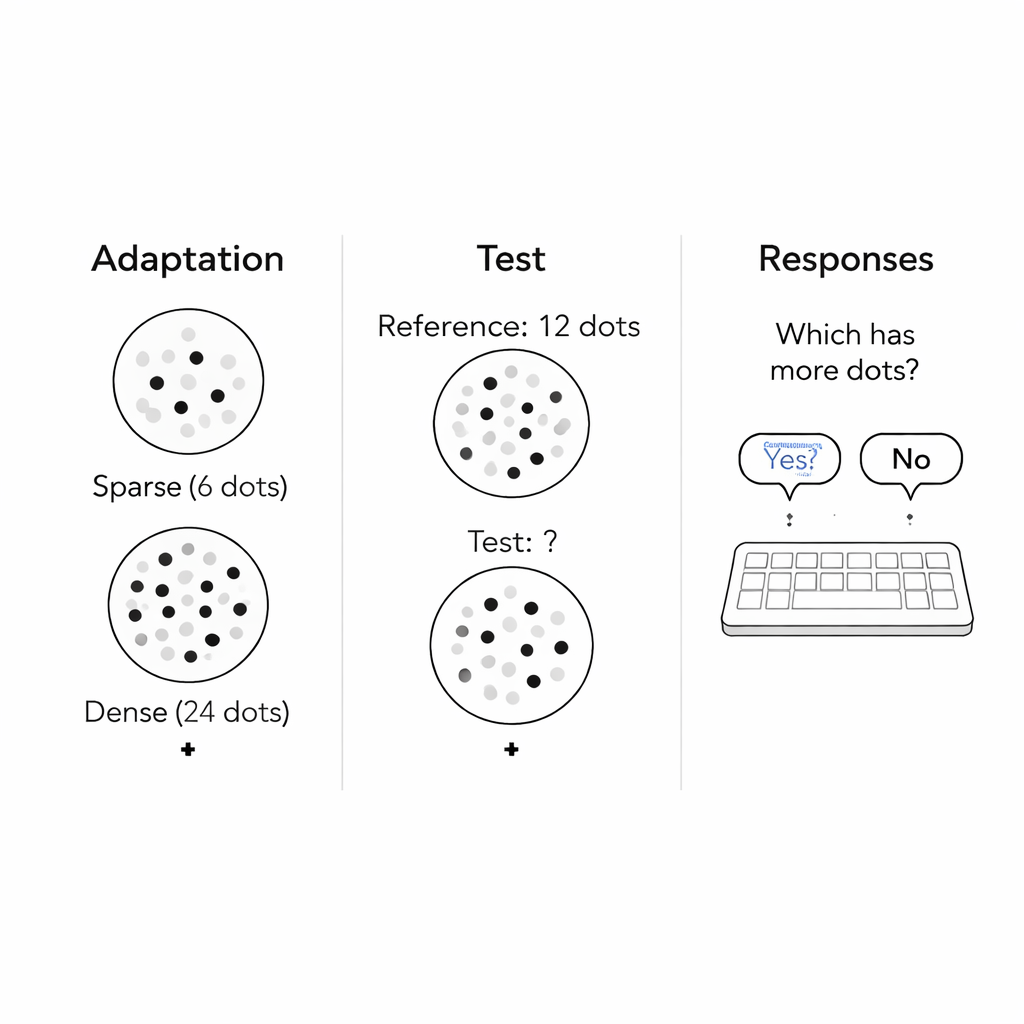
Thirty volunteers with normal vision took part in a simple but carefully controlled task. They fixated on a point while clouds of small black and white dots appeared above and below it. The upper cloud was a fixed “reference” containing 12 dots. The lower “test” cloud varied in number across trials. Sometimes there was no prior display (baseline). In other blocks, each trial began with a 5-second “adapting” display in the reference location: either a very sparse cloud with 6 dots (“adapt to few”) or a dense cloud with 24 dots (“adapt to many”). On every trial, people first chose which cloud had more dots, then pressed another key to say whether they felt confident about that choice. The researchers also recorded how long each decision took, down to fractions of a second.
How judgments, confidence, and timing all shift
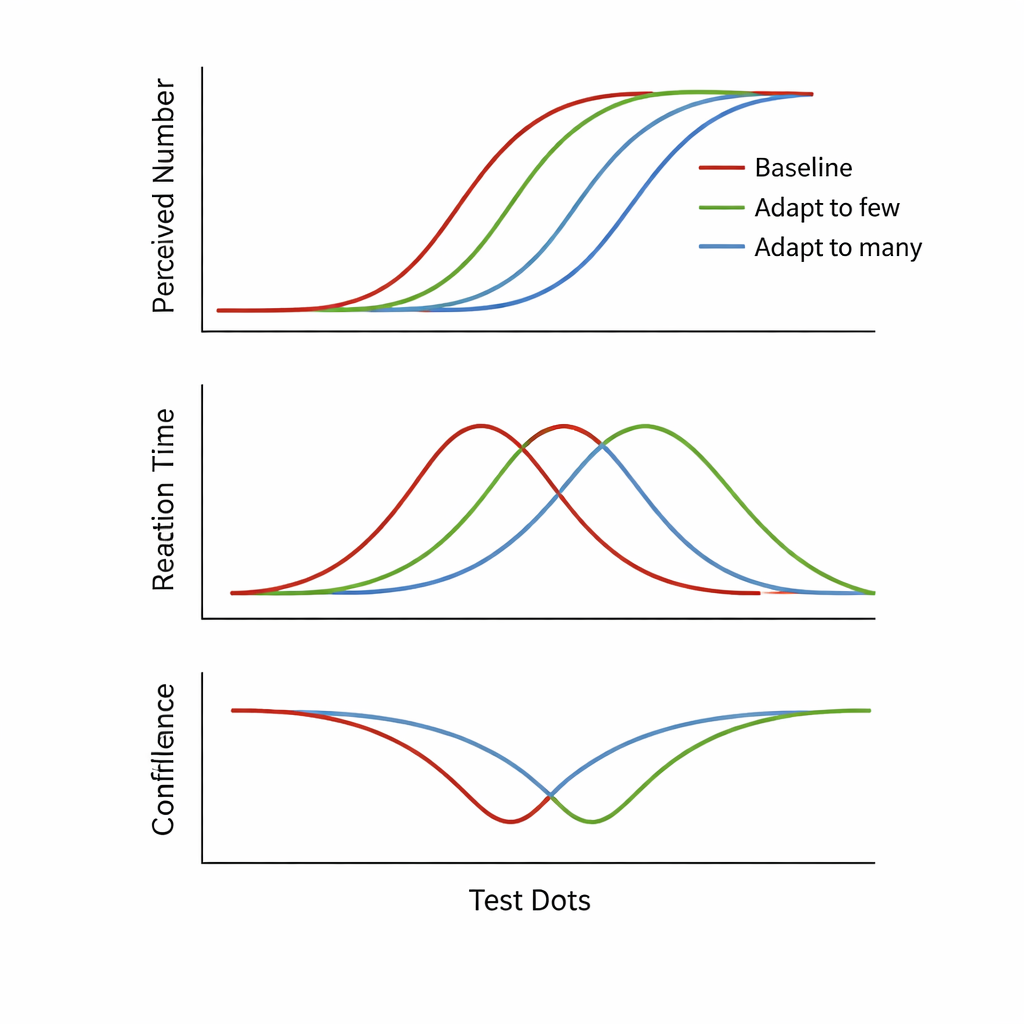
When all the data were combined, the pattern was clear. In the dense-adaptation condition, the test cloud needed fewer than 12 dots to look equal to the 12-dot reference, meaning the reference now appeared less numerous. After adapting to sparse displays, the opposite happened: the test needed more dots to look equal, so the reference appeared more numerous. These shifts occurred not only in the average judgments but also across individual observers. Most people showed decreased apparent number after dense adaptation and increased apparent number after sparse adaptation, although the reverse effect was smaller in size.
Uncertainty reveals what the brain is really doing
A key innovation was to look beyond what people chose, and examine how sure they felt and how long they took. Typically, decisions are slowest and confidence lowest when two stimuli are hardest to tell apart. If adaptation truly changes what is seen, then the hardest comparisons should occur when the perceived, not physical, numbers match. That is exactly what the researchers found. After adaptation, the longest reaction times and the lowest confidence shifted to the new “equal” point defined by the altered perception of number. This held for both adapting to many and adapting to few dots. If participants were simply biasing their answers while still seeing the same numbers, the physical equality point should have remained the hardest, and the confidence and timing curves would not move.
What this means for our basic sense of number
Taken together, the results show that our sense of “how many” is flexible and operates at a genuinely perceptual level. Prolonged exposure to either crowded or sparse patterns alters how numerous later displays look, and this change is mirrored in how uncertain and how slow our judgments become. In other words, the brain’s early representation of numerosity itself is being retuned, not just the strategy we use to answer. This supports the view that number is a primary visual attribute, shaped by recent experience in much the same way as brightness or motion, and challenges claims that numerosity adaptation is merely a cognitive illusion.
Citation: Benedetto, A., Anobile, G., Arrighi, R. et al. Adaptation acts directly on the sensory representation of numerosity. Sci Rep 16, 4892 (2026). https://doi.org/10.1038/s41598-026-35068-6
Keywords: numerosity, visual adaptation, number sense, perception, psychophysics