Clear Sky Science · en
Sustainable design of organic solar cells utilized machine and deep learning
Smarter Solar Cells for a Changing World
Solar panels are now a familiar sight on rooftops and in fields, but many people do not realize that new kinds of lightweight, flexible “plastic” solar cells are emerging in the lab. This article explores how researchers use computer simulations and artificial intelligence to design these organic solar cells so they turn more sunlight into electricity, waste fewer materials, and better support global climate and sustainability goals.
What Makes These Solar Cells Different
Traditional solar panels are usually made from stiff silicon wafers. Organic solar cells, by contrast, are built from thin carbon‑based layers that can be printed on flexible sheets. They can be lightweight, colorful, and potentially cheaper to manufacture. The downside is that their efficiency—how much of the Sun’s energy they turn into usable power—has historically lagged behind silicon. Thanks to new organic materials, lab devices have already passed 18 percent efficiency. To push even further, scientists must carefully tune the inner stack of layers that carry electric charges, especially the electron transport layer, the hole transport layer, and the light‑absorbing active layer in between.
Using Virtual Experiments Instead of Trial and Error
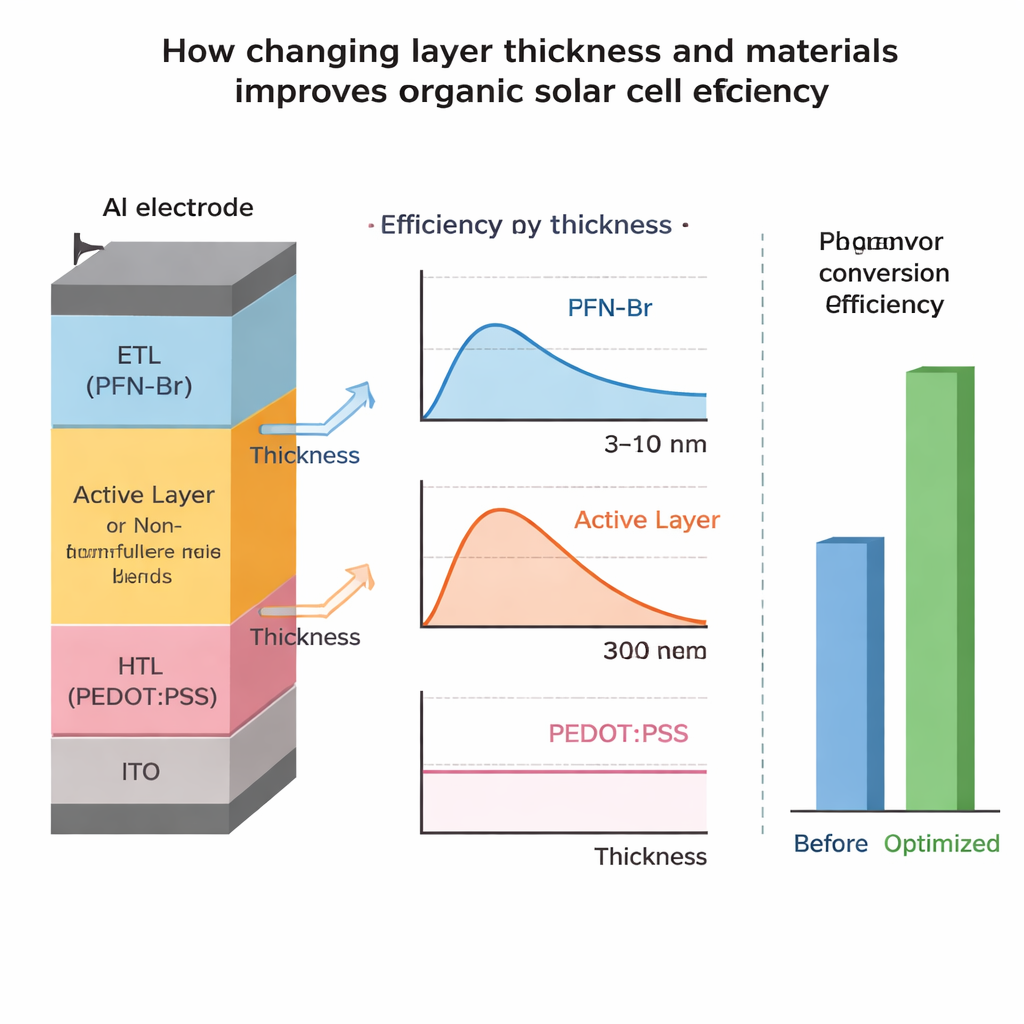
Rather than building countless test cells in the lab, the authors use a detailed computer program called SCAPS‑1D to run “virtual experiments.” They focus on a specific device structure that sandwiches an active blend called PBDB‑T:IT‑M between a hole‑transport layer (PEDOT:PSS) and an electron‑transport layer (PFN‑Br), with transparent indium tin oxide on one side and aluminum on the other. First, they check that the simulator matches published laboratory results, and find that it reproduces key measures—voltage, current, and overall efficiency—very closely. This gives them confidence to explore new designs on the computer, long before any materials are mixed or coated in a clean room.
Finding the Sweet Spot in the Layer Stack
With the virtual device validated, the team systematically adjusts the materials and thicknesses of each layer to see what combination works best. Among several electron‑transport candidates, PFN‑Br performs the best, mainly because its internal energy levels line up well with the active layer and it helps electrons move smoothly to the metal contact. When they vary PFN‑Br thickness from 5 to 30 nanometers (a nanometer is a billionth of a meter), they see that very thin layers—around 5 to 10 nanometers—give the highest efficiency. Thicker layers introduce extra resistance, causing more energy loss. For the active layer itself, making it thicker allows it to catch more sunlight, but also makes it harder for charges to escape before they recombine. The simulations show an ideal thickness near 300 nanometers, where light absorption and charge transport are well balanced.
Letting Artificial Intelligence Learn the Best Designs
Running many detailed simulations still takes time, so the researchers add a second tool: artificial intelligence. They generate a dataset of 300 simulated solar cells with different thickness choices for the two transport layers and the active layer. Then they train two kinds of AI models—convolutional neural networks (CNNs) and support vector regression (SVR)—to predict key outcomes: overall efficiency and the open‑circuit voltage. Once trained, the CNN can instantly estimate these performance numbers for new designs without rerunning the full physics simulation. In tests, the CNN predicts efficiency with far smaller errors than SVR, capturing the subtle, non‑linear ways that tiny changes in thickness ripple through the device’s behavior.
Linking Better Solar Cells to a Greener Future
Beyond the lab, the team connects their results to global sustainability goals. By nearly doubling the simulated efficiency—from about 12 percent to roughly 19.5 percent—an optimized organic solar cell can generate more power from the same area, reducing the amount of material, land, and supporting hardware required. That supports cleaner and more affordable energy (SDG 7), more innovative and efficient industries (SDG 9), more responsible use of resources (SDG 12), and stronger action on climate change (SDG 13). In simple terms, this work shows how combining virtual testing with AI can help design smarter solar cells faster, cutting waste and speeding up the arrival of flexible, high‑performance solar technologies in everyday life.
Citation: Mohyeldien, O.M., El-Amary, N.H. & Al Bardawil, A. Sustainable design of organic solar cells utilized machine and deep learning. Sci Rep 16, 3728 (2026). https://doi.org/10.1038/s41598-026-35067-7
Keywords: organic solar cells, machine learning, layer thickness optimization, photovoltaic efficiency, sustainable energy