Clear Sky Science · en
Energy and makespan optimised task mapping in fog enabled IoT application: a hybrid approach
Why smarter clouds matter to everyday devices
From fitness trackers and smart thermostats to connected cars and hospital monitors, billions of gadgets now constantly send data to be processed somewhere on the internet. When that “somewhere” is a far‑off cloud data center, the distance can introduce delays and waste energy. This paper explores a new way to decide where those digital chores should be done so that connected devices get answers quickly while the overall system uses less power.
Bringing the cloud closer to the real world
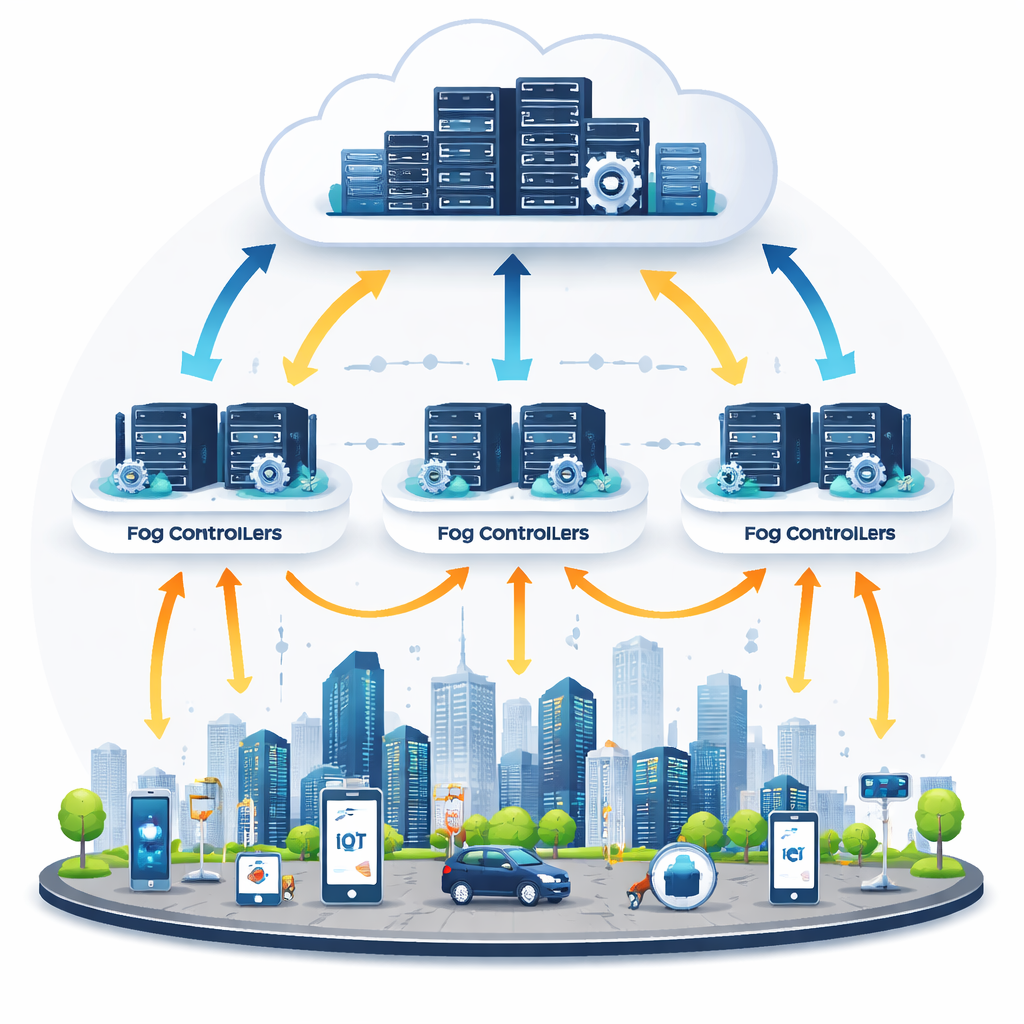
Today’s internet of things (IoT) often relies on huge cloud data centers to store and analyze information. That works well for many jobs, but not for activities that demand split‑second responses—such as autonomous driving, online gaming, or remote health monitoring—where even small delays can be harmful or annoying. To tackle this, engineers are increasingly using “fog computing,” which places smaller servers closer to where data is created. The authors study a three‑layer setup: everyday devices at the bottom, nearby fog nodes in the middle, and powerful cloud servers at the top. Most tasks should ideally be handled in the fog layer, with only the heaviest jobs sent up to the cloud.
The scheduling challenge behind the scenes
Deciding which server handles which task is surprisingly complex. Each incoming task has a size and arrival time, while each virtual machine has limits on processing speed, memory, and network bandwidth. If tasks are placed poorly, some machines sit idle while others are overloaded, leading to long waiting times and wasted electricity. The paper focuses on three goals at once: finishing all tasks as quickly as possible (short makespan), consuming as little energy as possible, and keeping the work spread evenly so no single machine becomes a hot spot. Instead of optimizing just one of these goals, the authors treat it as a combined, competing set of objectives that must be carefully balanced.
A swarm-inspired way to share the load
To solve this balancing act, the researchers build on particle swarm optimization (PSO), a technique inspired by the way birds flock or fish school. In PSO, many candidate solutions—here, different ways of assigning tasks to machines—“fly” through the space of possibilities, adjusting their positions based on what has worked best so far for themselves and for their neighbors. The authors propose an enhanced version called EMAPSO (Energy Makespan‑Aware PSO). It starts from a smart initial guess that favors machines with the shortest completion times, then continually updates task assignments using a fitness score that blends both energy use and total completion time. EMAPSO also watches how busy each machine is and avoids sending new work to any server that is already heavily loaded.
How the new method behaves in practice
The team tested EMAPSO in a simulated fog–cloud environment, comparing it with several existing approaches, including standard PSO and other swarm‑inspired algorithms based on birds and bees. They varied both the number of tasks and the number of virtual machines to mimic different real‑world conditions. Across all tests, EMAPSO consistently finished the same workload faster and with less energy. In one set of experiments, it cut energy use by about 35 percent while still keeping job completion times competitive or better. Statistical tests showed that these gains were not due to chance: the improvements in both speed and energy were significant across repeated runs.

What this means for everyday technology
For non‑specialists, the key message is that smarter scheduling inside the network can make connected devices feel more responsive while also trimming energy bills and easing pressure on data centers. EMAPSO offers a flexible way to trade off speed against power use—system operators can dial the algorithm to favor quick responses during busy hours or prioritize energy savings when traffic is light. While the work is based on simulations, it points toward future fog–cloud systems that automatically juggle millions of tiny digital tasks so your car, phone, or medical sensor can react in real time without silently wasting electricity in the background.
Citation: Tripathy, N., Sahoo, S., Alghamdi, N.S. et al. Energy and makespan optimised task mapping in fog enabled IoT application: a hybrid approach. Sci Rep 16, 5210 (2026). https://doi.org/10.1038/s41598-026-35065-9
Keywords: fog computing, internet of things, task scheduling, energy efficiency, particle swarm optimization