Clear Sky Science · en
Acoustic performance optimization of natural-fiber micro-perforated panels backed by an optimized polyurethane–fibrogranule composite
Why quieter cities need greener sound barriers
City life is getting louder—from traffic and construction to planes and factories—and that noise doesn’t just annoy us. Long-term exposure can damage hearing, disturb sleep, and strain the heart. Most sound-absorbing products used in buildings and vehicles are made from synthetic foams or mineral fibers, which work well but come with environmental costs. This study explores a new kind of sound absorber built largely from farm by‑products—flax fibers and rice husks—showing how waste from the field can become a high‑performance, eco‑friendly shield against urban noise.
Turning crops and foam into a smart sound sponge
The researchers set out to create a “hybrid” acoustic panel that blends two well-known sound‑control tricks in a single, thin package. The front layer is a rigid sheet peppered with thousands of tiny holes, known as a micro‑perforated panel. Behind it sits a thicker, soft foam that behaves like a sponge for sound. Both layers are reinforced with finely processed flax fibers and rice husk particles, which replace part of the petroleum‑based content in conventional polyurethane foam. By using the same natural ingredients in both the front panel and the backing foam, the team aimed to improve how firmly the layers bond together and how sound is steered and slowed as it passes through. 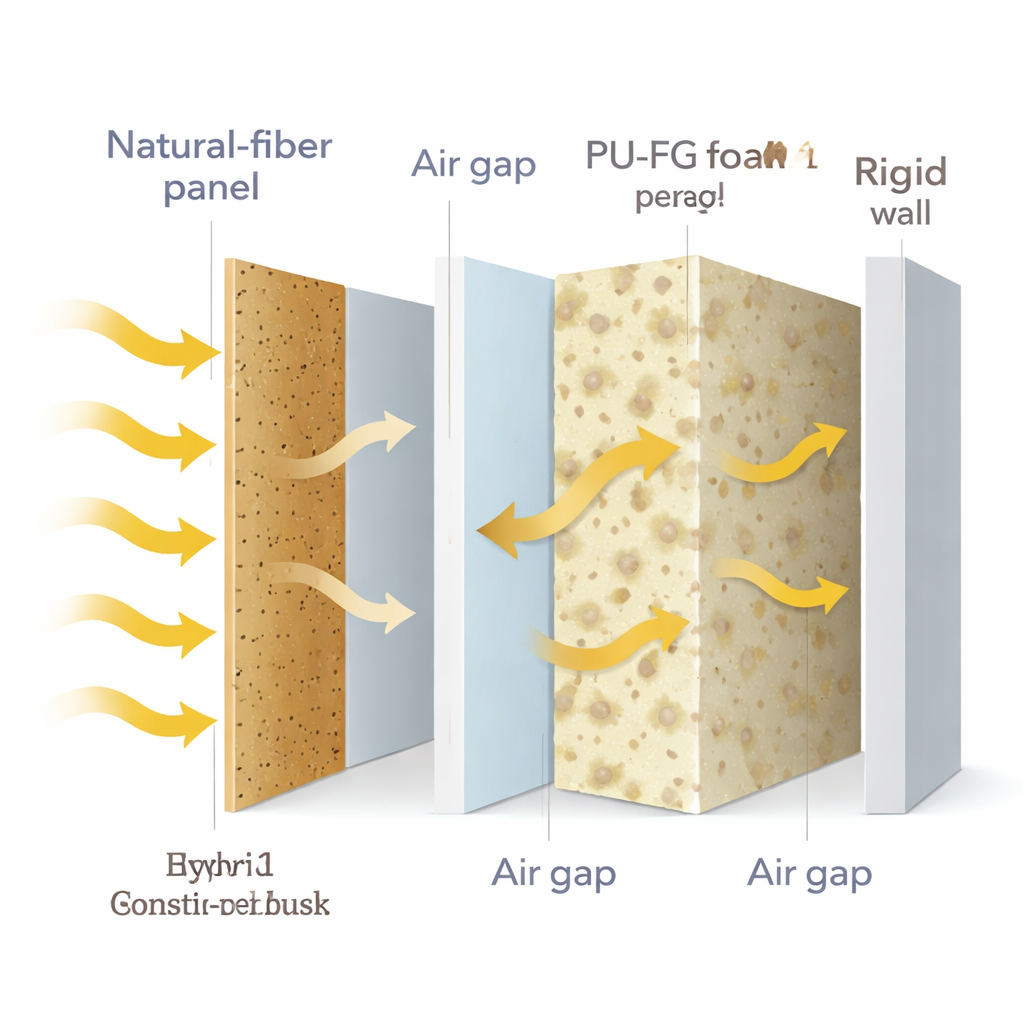
How the material is built from farm waste up
To make the backing layer, the team first cleaned and chemically treated flax fibers and rice husks so they would mix well with liquid polyurethane. These treated fibers and granules were blended into the foam’s base liquid and allowed to expand and cure, creating a lightweight block filled with tiny interconnected cells. For the front sheet, the same natural fibers and husks were ground to powder, mixed with a water‑based binder, pressed into thin panels, and then drilled with laser‑cut micro‑holes only half a millimeter wide. Air gaps were left in front of and behind the foam when the layers were assembled, forming a carefully tuned stack: perforated panel, front air space, natural‑fiber foam, and a rear air space backed by a rigid wall.
Finding the sweet spot with guided trial and error
Because every detail—the foam thickness, the amount of fiber and husk, their mixing ratio, and the size of the air gaps—changes how sound behaves, the researchers used a structured trial‑and‑error strategy borrowed from statistics. This approach, called response surface methodology, lets them vary several factors at once and mathematically map how each one influences average sound absorption across a wide band of frequencies important to human hearing. In a first round, they tuned the foam alone, discovering that a 40 mm thick layer with about 15.5% natural filler and a mix richer in rice husks than flax gave the best overall performance. In a second round, they adjusted how many holes are in the front panel and how big the gap is between panel and foam, identifying a very narrow range where the system soaks up the most sound without becoming leaky to noise.
What happens to the sound inside the panel
Tests in a standardized measurement tube showed how these design choices pay off. The optimized foam by itself already absorbs much of the sound between about 900 and 3000 Hz, thanks to its maze of small, irregular pores and embedded particles that force air to twist and rub, turning sound energy into tiny amounts of heat. The perforated front layer adds a different effect: each micro‑hole behaves like a tiny bottle‑shaped resonator that is especially good at trapping low‑frequency noise, the deep rumbles most materials struggle with. When the panel, foam, and air spaces are arranged in the best sequence, their effects reinforce one another. The final stack keeps the sound absorption coefficient above about 0.85—very close to a perfect absorber—across roughly 450 to 2200 Hz, comfortably covering most of the pitch range of speech and traffic noise. 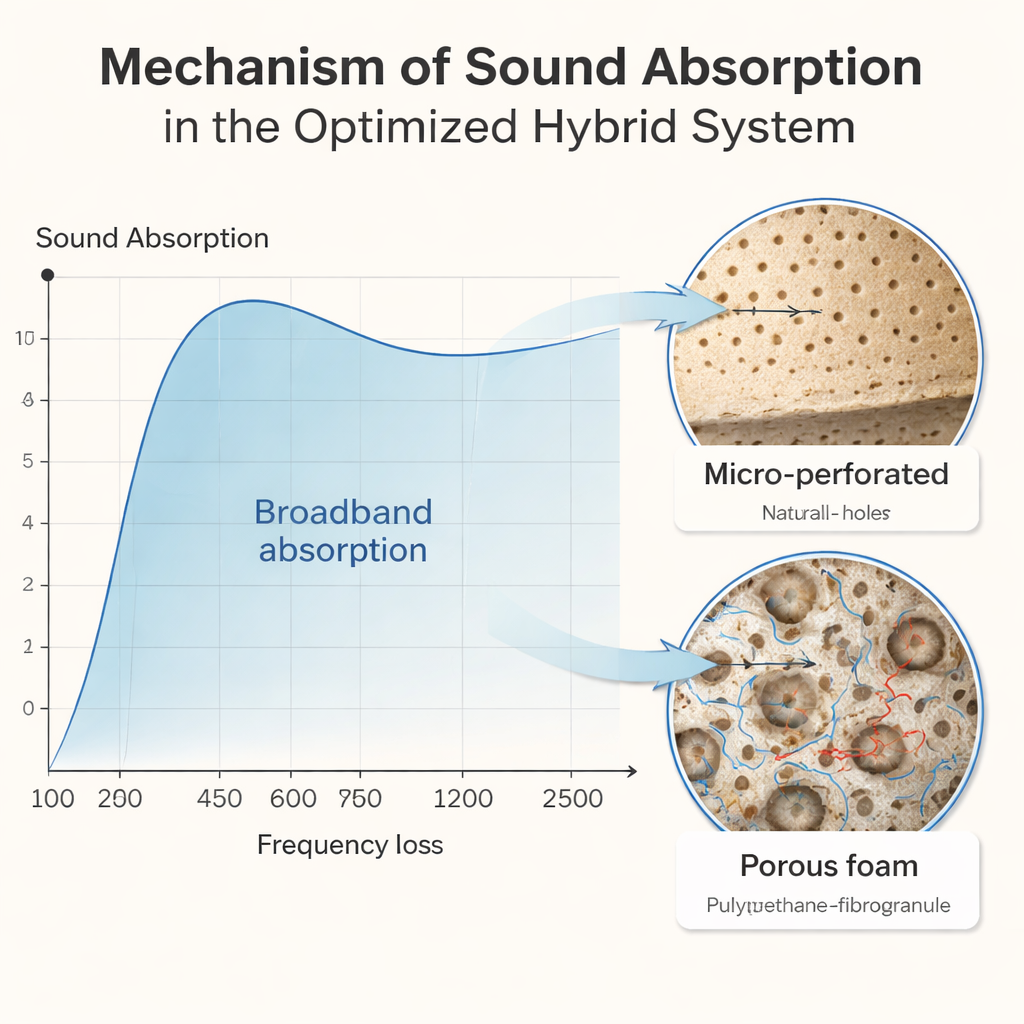
What this means for quieter, cleaner buildings
To a non‑specialist, the key outcome is simple: by carefully combining a holed front sheet, an air cushion, and a natural‑fiber foam backing, the researchers built a relatively thin wall element that soaks up a broad range of everyday noise as effectively as many commercial synthetic products, while replacing more than half of the material with renewable content from flax and rice farming. This makes it easier to design offices, homes, and transport systems that are both quieter and greener. Although more work is needed to test performance in real rooms and over years of use, the study shows that everyday agricultural residues can be engineered into advanced acoustic materials that help protect hearing and improve comfort without relying solely on fossil‑based or mineral resources.
Citation: Nakhaeipour, M., Forouharmajd, F., Habibi, E. et al. Acoustic performance optimization of natural-fiber micro-perforated panels backed by an optimized polyurethane–fibrogranule composite. Sci Rep 16, 5464 (2026). https://doi.org/10.1038/s41598-026-35058-8
Keywords: sound absorption, natural fiber panels, noise control, polyurethane foam, sustainable acoustics