Clear Sky Science · en
Thinning altered the optimum photosynthetic environment in a subtropical coniferous plantation
Why tree thinning matters for our changing climate
As the world warms, forests are asked to do double duty: provide wood and wildlife habitat while also soaking up huge amounts of carbon dioxide from the air. Many of these forests are man‑made plantations planted in tight rows, especially across rapidly greening regions of China. This study asks a deceptively simple question with big implications: when we thin these crowded plantations—removing some trees to give the rest more space—how does that change the sweet spot of light, temperature, and moisture where the forest captures the most carbon?
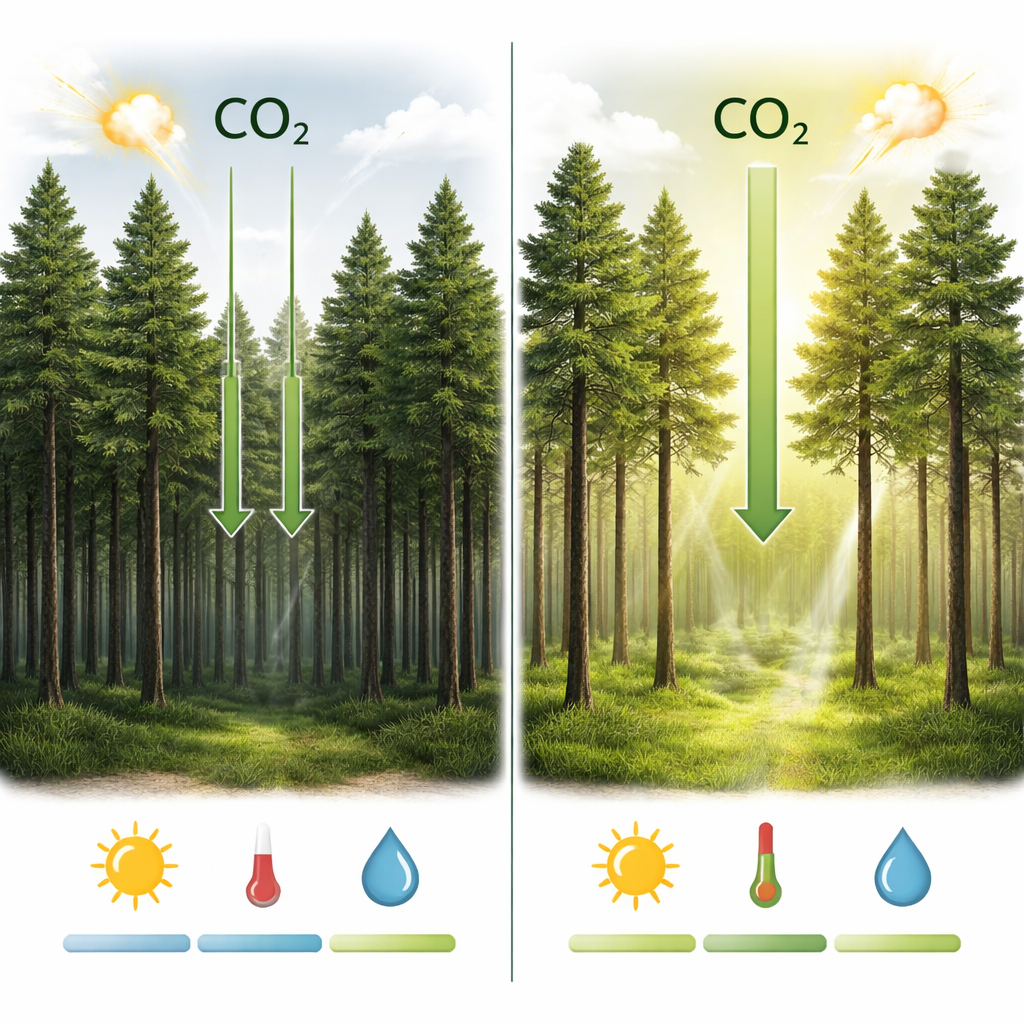
From crowded pine stands to roomier forests
The researchers worked in a large subtropical conifer plantation in southern China that has been carefully monitored for years. The site, once badly eroded, was replanted in the 1980s with fast‑growing pines and Chinese fir. By the late 2000s, the trees had grown dense and uniform, with more than 1,300 stems per hectare: a classic, tightly packed plantation. In the winter of 2012, managers removed about a quarter of the stand’s basal area—roughly one in every three to four trees—around an instrumented flux tower. This moderate thinning, common in regional forestry practice, opened the canopy, increased light penetration, and reduced competition for water and nutrients among the remaining trees.
Listening to a forest breathe
To find out how the forest’s carbon uptake responded, the team relied on a technique called eddy covariance, which continuously measures exchanges of carbon dioxide between the forest and the atmosphere. Over six years—four before thinning and two after—they recorded how much carbon the plantation pulled from the air (its gross primary productivity, or GPP) alongside key environmental conditions: net radiation from the sun, air temperature, the dryness of the air (vapor pressure deficit), and moisture in the top soil layer. By grouping the data into ranges of each factor, they could see how GPP rose, peaked, and then declined as conditions became too dim, too cool, too hot, or too dry.
Finding the forest’s “Goldilocks” zone
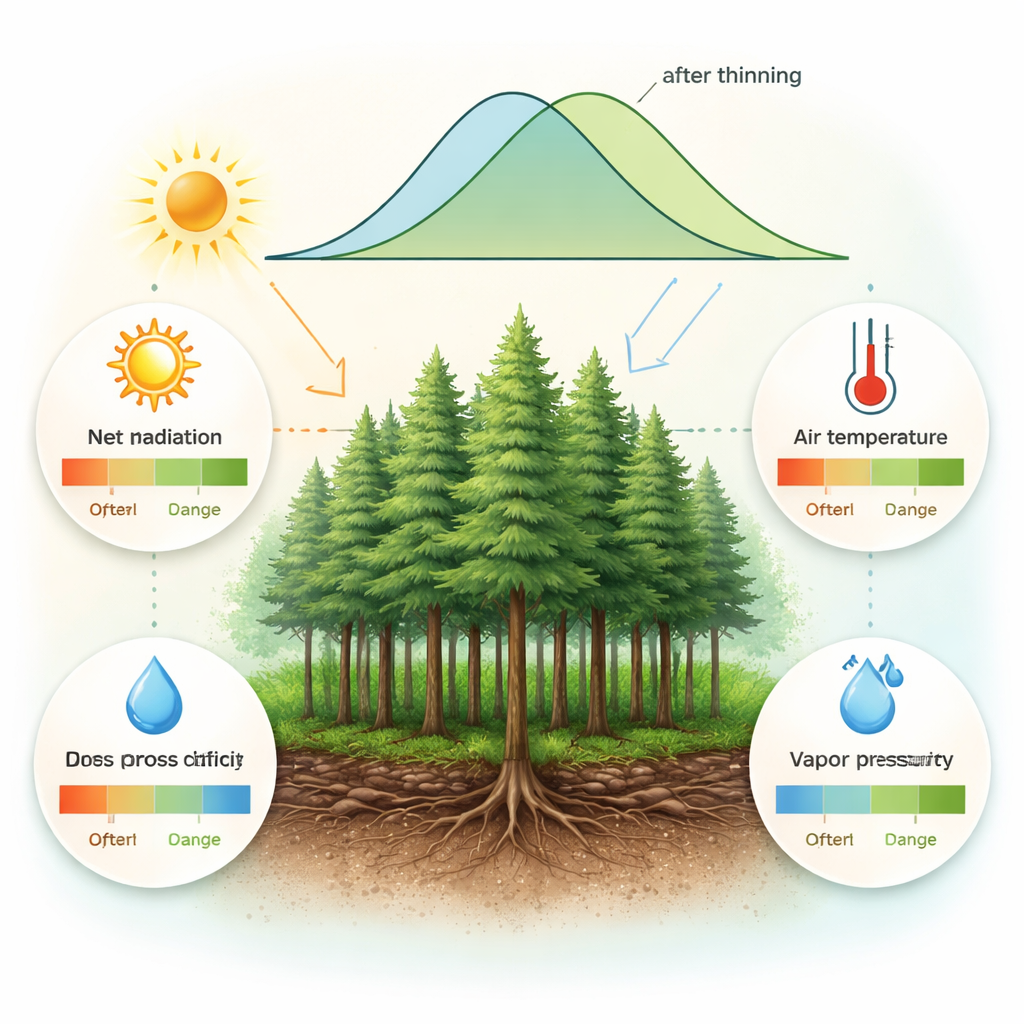
The analysis showed that for light, temperature, and air dryness, the forest followed a classic “too little, just right, too much” pattern. Before thinning, the forest reached its best performance at a certain level of sunlight, a warm but not scorching air temperature, and moderately dry air. After thinning, those optimal points shifted upward: the stand could now handle stronger sunlight, slightly higher temperatures, and drier air before photosynthesis began to drop off. At the same time, the maximum carbon uptake at each optimum increased. For example, when sunlight was at its preferred level, the thinned forest’s peak GPP was about 13 percent higher than before thinning. The authors link these gains to better light distribution in the canopy, improved air movement, and reduced competition for soil water, which together allowed trees and understory plants to keep their leaves working efficiently under more demanding conditions.
When nature’s knobs turn together
In the real world, of course, light, temperature, and air dryness do not adjust one at a time. Hot, bright days also tend to be dry. The researchers therefore went beyond single‑factor tests to search for realistic combinations of conditions that delivered the highest observed GPP. Before thinning, the forest’s best‑case mixture involved high but not extreme sunlight, a mild temperature of roughly 23 °C, moderately dry air, and reasonably moist soil. Under these circumstances, the forest reached a maximum carbon uptake of about 0.98 milligrams of CO₂ per square meter each second. After thinning, the “best mix” shifted: the forest’s optimum now sat at nearly the same light level but at a warmer 27 °C and drier air, with slightly wetter soil, and the peak GPP rose to about 1.11 milligrams CO₂ per square meter per second. Importantly, these real‑world optima were not simply the theoretical best of each factor; they reflected trade‑offs and interactions among all four.
What this means for managing working forests
For a lay reader, the key message is that thinning did more than just free up space; it actually changed the environmental “comfort zone” where this plantation operates most efficiently as a carbon sponge. After thinning, the forest could thrive under brighter, warmer, and drier conditions and convert that extra energy into more carbon uptake rather than stress. Because climate change is pushing many regions toward hotter and more variable weather, understanding and adjusting this optimum zone through management becomes increasingly valuable. The study suggests that well‑planned thinning in overly dense subtropical plantations can both maintain timber production and help forests remain effective, resilient carbon sinks in a warming world.
Citation: Li, S., Xu, M., Yang, F. et al. Thinning altered the optimum photosynthetic environment in a subtropical coniferous plantation. Sci Rep 16, 4867 (2026). https://doi.org/10.1038/s41598-026-35052-0
Keywords: forest thinning, carbon uptake, subtropical plantation, photosynthesis, climate adaptation