Clear Sky Science · en
Influence of non-stationarity in friction angle on the performance of the braced excavation system
Why digging next to buildings is a big deal
Modern cities constantly dig deep pits for subway lines, basements and utility tunnels. These braced excavations must be cut safely in crowded neighborhoods, often just a few meters from existing buildings. If the soil moves more than expected, walls can lean, streets can sink and nearby structures can crack. This paper explores how a subtle detail – the way sand becomes stronger with depth – changes our predictions of ground movement and the chances of damage when we dig.
How deep pits are held back
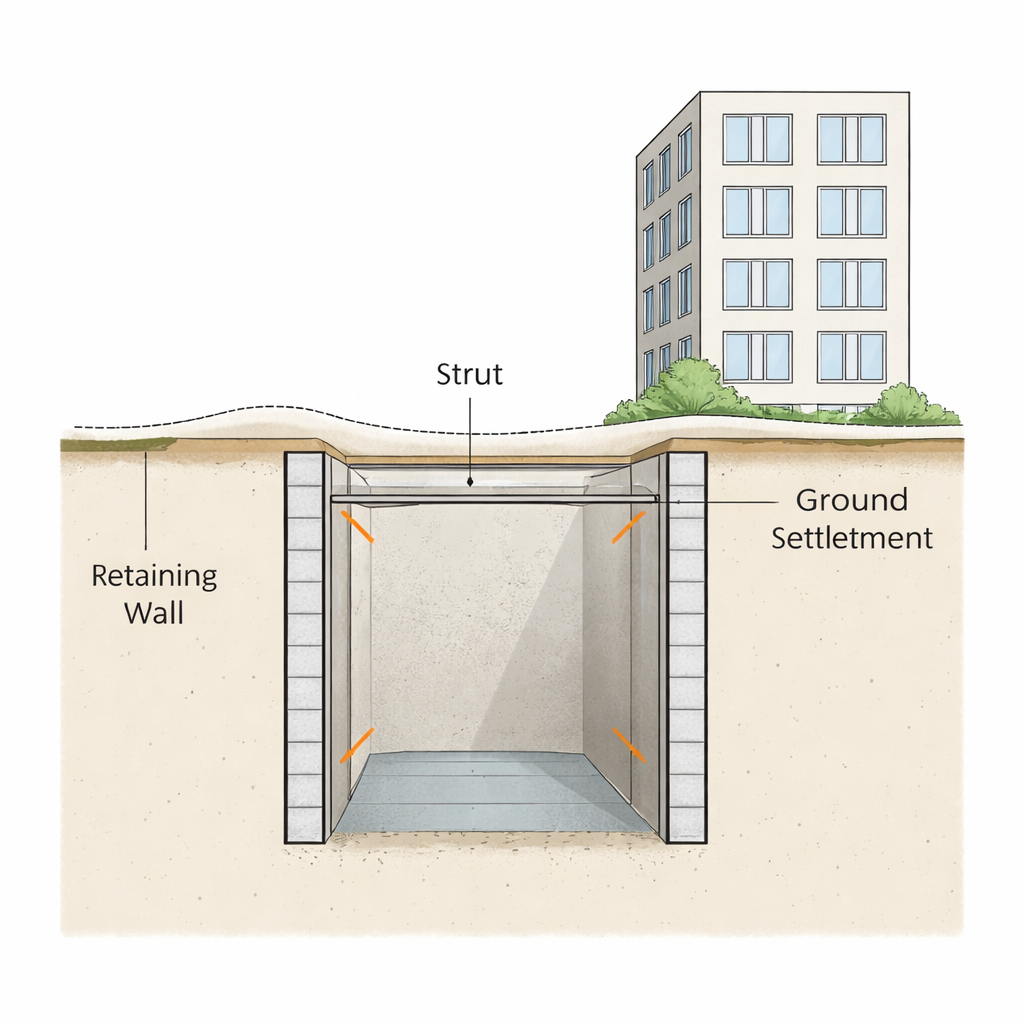
A typical braced excavation uses a stiff underground wall and one or more horizontal struts to hold back the surrounding ground. Designers worry about two main kinds of behavior. First are strength failures, such as the retaining wall bending or struts overloading. Second are service problems, such as the wall leaning too much or the ground settling enough to harm nearby buildings. In practice, authorities like those in Shanghai set strict limits on wall movement and ground settlement, especially around critical infrastructure like metro lines and pipelines. Meeting these limits requires realistic predictions of how soil will deform as excavation progresses.
Soil is never truly uniform
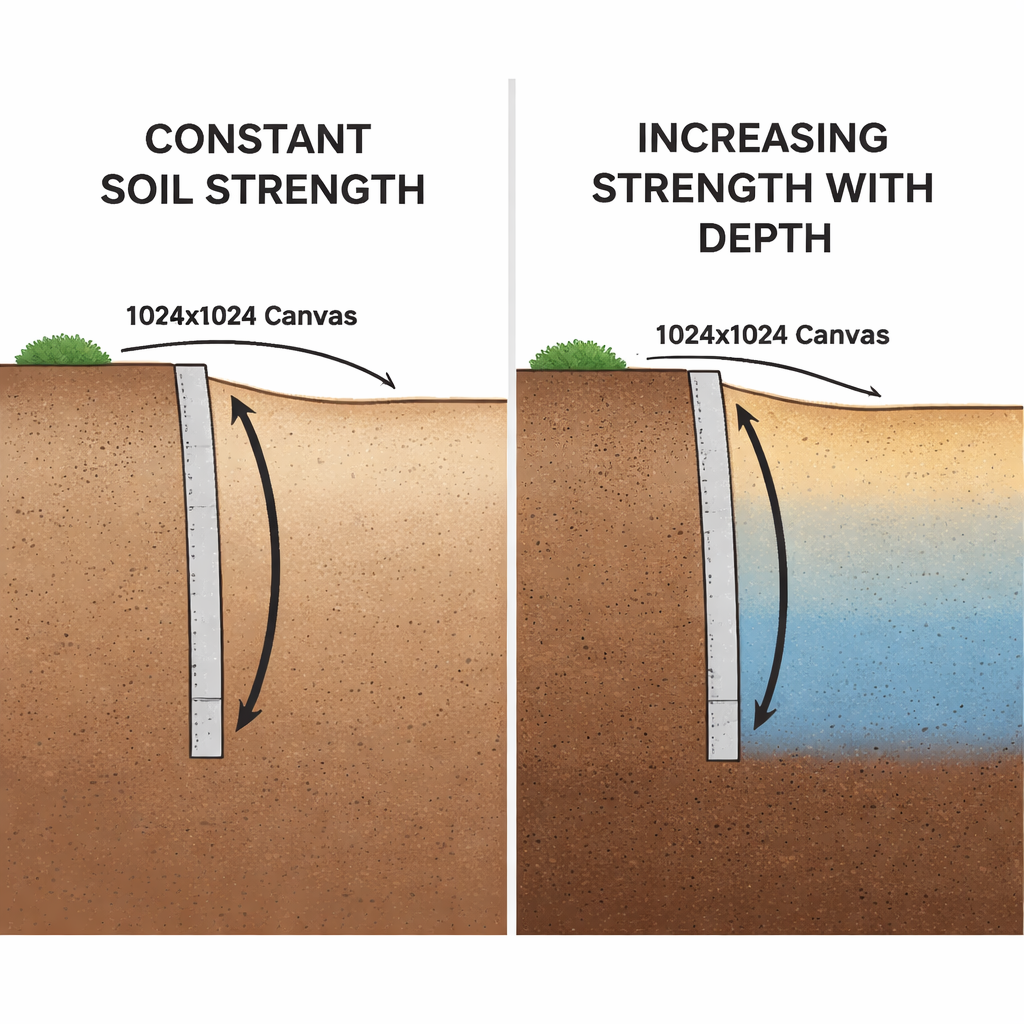
Engineers know that soil properties vary from place to place because of how layers were deposited and squeezed over time. Traditionally, computer models treat a property like the “friction angle” of sand – which reflects how well grains lock together – as randomly variable but with the same average value at all depths. Field data, however, show that sand usually becomes stronger with depth due to rising pressure from the weight of overlying material. The authors call this a non-stationary condition: the average strength trends upward with depth, while the amount of scatter around that trend stays similar.
Simulating thousands of possible ground movements
To test how this depth trend matters in practice, the researchers modeled a real braced excavation case using specialized finite-difference software. The model included a sandy soil layer, a deep retaining wall, and a single strut, with groundwater and construction steps represented realistically. They fed the model with hundreds of different “maps” of soil strength, generated by computer to mimic natural randomness. In some sets, sand strength was assumed constant on average with depth; in others, the average strength increased linearly with depth, while still allowing random local variations. For each case, they ran 600 simulations to track key responses: the maximum lateral wall deflection, the maximum ground surface settlement and a new index called building wall torsional tilt, which measures how uneven settlement causes a building wall to twist.
What changes when deeper soil is stronger
The results show that ignoring the increase of sand strength with depth leads to predictions that are both more pessimistic and less realistic. When the average friction angle was allowed to grow with depth, the wall pushed less into the ground and the surface settled less. For example, increasing the strength gradient reduced typical maximum wall deflection from around 29 millimeters to about 18 millimeters, and maximum surface settlement from about 22 millimeters to as low as 10 millimeters. The depth at which the wall bent the most also shifted upward, because the deeper, stronger soil held the base of the wall more firmly. At the same time, the overall pattern of where the ground settled the most stayed fixed by geometry – near the far edge of the neighboring building – but the size of that settlement changed appreciably with the strength trend.
Rethinking risk and damage probabilities
Beyond average movements, the team estimated how often code-style limits would be exceeded. They examined probabilities of failure for individual components (such as wall bending or strut force limits) and for the system as a whole, under three protection levels based on Shanghai metro criteria. When soil was treated as having constant-average strength with depth, the computed chances of exceeding allowable movements were much higher than when the realistic increasing-strength profile was used. For a moderate protection level, the probability that any part of the system would violate its limits nearly halved once depth-dependent strength was included. A key finding is that differential settlement, expressed through building wall torsional tilt, often dominates the overall risk: a design that looks safe on maximum settlement alone may still pose a serious hazard to adjacent buildings.
What this means for city construction
For a lay reader, the conclusion is that small refinements in how we describe the ground can significantly change our view of excavation safety. Treating sand as if it had the same average strength from top to bottom overstates how much walls will lean and how much the ground will sink, and can exaggerate the calculated risk of damage. More realistic models, in which deeper soil is stronger on average but still variable, give lower and better-targeted estimates of movement and failure probability. Importantly, the study also shows that engineers should look not only at how much the ground settles overall, but at how uneven that settlement is, because twisting of building walls can be a critical driver of damage. These insights can lead to safer, more economical designs for deep excavations in dense urban settings.
Citation: Rafi, K.M., Ering, P. Influence of non-stationarity in friction angle on the performance of the braced excavation system. Sci Rep 16, 5477 (2026). https://doi.org/10.1038/s41598-026-35051-1
Keywords: braced excavation, ground settlement, soil variability, urban tunneling, excavation risk