Clear Sky Science · en
Growing dune encroachment threatens the habitability of the western Nile riverbank
When the Desert Moves Toward the River
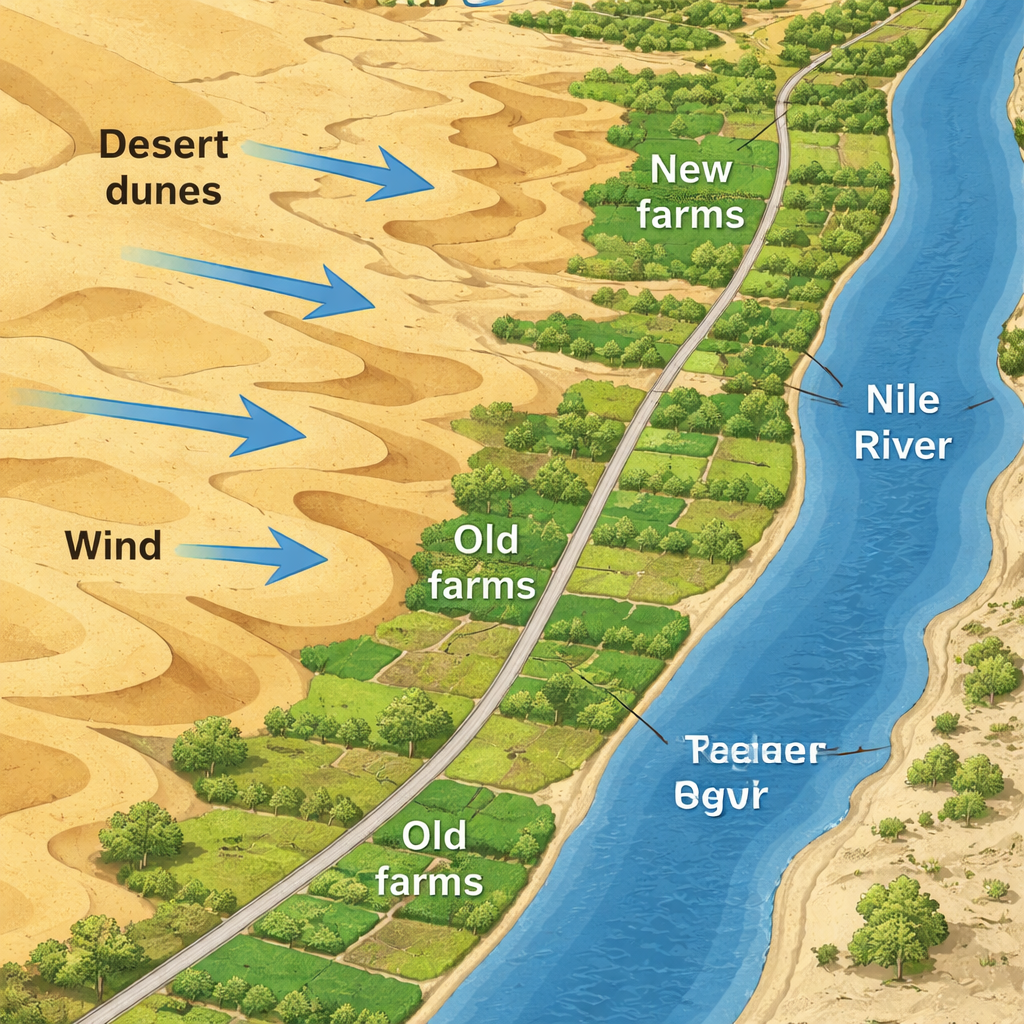
Along Egypt’s Nile River, green fields and villages sit side by side with some of the world’s largest deserts. This paper shows how shifting sand dunes are steadily invading those narrow fertile strips in West El-Minya, a key farming region on the western Nile riverbank. As the dunes creep forward, they bury crops, clog canals, and cut roads—threatening food supplies, local livelihoods, and the habitability of entire communities.
A Narrow Lifeline Under Pressure
Egypt’s population depends on a thin ribbon of arable land along the Nile; more than 90% of the country is desert, and only a few percent is truly habitable. To keep pace with a fast-growing population, Egypt has launched large projects to reclaim new farmland in the Western Desert, including West El-Minya. But this study finds that these very new fields are being built in the direct path of migrating sand dunes. The dunes, driven by strong seasonal winds, can move several meters each year and now threaten both long-established farms and newly reclaimed lands, as well as key roads and irrigation canals.
Measuring Where Sand Will Strike Next
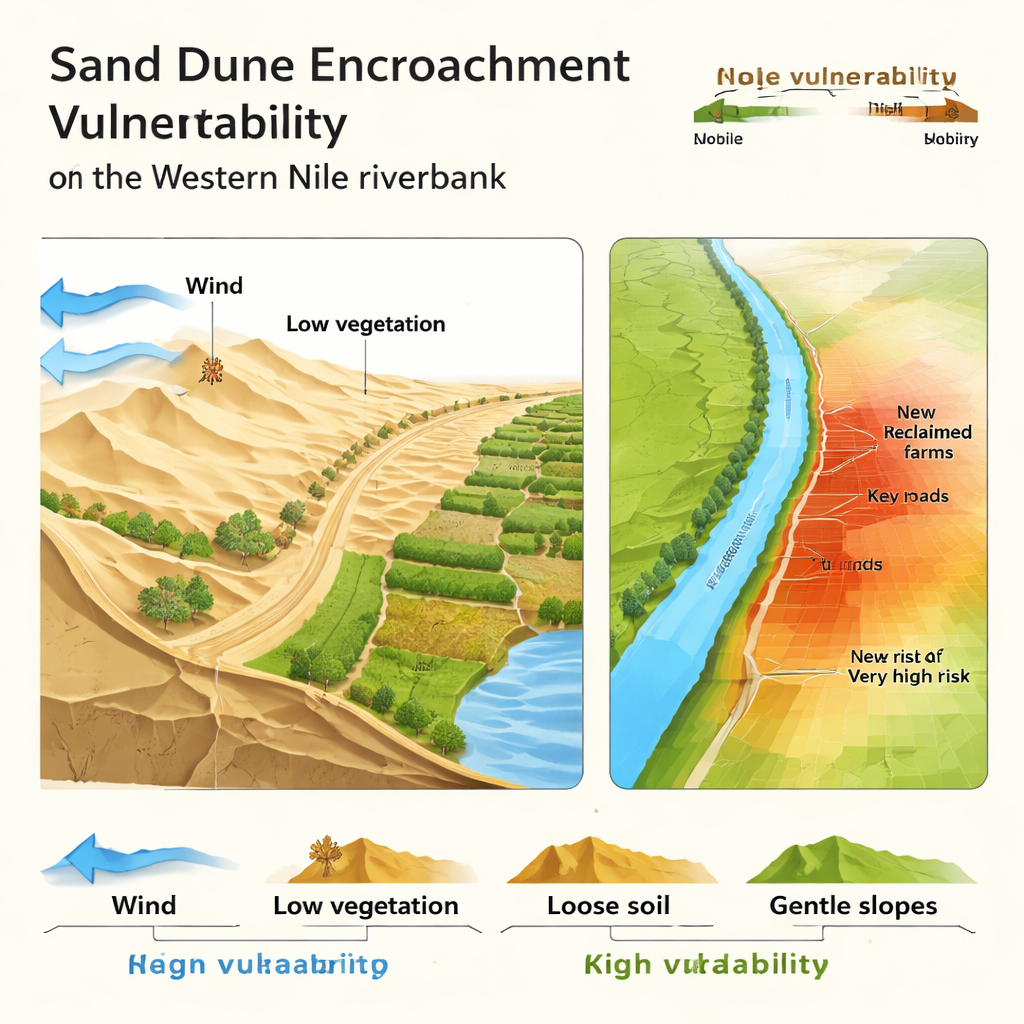
The researchers used satellite data and computer-based mapping tools to build a “vulnerability index” for sand encroachment, known as SDEVI. Instead of looking at sand movement in just a few locations, they combined seven factors over the entire landscape: wind speed and direction, ground elevation and slope, land use, vegetation cover, and how tightly soils hold together. Each factor was scored from very low to very high risk, then added up to pinpoint areas where dunes are most likely to advance. This approach allowed them to see not only where sand is moving now, but where it is poised to threaten farms, roads, canals, and villages in the near future.
The Cost of Letting Sand Take Over
The vulnerability map reveals a striking pattern: agricultural soils with poor irrigation and little vegetation, especially where they border bare sand, are the most exposed. About 14% of all cultivated land in the El-Minya governorate—more than thirty thousand hectares—is already affected by dune encroachment. The authors estimate that this buried or damaged cropland translates into roughly 263 million U.S. dollars in lost harvests each year. New agricultural projects fare even worse: around 42% of recently reclaimed land lies in zones of very high vulnerability, with expected yield drops of about one quarter and rehabilitation costs approaching 52 million dollars annually. Critical infrastructure is also under siege. Highways that connect Cairo to Upper Egypt require about 6.5 million dollars per year in sand removal, while the Bahr Youssef irrigation canal faces rising sediment loads that degrade water quality and add over 31 million dollars a year in dredging costs.
Turning a Growing Risk Into an Opportunity
To test whether it is better to endure these ongoing losses or to fight back, the authors carried out an economic analysis of different mitigation strategies. They focused on “nature-based” measures that reshape and stabilize dunes rather than simply pushing sand aside. Releveling dune fields and converting them into arable land, combined with planting trees, shrubs, and grasses as windbreaks, emerged as especially promising. Although these actions require an upfront investment of about 9,500 dollars per hectare, the study shows that they can pay for themselves in just over a year by preventing the average 8,000 dollars per hectare in annual crop losses. Over a decade, the net gains for West El-Minya alone could reach billions of dollars, while also safeguarding transport links, irrigation canals, and cultural sites.
Keeping Desert Towns Livable
For non-specialists, the core message is clear: if left unchecked, migrating dunes in West El-Minya will steadily erase farmland, strain Egypt’s food supply, and push rural families to move elsewhere. Yet the same analysis that sounds this alarm also points to practical solutions. By mapping where sand is most likely to advance, planners can target dune leveling, planting, and protective fencing to the places where they will save the most land and money. Done at scale, these measures could help keep desert-edge communities habitable, reduce the risk of displacement and conflict, and offer a blueprint for other North African regions grappling with a moving desert.
Citation: Taha, M.M.N., Heggy, E., Ali, R.R. et al. Growing dune encroachment threatens the habitability of the western Nile riverbank. Sci Rep 16, 3253 (2026). https://doi.org/10.1038/s41598-026-35048-w
Keywords: sand dune encroachment, Nile riverbank agriculture, desertification, land reclamation Egypt, nature-based dune stabilization