Clear Sky Science · en
Employing artificial intelligence to predict δ¹⁸O and δ²H isotope ratios in precipitation in Iraq under changing climate patterns
Why Rain’s Hidden Fingerprints Matter
In dry countries like Iraq, every drop of rain counts. But rain does more than fill rivers and reservoirs—it carries a chemical “fingerprint” that reveals where the water came from, how the clouds formed, and even how the climate is changing. This study shows how modern artificial intelligence can read those fingerprints and turn routine weather data into powerful clues for managing scarce water resources in a warming world.
Water’s Secret Signatures
Rainwater is made of more than just H₂O. Tiny variations in the types of oxygen and hydrogen atoms—called stable isotopes—act like natural tracers. Two of the most useful are known as δ¹⁸O and δ²H. Their values shift with temperature, storm paths, altitude, and evaporation, giving scientists insight into where water originated and how it moved through the atmosphere and landscape. Traditionally, measuring these isotopes requires specialized lab equipment and careful sampling, which can be expensive and hard to maintain over large regions and long time periods.
Tracking Rain Across a Varied Landscape
Iraq provides a natural laboratory for this work because its climate ranges from cool mountains in the north and northeast to hot, dry deserts and lowland plains in the center and south. More than 70% of the country is arid or semi-arid, and rainfall can differ sharply from one region to another. To capture this diversity, the researchers drew on data from 34 meteorological stations spread across the country over 14 years, from 2010 to 2024. These stations supplied isotope measurements along with everyday weather readings such as rainfall amount, air temperature, relative humidity, and elevation. Together, they formed a rare long-term picture of how climate and geography shape the isotopic makeup of rain in Iraq. 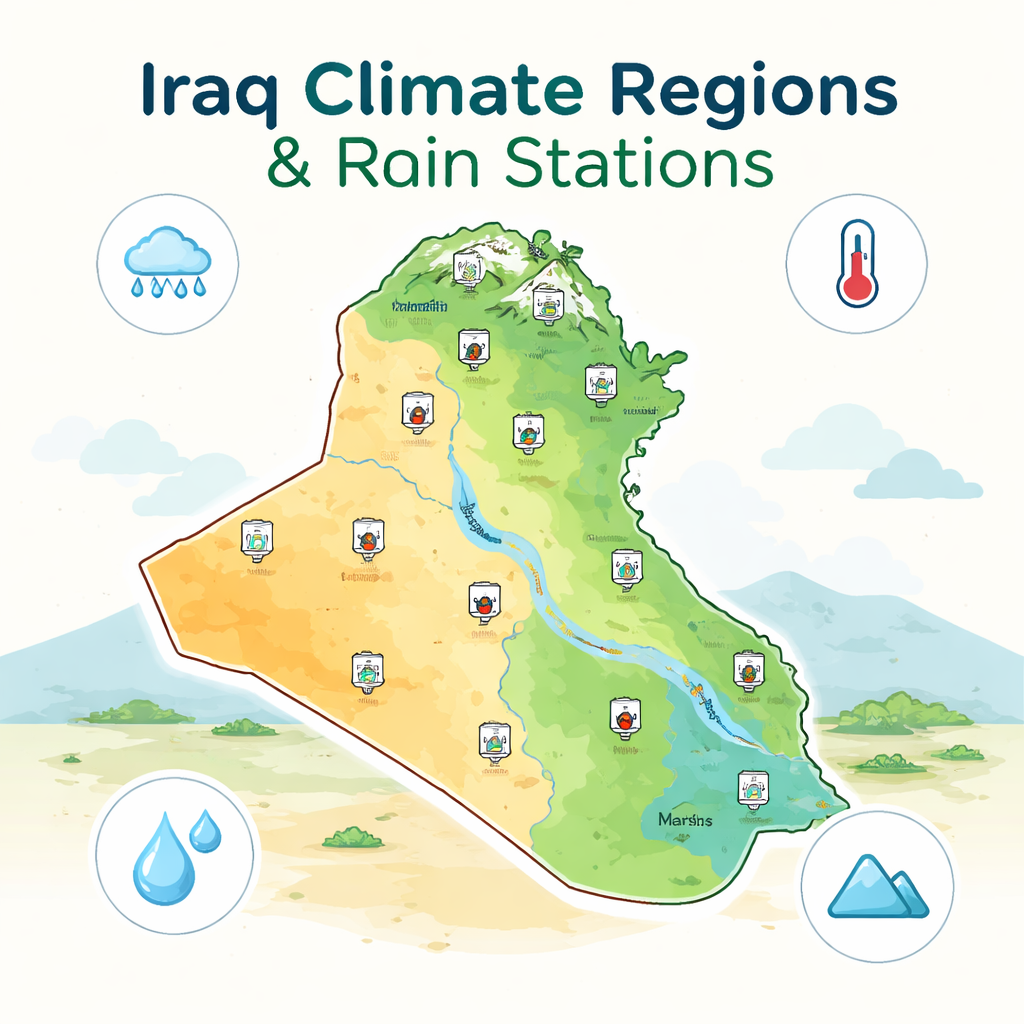
Teaching Machines to Read the Rain
Instead of relying only on laboratory measurements, the team asked a new question: can artificial intelligence learn to predict δ¹⁸O and δ²H using just standard weather data? They tested six popular machine learning methods, including support vector machines, neural networks, gradient boosting tools, and a technique called random forest, which builds many decision trees and averages their results. The dataset was split into training and testing groups, and the researchers used a careful strategy called data augmentation—adding small, realistic variations to the inputs—to help the models generalize better to new conditions rather than simply memorizing the original numbers.
The Standout Model and What It Learned
Among all the approaches, the random forest model clearly came out on top. It explained about 90% of the variation in isotope values and kept prediction errors relatively low, far outperforming simpler methods like support vector machines. When the model’s predictions were plotted against actual isotope measurements, the points lined up closely along the ideal one-to-one line, showing that the system was capturing the essential behavior of the rainfall isotopes. The model also revealed which weather factors mattered most: the amount of rain and air temperature were the strongest influences, followed by elevation and relative humidity. These rankings fit well with physical understanding of how raindrops form, fall, and evaporate in different climates. 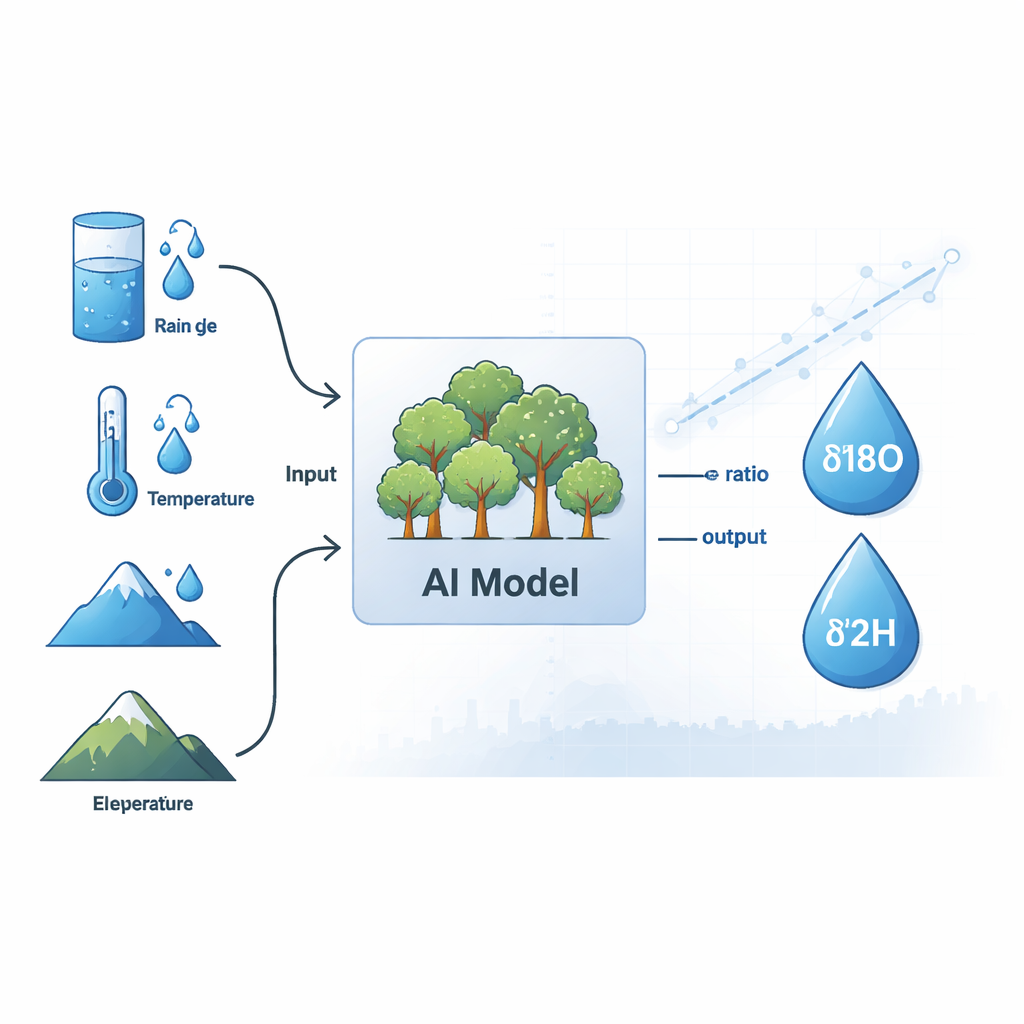
From Computer Code to Real-World Water Decisions
By proving that isotope ratios can be estimated reliably from routine weather data, this study opens the door to building dense, continuous maps of rainfall fingerprints across Iraq—even in places or years where no isotope samples were collected. Such maps can help scientists trace how rainwater seeps into aquifers, feeds rivers, or is lost to evaporation, and they provide valuable clues about how climate change is reshaping the water cycle. For decision-makers in arid and semi-arid regions, AI-based models like this one offer a practical and affordable way to support long-term water planning, protect supplies, and better understand how today’s storms will shape tomorrow’s resources.
Citation: Maliki, A.A., Al-Naji, A., Lami, A.K.A. et al. Employing artificial intelligence to predict δ¹⁸O and δ²H isotope ratios in precipitation in Iraq under changing climate patterns. Sci Rep 16, 1296 (2026). https://doi.org/10.1038/s41598-026-35047-x
Keywords: rainfall isotopes, artificial intelligence, water resources, Iraq climate, random forest