Clear Sky Science · en
The influence of solar PV panels on CO dispersion in ideal 2D street canyons
Why Rooftop Solar Can Also Clean the Air
City streets often feel like deep corridors walled in by tall buildings. Exhaust from cars can linger in these "street canyons," harming the health of people who live and walk there. This study asks a surprising question: if we cover roofs with solar panels to make clean electricity, can those panels also help sweep traffic pollution out of the streets below?
Street Canyons and Trapped Car Exhaust
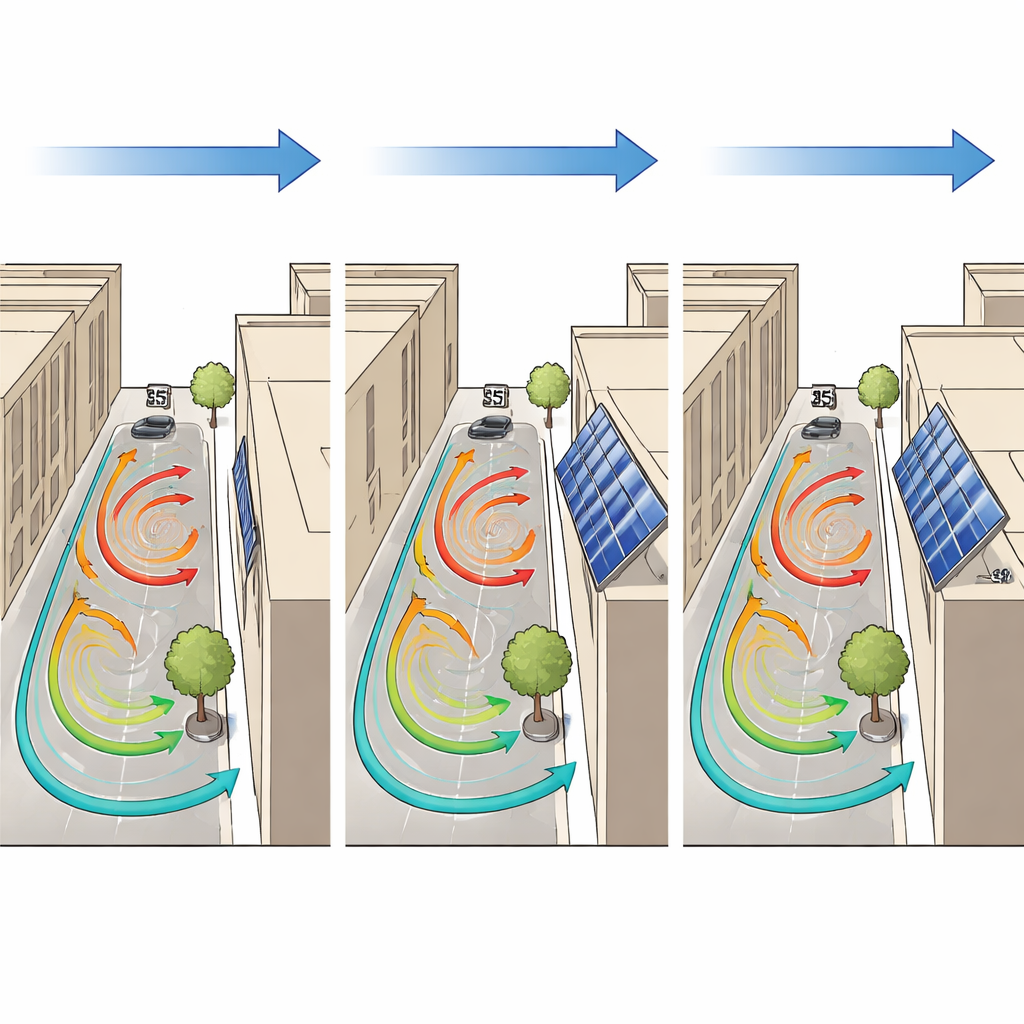
When wind blows across a row of buildings, it curls down into the gap between them and creates a large, slow-moving whirl of air. That whirl tends to push car exhaust, such as carbon monoxide, toward one side of the street and keep it close to the ground. In many busy cities, this means that even if overall air quality is improving, people at sidewalk level can still breathe high levels of fumes for hours each day.
Using Computer Models as a Virtual Wind Tunnel
To explore how rooftop solar might change this picture, the researcher built a detailed computer simulation of an idealized two-dimensional street canyon. The buildings on both sides and the road between them were all the same height and width, simplifying the real world so that the role of the solar panels could be isolated. A thin line source on the street released carbon monoxide, standing in for car traffic, while a steady wind blew across the roofs, at right angles to the street. The study used a well-tested type of airflow model that has been extensively compared with wind-tunnel experiments, giving confidence that the virtual results are physically realistic.
Tilting the Solar Panels to Steer the Wind
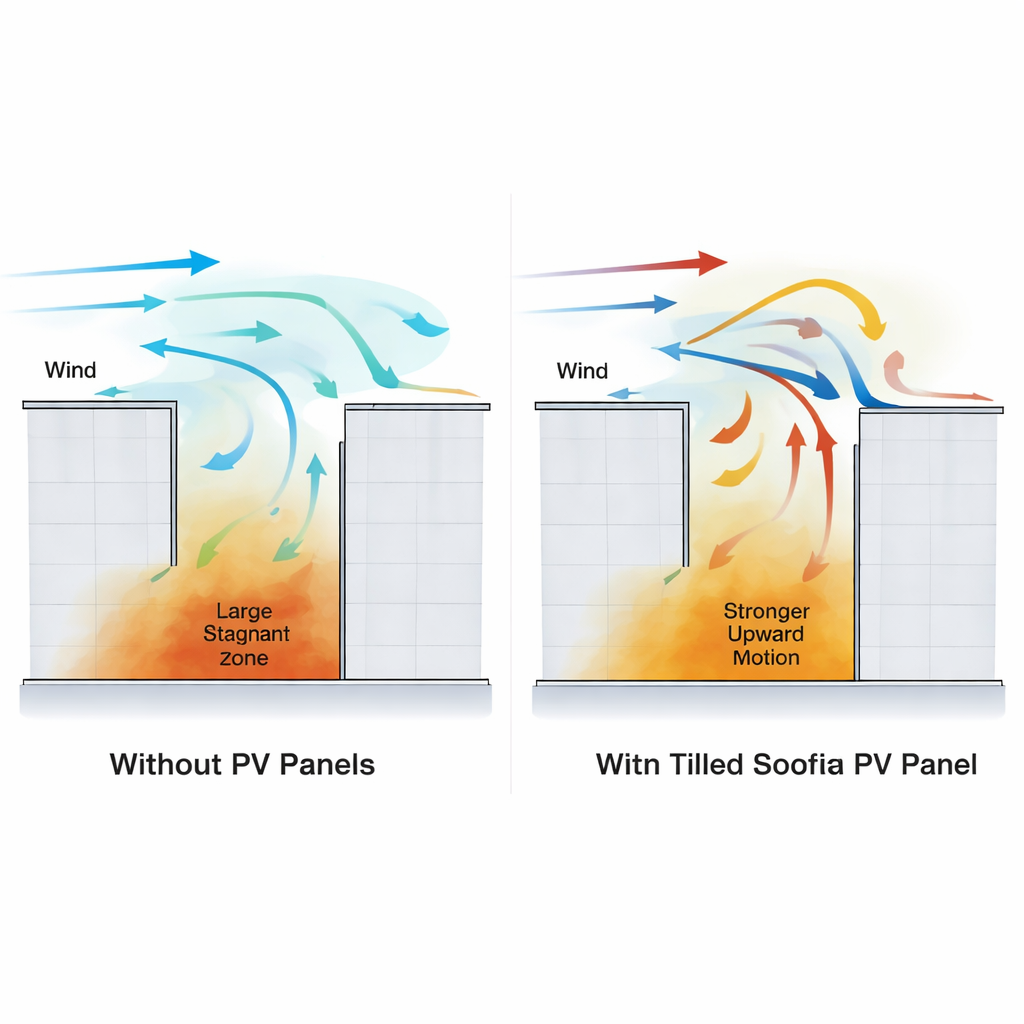
The key experiment was to place solar panels on the downwind building’s roof and tilt them at three different angles: 30°, 45°, and 60°. Compared with a flat roof with no panels, adding panels changed both wind speed and the shape of the air whirl in the canyon. At a 30° tilt, air sped up as it flowed over the panel and then formed a low-pressure region just behind it. This combination pulled more air up and out of the canyon, shrinking the slow, stagnant zone in the middle and near the ground. As the tilt angle increased to 45° and then 60°, the vertical height and "frontal area" of the panel became smaller, the low-pressure region shrank, and the beneficial effect on the wind weakened.
Less Pollution in the Canyon and Near People
These changes in airflow translated into noticeable differences in pollution. Across the whole canyon, average carbon monoxide levels dropped by 21.7 percent with a 30° tilt, nearly 20 percent with 45°, and about 14 percent with 60°, compared with no panels. The worst pollution always occurred on the downwind wall, where the main air whirl drives exhaust and smaller corner eddies trap it. Here again, the 30° panels performed best, giving the lowest concentrations at the building surface and at a typical pedestrian height of 15 centimeters above the road in the scale model. Even though panels slightly reduced mixing right at the roof edge, this drawback was outweighed by the stronger upward flow that carried more pollution out of the canyon.
What This Means for Future City Streets
In simple terms, thoughtfully angled rooftop solar panels can do double duty. Besides generating clean electricity, they can nudge the wind in ways that help flush car exhaust from narrow streets. In this idealized setup, a 30° tilt gave the best balance, boosting airflow and cutting average pollution in the canyon by more than one-fifth. Real cities are more complex than this two-dimensional model, but the study shows that small design choices on rooftops can have a measurable impact on the air that pedestrians breathe, offering urban planners a new reason to pay attention to how solar panels are installed.
Citation: Guang-Xing, H. The influence of solar PV panels on CO dispersion in ideal 2D street canyons. Sci Rep 16, 4745 (2026). https://doi.org/10.1038/s41598-026-35045-z
Keywords: urban air pollution, street canyon, rooftop solar panels, wind flow, pollutant dispersion