Clear Sky Science · en
Fracture behavior of Ti-6Al-4V in the extreme thermo-mechanical environment of fan blade-out
When a Jet Engine Throws a Blade
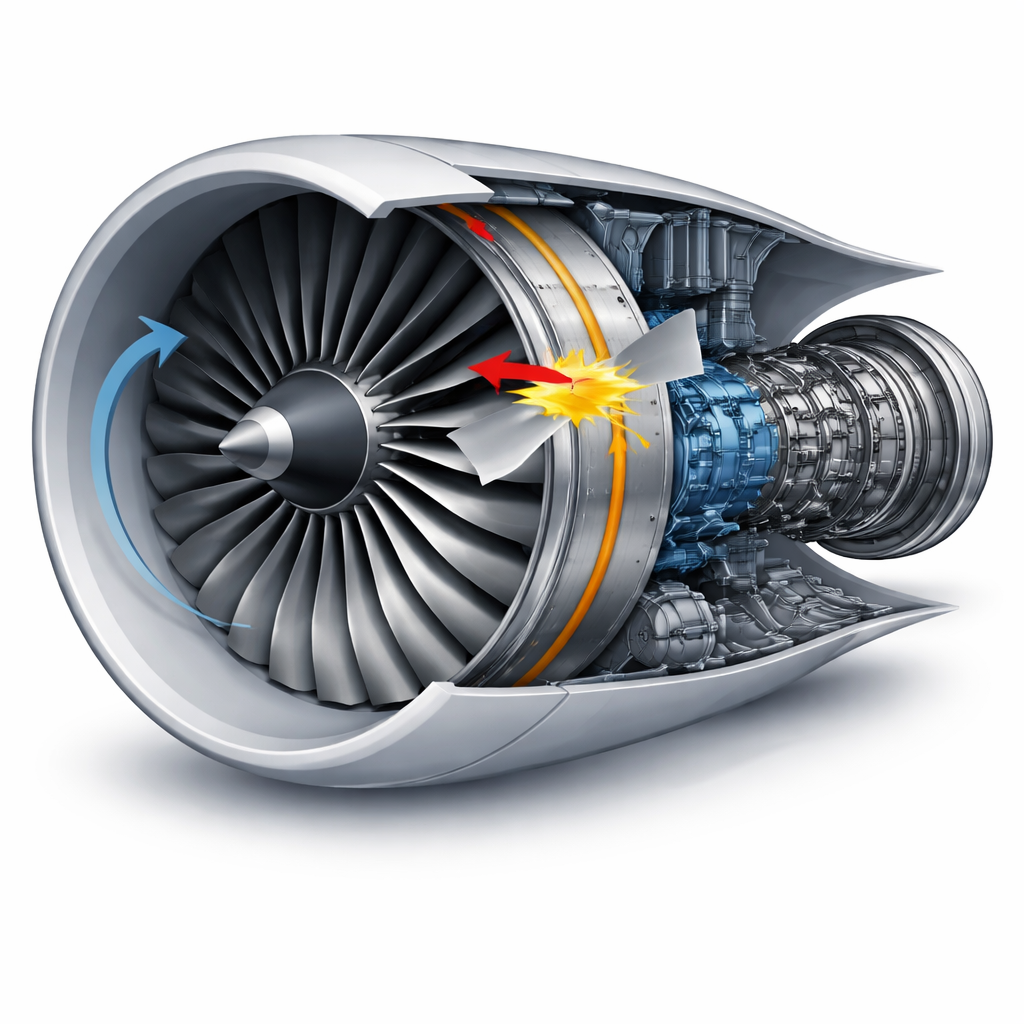
Modern passenger jets are designed to keep flying safely even if a fan blade inside the engine suddenly breaks off and slams into the engine’s outer shell. This dramatic scenario, known as a fan blade-out event, is rare but potentially catastrophic if metal fragments break through the casing and strike the airplane’s body or fuel lines. The study summarized here uses advanced computer simulations to understand exactly how a widely used titanium alloy deforms and cracks under these extreme conditions, so that future engines can be both lighter and safer.
The Hidden Shield Around the Fan
Behind the smooth engine cover you see from your airplane window sits a thick metallic ring called the containment case. Its job is simple but demanding: if a fan blade snaps off at high speed, the ring must absorb the impact and stop the fragment from escaping. Regulations from aviation authorities in the United States and Europe require that engines prove they can do this. Full-scale tests, however, are enormously expensive and difficult to repeat, so engineers rely heavily on detailed computer models to predict what will happen when a blade strikes the casing. This work focuses on Ti-6Al-4V, a titanium alloy commonly used for these rings, and on how its internal state of stress and damage evolves during a blade-out event.
Simulating Extreme Heat and Impact
The researchers built a high-fidelity digital model of a large turbofan engine, conceptually similar to those that power modern airliners. They represented the fan, the detached blade, and the titanium containment ring with hundreds of thousands of finite elements—tiny blocks that approximate the metal’s behavior. To describe how the alloy responds when it is stretched, heated and hit at thousands of times per second, they used a widely adopted mathematical description called the Johnson–Cook model. This model was carefully tuned using real laboratory data so that it could reproduce how the metal hardens with increasing loading rate, softens at high temperatures, and eventually cracks.
What Changes When the Fan Spins Faster
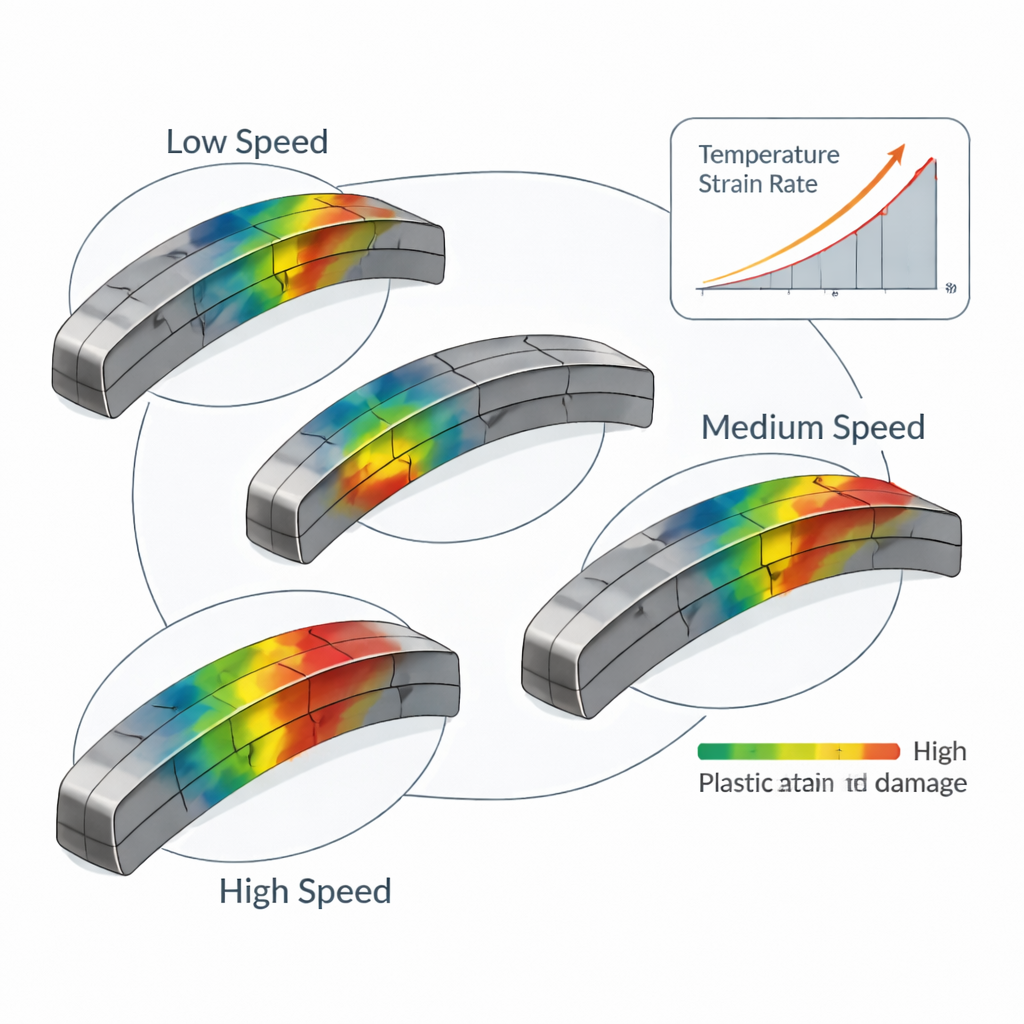
With this setup, the team simulated blade failures at several rotation speeds ranging from moderate to very high, and then a final, extreme case that forced the ring to fracture. As the fan spun faster, the released blade carried more kinetic energy and traveled farther along the inner surface of the ring, leaving behind a longer path of permanent deformation. In the titanium, local stretch levels became very large and were accompanied by intense stress waves that rippled through the structure. The simulations showed that areas near the impact site experienced incredibly high loading rates—thousands to tens of thousands of strain cycles per second—which in turn generated heat, driving local temperatures above 900 °C in some spots.
From Tearing to Shearing: How the Metal Fails
One of the central findings concerns the way the failure mechanism changes as impact energy rises. At lower rotation speeds, the most damaged regions of the ring were under a tensile state, meaning the metal was being pulled apart. In this regime, tiny internal voids grow and link up, producing a tearing-type fracture. At higher speeds, the critical regions instead experienced a strongly shearing state, where layers of material slide past each other and narrow shear bands form. This marks a fundamental shift from tension-driven to shear-driven failure within a single type of event, depending mainly on fan speed. The numerical results also revealed that by the time the material’s damage index approached about two-thirds of its failure value, the local load-carrying capacity had already been severely compromised, even though a full crack had not yet formed.
Pushing Models Beyond Their Comfort Zone
In the most extreme simulation, the containment ring finally split. Here the conditions—very high temperature, very high loading rate, and specific mixed stress states—went beyond those used to calibrate the Johnson–Cook model in laboratory tests. The predicted fracture still followed clear physical trends: higher speeds led to stronger heating, more softening, faster stretching, and ultimately failure. Yet the study shows that, without test data taken under these combined conditions, any numerical prediction of the exact moment and place of fracture carries significant uncertainty. In other words, the model can tell us how and where the ring is likely to fail, but its numerical safety margins are less reliable when pushed far outside the tested range.
What This Means for Safer, Lighter Engines
For non-specialists, the key message is that today’s computer tools can capture many of the violent details of a fan blade-out event, but they are only as trustworthy as the experimental data used to build them. This work clarifies how the titanium ring evolves from safe deformation to near-failure and finally to full fracture, and it highlights a speed-dependent shift between two very different ways the metal can break. The authors argue that to design the next generation of lighter yet damage-tolerant engines, researchers must perform new experiments that mimic the true combination of heat, extreme loading speed, and complex stress states found in real blade-out events. Such data will tighten the link between simulation and reality, improving both safety certification and engine efficiency.
Citation: Tuninetti, V., Beecher, C., Arcieri, E.V. et al. Fracture behavior of Ti-6Al-4V in the extreme thermo-mechanical environment of fan blade-out. Sci Rep 16, 4962 (2026). https://doi.org/10.1038/s41598-026-35044-0
Keywords: fan blade-out, titanium alloy, aeroengine safety, fracture mechanics, finite element simulation