Clear Sky Science · en
Hybrid optimization algorithm for solving path planning problems based on grey wolf optimization algorithm
Smarter Routes in Crowded Cities
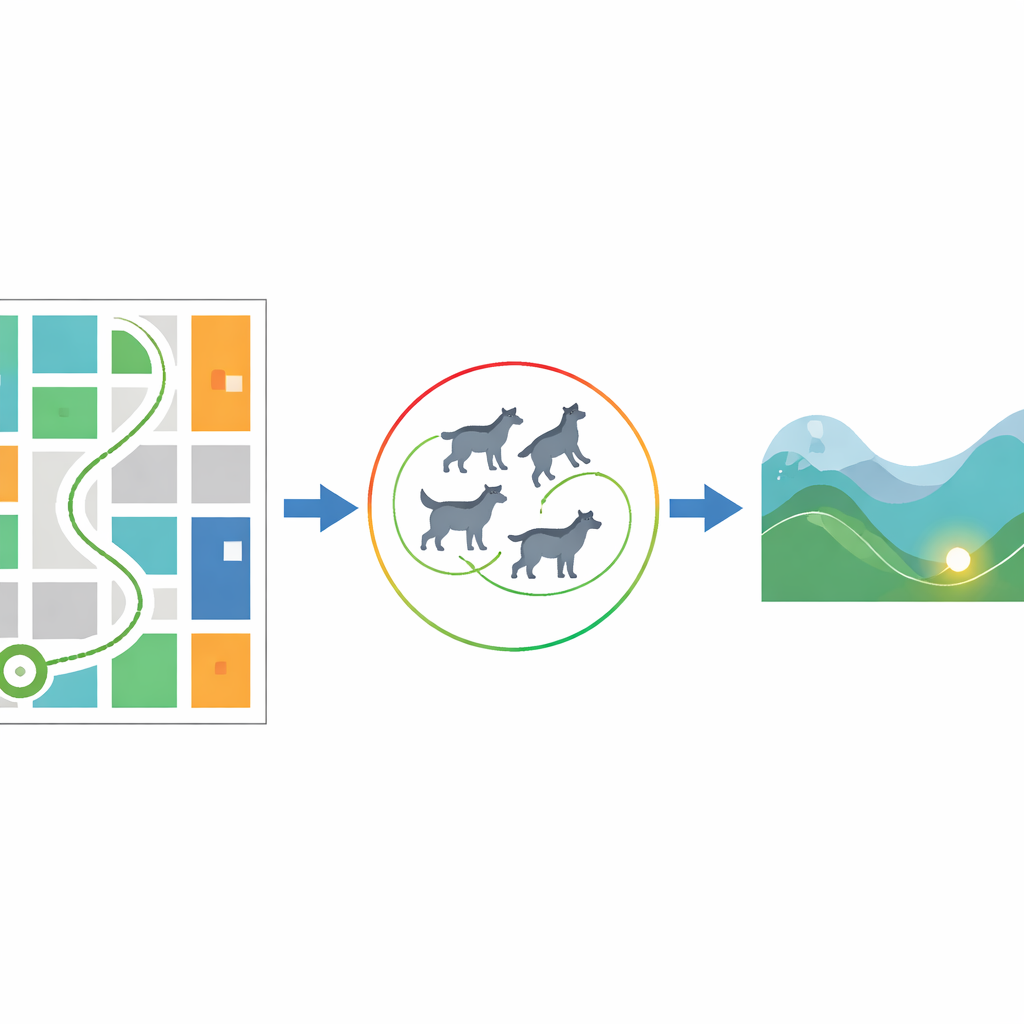
Every day, drivers, delivery vans, and robots all face the same challenge: how do you get from A to B quickly, safely, and without wasting fuel or time? This paper presents a new computer method that plans shorter, smoother routes through complex street networks packed with obstacles and congestion. By borrowing ideas from how grey wolves hunt in packs and how prospectors search for gold, the authors show how to steer vehicles and robots more efficiently through busy urban environments.
Why Better Paths Matter
As cities grow and traffic thickens, even small improvements in routing can translate into big savings in time, energy, and pollution. Traditional path-finding methods can work well when the map is simple, but they often slow down or get stuck when the environment is cluttered with many possible turns and barriers. Modern "intelligent" search methods try to imitate nature—such as flocks of birds or colonies of ants—to explore many options at once and settle on good solutions. One such method, called the grey wolf optimization algorithm, has become popular because it is simple and flexible, but it still suffers from three main problems: it can get trapped in second-best routes, it may converge too early, and it does not always search the whole map thoroughly.
Mixing Wolves, Chaos, and Gold Hunters
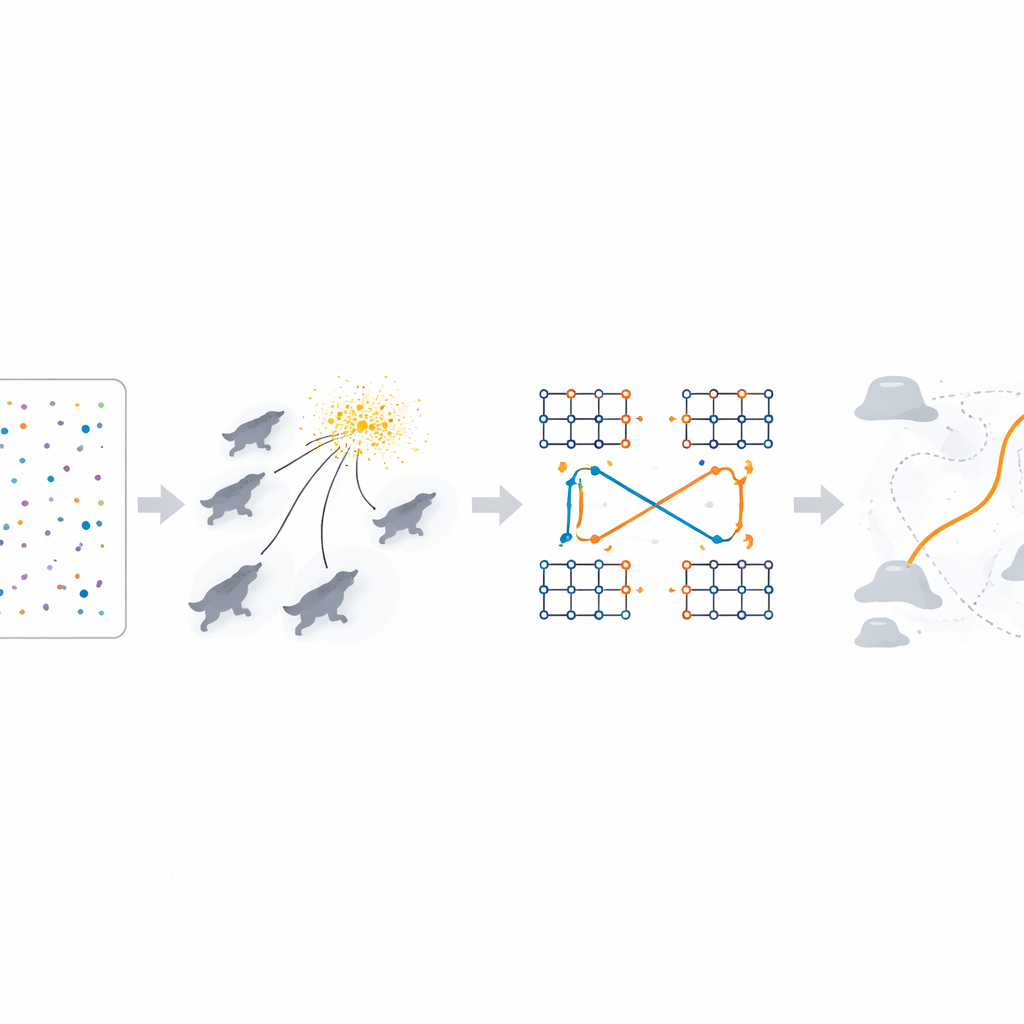
To overcome these weaknesses, the authors design an improved version they call CGGWO. It keeps the basic idea of a pack of virtual grey wolves that search for the best route, but changes how the pack spreads out and learns. First, instead of placing the wolves at random starting points, the method uses a mathematical trick called chaotic mapping to scatter them more evenly across the search area. This increases the chance that at least some wolves will discover promising regions of the map. Next, the method borrows a rule from another technique inspired by gold prospectors. Here, the leading "alpha" wolf is nudged toward especially rich regions of the search space, much like miners gradually shifting toward areas with more gold. This step injects controlled randomness and variety, helping the pack escape poor local choices.
Clever Crossing and Gentle Shaking
CGGWO then adds two kinds of "criss-cross" moves that shuffle information among the wolves. In the horizontal move, two different candidate paths trade parts of their routes, shrinking blind spots and encouraging the search to cover the map more completely. In the vertical move, different sections within a single path mix with each other, which can revive stagnant portions of the solution and prevent the pack from freezing too early on a flawed route. Finally, a gentle dose of Gaussian mutation—small, random nudges guided by how well each wolf is doing—keeps the pack exploring. If a wolf’s route is worse than average, it receives a stronger shake, which helps the whole group avoid being trapped in one corner of the solution landscape.
Putting the New Method to the Test
The researchers first test CGGWO on 23 standard mathematical puzzles that are widely used to judge search algorithms. These puzzles range from smooth landscapes with a single best valley to rough terrains pitted with many local low points. Across most of these tests, CGGWO finds better answers, converges faster, and shows more stable behavior than several well-known competitors, including the original grey wolf method, particle swarm optimization, and genetic algorithms. The team then turns to a realistic path planning problem based on a simplified street grid near a busy commercial area in Lhasa. Obstacles represent blocked or congested sections, and the aim is to connect a start and end point with a short, smooth route that avoids them.
Shorter, Smoother Trips
In the traffic-style test, CGGWO consistently produces shorter paths with fewer sharp turns than the other methods while requiring modest computing time. Compared with the original grey wolf algorithm and several rival techniques, its planned routes are straighter and easier to follow, reducing distance by up to about one quarter in some comparisons. For a lay reader, the takeaway is clear: by cleverly combining ideas from chaos, group hunting, and gold prospecting, the new method searches maps more thoroughly and resists getting stuck on merely good-enough solutions. That makes it a promising tool for future navigation systems, delivery robots, and other smart machines that must quickly find safe, efficient paths through the crowded, changing mazes of modern cities.
Citation: Cheng, G., Liu, Y. Hybrid optimization algorithm for solving path planning problems based on grey wolf optimization algorithm. Sci Rep 16, 8479 (2026). https://doi.org/10.1038/s41598-026-35037-z
Keywords: path planning, optimization algorithm, intelligent transportation, swarm intelligence, robot navigation