Clear Sky Science · en
Morphological and genetic diversity of breeding clones derived from Hippeastrum × chmielii
New Life for a Beloved Holiday Flower
Many people know amaryllis as the spectacular bulb that erupts into huge red trumpets on a windowsill in winter. Behind those showy blooms lies a quiet breeding race to create plants with even more striking colors, bigger flowers, and better performance in pots and vases. This study from Polish researchers peeks behind the curtain, showing how careful crossing and DNA analysis can turn an older, underused line of Hippeastrum into a source of fresh, market-ready varieties.
From Modest Ancestor to Showpiece Blooms
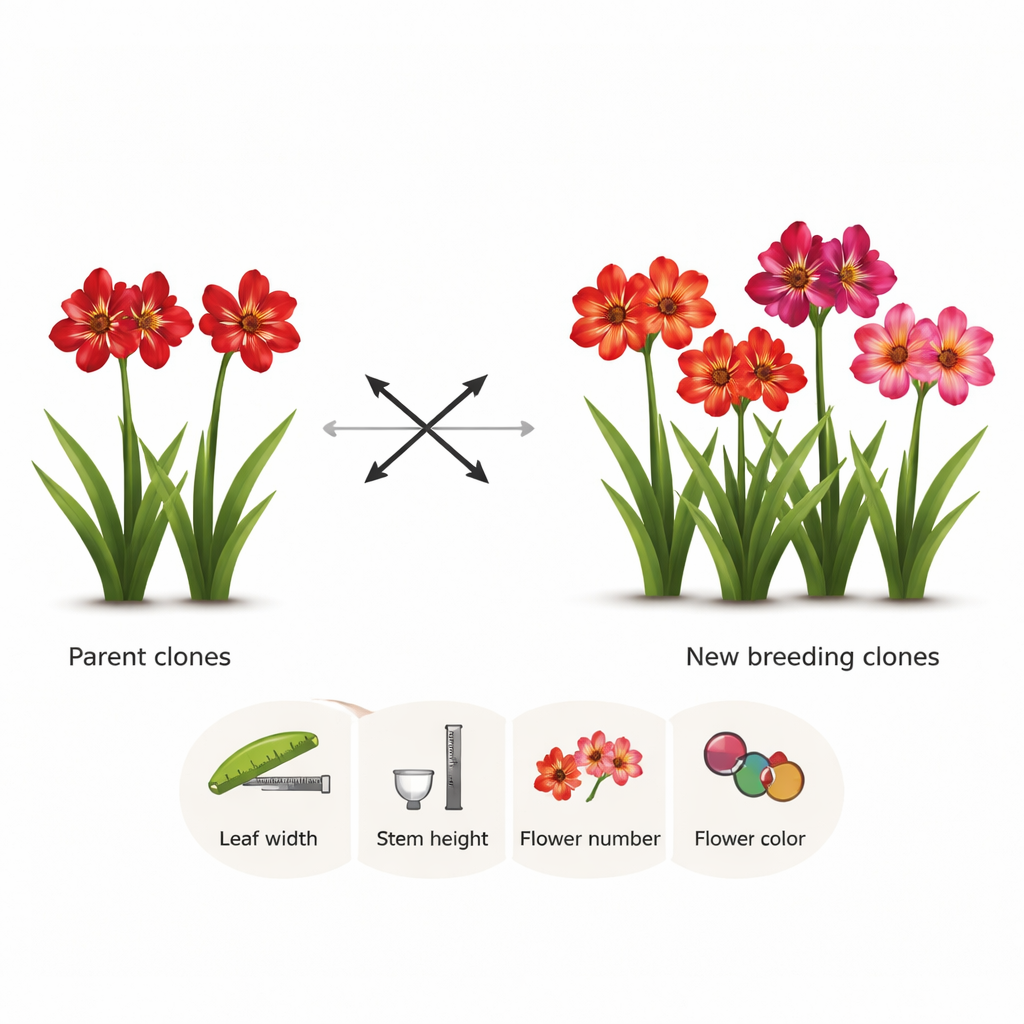
The work centers on a special hybrid called Hippeastrum × chmielii, created in Warsaw in the 1990s. These plants had many practical virtues: they grew vigorously, skipped the usual dormant period, flowered more than once a year, and multiplied bulbs quickly. Their main weakness was aesthetic—flowers that were too small to excite commercial growers. Decades later, the team revisited this forgotten resource. They crossed two old H. × chmielii clones with three modern, large-flowered Hippeastrum cultivars, then closely examined 15 resulting “breeding clones” to see which combined beauty with robust growth.
Measuring Beauty: Size, Shape, and Color
To judge the new plants, the scientists relied on international guidelines used to register new ornamentals. They measured leaf width, stem (peduncle) height, the number of flowers per stalk, and both the length and width of the flower segments (the perianth). They also scored flower shape—round, triangular, or star-like—and matched colors using the Royal Horticultural Society color charts. Many of the new clones produced flowers as wide as, or wider than, popular commercial cultivars and clearly larger than the old H. × chmielii parents. About half of the plants reached the prized “Galaxy” size class (flowers over 16 cm across), while the rest fell into the slightly smaller “Diamond” class. Several clones also carried more flowers per stem, making them especially eye-catching for pot or cut-flower use.
Hidden Leaf Features and What They Reveal
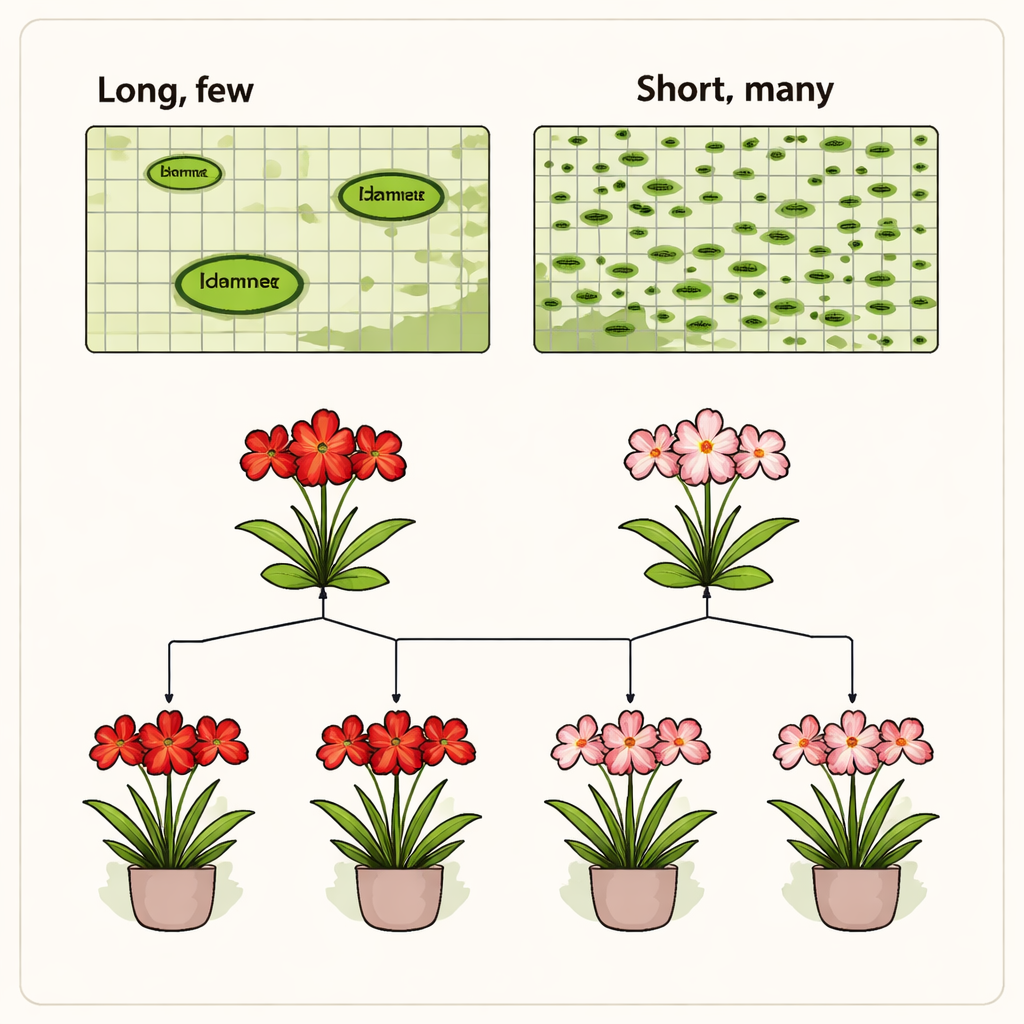
The team also looked at stomata—tiny pores on leaves that control gas exchange and water loss. Under the microscope, they counted how many stomata appeared in a given leaf area and measured their length. Across the 20 genotypes, they found a clear pattern: plants with longer stomata tended to have fewer of them, while those with shorter stomata packed many more into the same space. This strong inverse relationship hints at underlying differences in chromosome sets (ploidy levels) and may offer breeders a quick, low-cost way to distinguish types or spot polyploids without elaborate lab equipment.
Reading the DNA to Map Family Ties
Beyond looks and leaf pores, the study probed genetic relationships using two common DNA fingerprinting methods, known as RAPD and ISSR markers. These techniques generate characteristic band patterns on a gel, which can be compared across plants. The resulting data showed that the parental lines and their breeding clones shared a moderate but meaningful level of similarity—roughly 74–85 percent. When the researchers built a family tree from these patterns, the new clones clustered logically around their respective parents, confirming that the crosses were correctly recorded and that each group formed a coherent genetic line suitable for breeding and registration.
Three Rising Stars for Gardens and Florists
From this combined visual, anatomical, and genetic scrutiny, three standout clones emerged. One, labeled 0037-13, carries large beetroot-purple flowers with a green throat and white petal edges, plus more blooms per stem than its H. × chmielii mother. Two others, 0021-10 and 0023-11, inherited vivid orange-red and salmon tones with strong veining and starry shapes from their modern parents, while surpassing the old line in flower size and number. All three not only satisfy official criteria for distinct, stable varieties but also offer the color impact and flower abundance that attract buyers.
What This Means for Flower Lovers
In plain terms, this study shows how plant breeders can rescue a nearly forgotten line with good “hidden” traits and, by carefully combining it with modern varieties and checking both appearance and DNA, turn it into a source of new showpiece plants. For gardeners and florists, the outcome is simple: future amaryllis bulbs may offer even larger, richer-colored blooms that flower reliably and multiply well. For breeders, the work provides a model—blend classic and modern stock, measure both what you see and what lies in the genes, and select only those clones that shine on the windowsill and in the lab.
Citation: Marciniak, P., Zajączkowska, M., Rabiza-Świder, J. et al. Morphological and genetic diversity of breeding clones derived from Hippeastrum × chmielii. Sci Rep 16, 4950 (2026). https://doi.org/10.1038/s41598-026-35035-1
Keywords: Hippeastrum breeding, ornamental bulbs, flower color variation, plant genetic diversity, stomata traits