Clear Sky Science · en
Experimental evaluation of alumina nanoparticle additives in sunflower oil methyl ester for enhanced CI engine performance and emission control
Cleaner Fuel from Common Crops
Diesel engines power trucks, tractors, and backup generators worldwide, but they also emit harmful gases and soot. This study explores a way to make those engines run cleaner and more efficiently without changing the engines themselves. By turning sunflower seeds into biodiesel and then sprinkling in an ultra-small powder of alumina (a form of aluminum oxide), the researchers show how we might keep the convenience of diesel power while cutting pollution and fuel use.
From Sunflower Seed to Engine-Ready Fuel
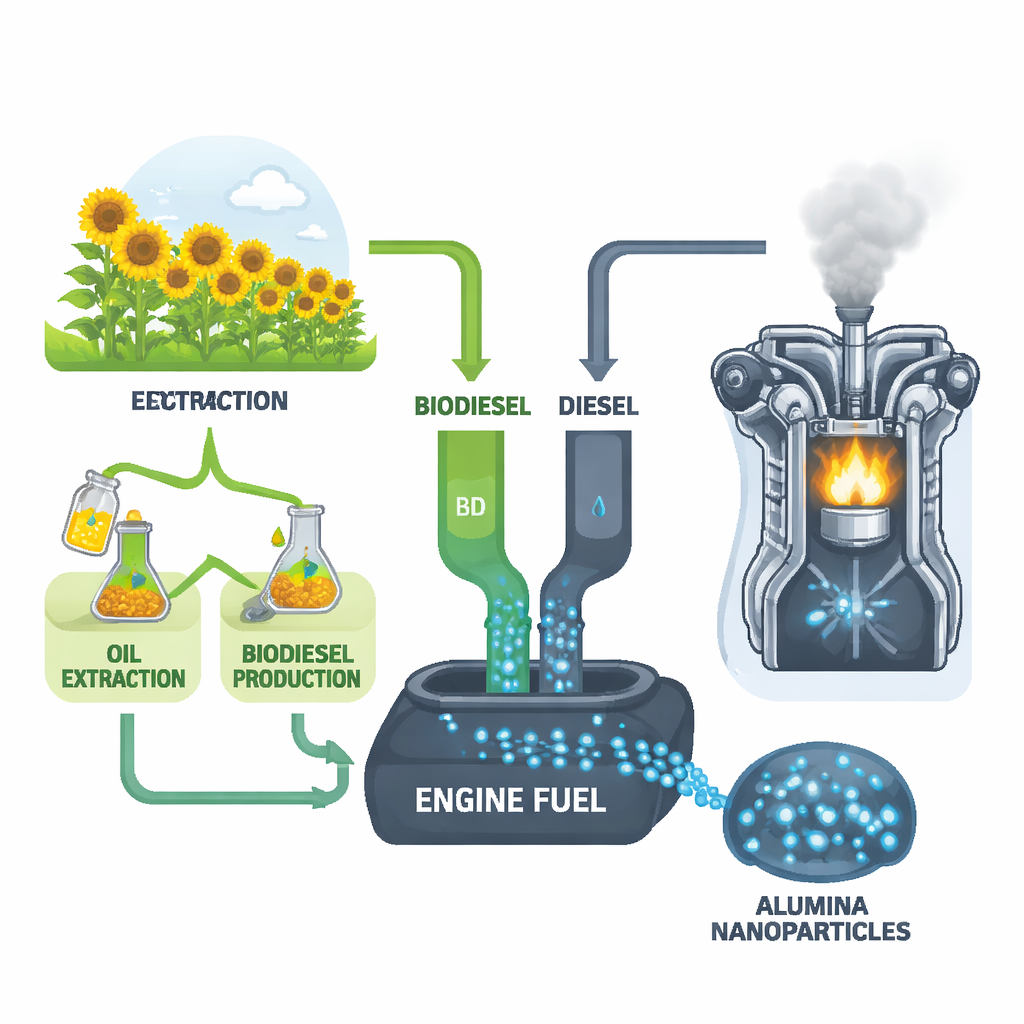
Sunflowers are more than bright garden ornaments—they are also rich in oil. The team pressed sunflower seeds from Indian farms to extract the oil, then converted it into biodiesel through a standard chemical process. This biodiesel, called sunflower oil methyl ester, was blended with regular diesel in different proportions. The most promising mix turned out to be 40% sunflower biodiesel and 60% diesel. This mid-range blend kept many of diesel’s desirable handling and combustion traits while adding the cleaner-burning nature of biodiesel.
Adding Tiny Helpers to the Fuel
On its own, biodiesel can be thicker than diesel and may not burn quite as efficiently. To address this, the researchers added an extremely small amount—just 50 parts per million—of alumina nanoparticles to the 40% biodiesel blend. These particles are tens of nanometers across, far smaller than the width of a human hair. Using mechanical stirring, ultrasound, and a small dose of a surfactant (a kind of chemical stabilizer), they created a stable mixture where the particles stayed evenly dispersed instead of clumping or settling. Measurements of the electrical charge on the particle surfaces confirmed that the nano-additive blend would remain uniform long enough for realistic storage and engine use.
Testing the Fuel in a Real Engine
The team ran a standard single-cylinder, four-stroke diesel engine at a constant speed and different load levels, first with regular diesel, then with several sunflower biodiesel blends, and finally with the nano‑enhanced 40% blend. They measured how much fuel the engine burned for each unit of power, how efficiently it converted fuel energy into useful work, and how hot the exhaust became. They also tracked key pollutants: carbon monoxide (CO), unburned hydrocarbons, nitrogen oxides (NOx), and smoke. All tests were repeated several times, and the researchers carefully accounted for measurement uncertainties to ensure the differences they observed were real and not just instrument noise.
What Changed Inside the Cylinder
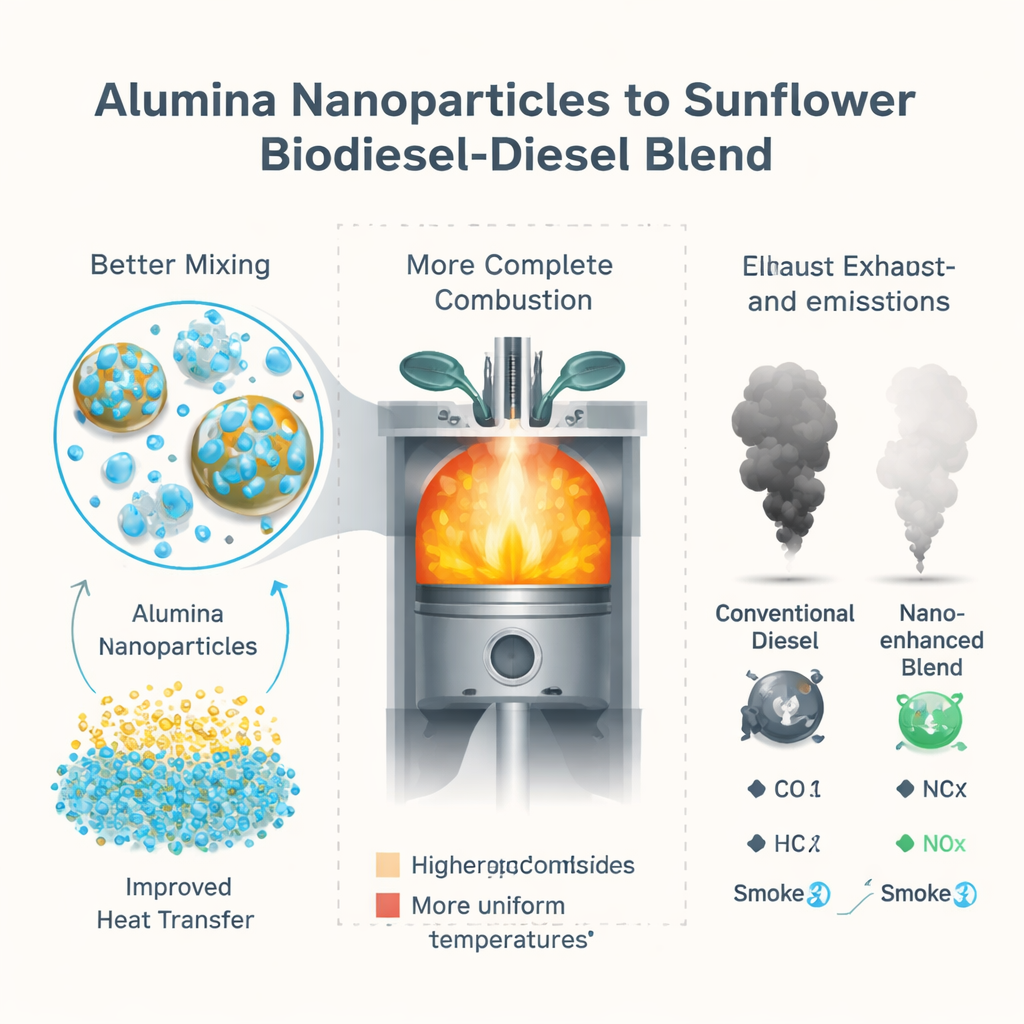
With the nano‑enhanced blend, the engine burned fuel more completely and more evenly. The rate at which heat was released during combustion increased, and in‑cylinder pressure rose slightly, both signs of more effective burning. Brake thermal efficiency—the share of fuel energy turned into useful shaft power—went up by about 5% compared with the same fuel without nanoparticles, and the fuel needed per unit power dropped by about 1.5%. Although standard diesel still had a small edge in efficiency, the gap narrowed substantially. Exhaust temperature rose moderately, which the authors interpret as a sign that more of the fuel energy was released inside the cylinder rather than being lost as unburned products.
Cleaner Exhaust Without Rebuilding Engines
Perhaps most important for everyday life, the nano‑enhanced sunflower blend clearly reduced emissions. Compared with the plain 40% biodiesel blend, CO dropped by roughly a quarter, unburned hydrocarbons by about 15%, NOx by about 13%, and smoke by about 16%. Against pure diesel, the improvements were even larger: around 25% less NOx and more than 27% less smoke, with noticeable cuts in other pollutants as well. The authors attribute these gains to the nanoparticles’ high surface area and heat-carrying ability, which improve fuel atomization, speed up oxidation, and smooth out hot spots that tend to form soot and NOx. To a non-specialist, the takeaway is straightforward: by combining a common crop-based fuel with a pinch of engineered nano‑powder, this work points to a practical, drop‑in replacement for part of our diesel use that could make engines run cleaner and a bit more frugally, using resources that are renewable and widely available.
Citation: Chohan, J.S., Prakash, K., Vijay, P. et al. Experimental evaluation of alumina nanoparticle additives in sunflower oil methyl ester for enhanced CI engine performance and emission control. Sci Rep 16, 4789 (2026). https://doi.org/10.1038/s41598-026-35034-2
Keywords: biodiesel, nanoparticles, diesel engine, emissions, sunflower oil