Clear Sky Science · en
Lifetime existence of a core of mutualistic symbionts and functionally uncoupled taxa in the gut of a Mediterranean cohort
Why Your Gut’s Tiny Tenants Matter as You Age
Deep inside our intestines lives a bustling community of microbes that help us digest food, train our immune system, and may even influence our mood. But how stable is this inner ecosystem as we move from childhood to old age? This study followed people in a Mediterranean region over several years to see which microbes stick with us for life, which come and go, and how some of their helpful activities may fade with age.
Three Generations, One Gut Story
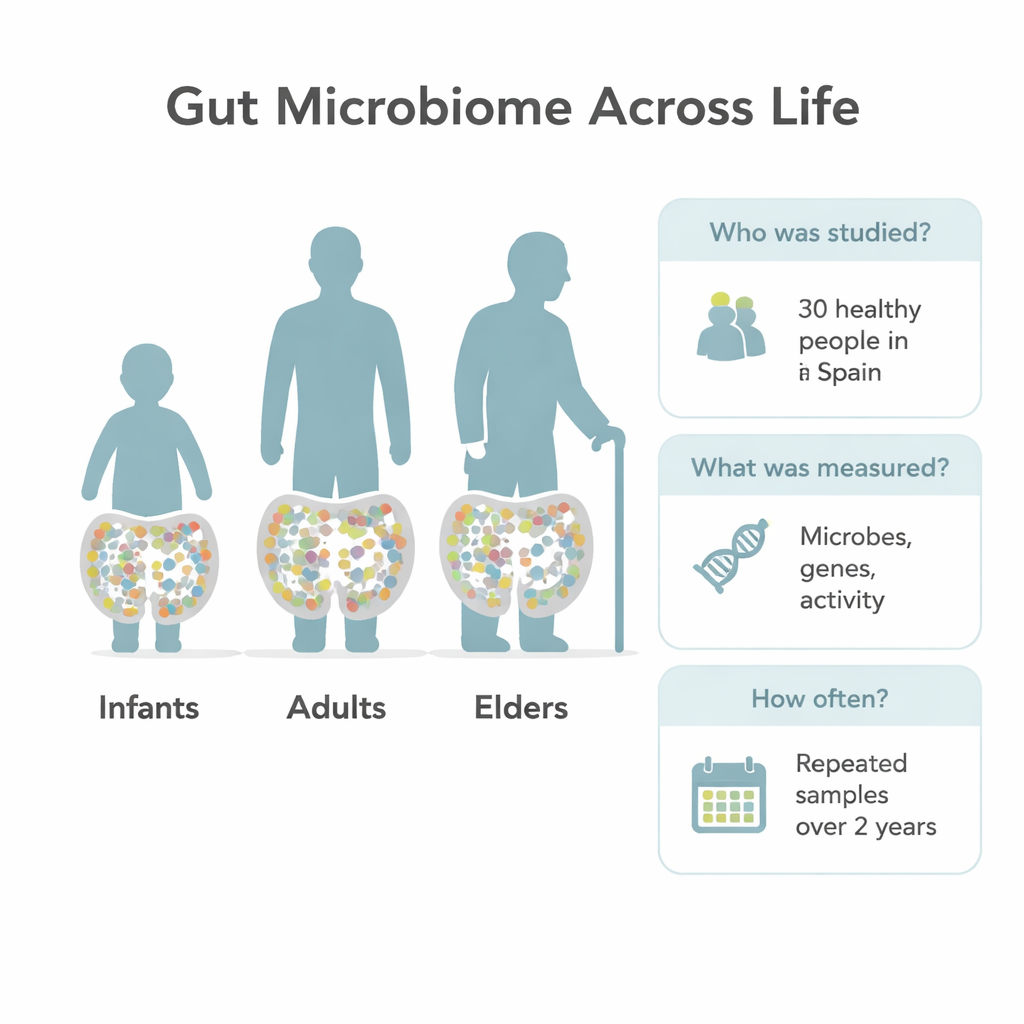
The researchers tracked 30 healthy volunteers from Spain, grouped into infants, adults, and elders. Over about two years, each person regularly collected stool samples at home. From these samples, the team measured not just which microbes were present, but also the genes they carried and which of those genes were actively being used. This multi-layered view let them compare the gut communities of children, middle-aged adults, and older adults, and see how stable each person’s microbiome was over time.
A Shared Core of Helpful Microbes
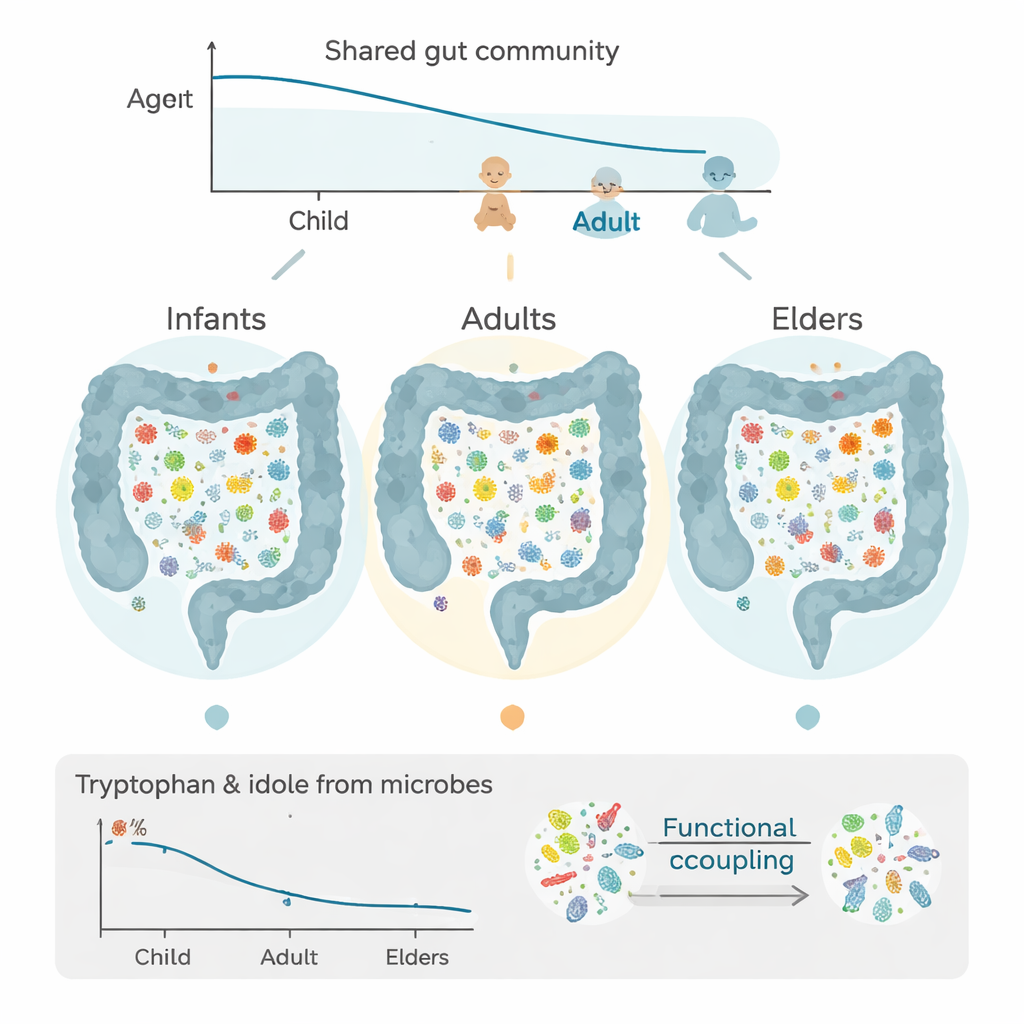
Despite large differences from person to person, the study found a surprisingly robust “core” set of gut bacteria that showed up again and again. Across all ages, about 60% of bacterial genera were shared, and several common groups—such as Bacteroides and Faecalibacterium—were nearly universal. These microbes are well-known helpers: they break down complex carbohydrates, produce short-chain fatty acids that nourish the gut lining, and help regulate the immune system. As people aged, the number of core microbes tended to grow, especially in adults and elders, suggesting that a stable set of long-term partners becomes established over time.
Microbial Change from Cradle to Old Age
Even with this shared core, the mix of microbes clearly shifted with age. Infants had less diverse and less stable gut communities: their microbial profiles changed more over time, and some groups common in childhood faded later in life. Adults and elders, by contrast, showed more stable communities, with their gut make-up changing less between samples taken months apart. Certain genera became more common with age, including bacteria previously tied to Western-style diets and to both healthy and unhealthy aging. These patterns suggest that our lifestyle and environment, layered on top of normal aging, slowly reshape the gut ecosystem.
When Microbes Stay but Their Work Slows Down
A key focus of the study was a pair of microbial products: tryptophan and indole, molecules linked to immune regulation, gut barrier health, and possibly resilience in old age. Earlier work in the same cohort showed that these compounds were plentiful in infants but dropped sharply in adults and were nearly absent in elders. By digging into microbial DNA and RNA, the authors found that some bacteria that can make these molecules remain present, but their activity changes. In particular, the genus Akkermansia produced far less of the messenger RNA needed to make the enzyme tryptophanase in adults and elders—around ten times lower than in children. Other bacteria involved in related steps showed a similar age-related decline in activity or disappeared altogether.
What This Means for Healthy Aging
To a non-specialist, the most important message is that our gut keeps a core group of long-term microbial partners throughout life, but what those microbes actually do can change with age. The study suggests that while a mutualistic “core” of symbionts persists, some functions—such as producing tryptophan- and indole-related compounds—may become partly uncoupled from the human host in later years. This functional slowdown could contribute to frailty and other problems in old age, and it points toward future strategies: instead of only asking which microbes we have, we may need to ask how to maintain or restore what they do, especially for key metabolic pathways that support healthy aging.
Citation: Ruiz-Ruiz, S., Piquer-Esteban, S., Pérez-Rocher, B. et al. Lifetime existence of a core of mutualistic symbionts and functionally uncoupled taxa in the gut of a Mediterranean cohort. Sci Rep 16, 4921 (2026). https://doi.org/10.1038/s41598-026-35033-3
Keywords: gut microbiome, healthy aging, mutualistic bacteria, Mediterranean cohort, tryptophan metabolism