Clear Sky Science · en
The experience of recurring ambivalence and its relation to effortful problem-focused coping
Why Mixed Feelings Matter More Than We Think
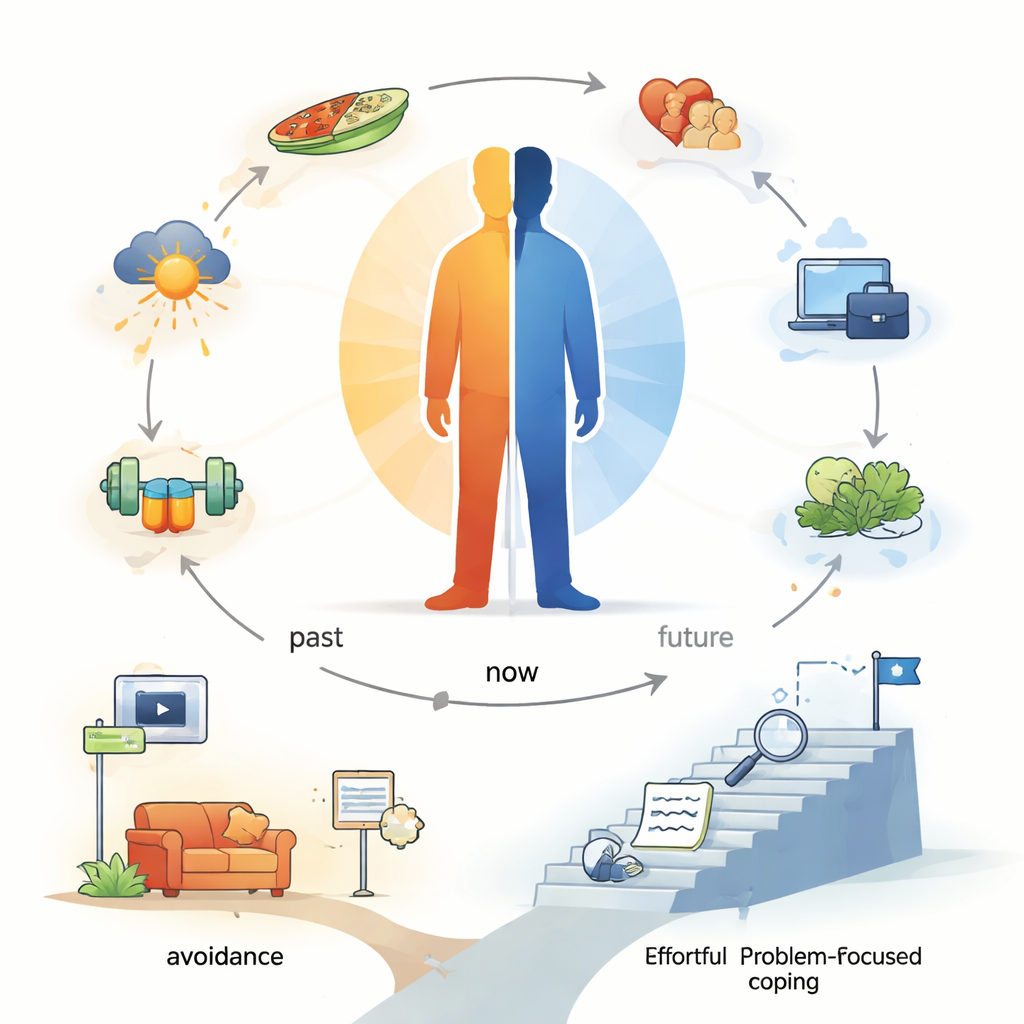
Most of us know what it’s like to feel torn: loving meat but worrying about animals, enjoying a partner’s company yet doubting the relationship, or wanting to relax while feeling guilty about unfinished work. This kind of inner tug‑of‑war—ambivalence—is usually treated as a momentary nuisance. But for many people, these mixed feelings keep coming back, week after week or even daily. This paper asks a deceptively simple question with big everyday implications: when ambivalence becomes a recurring experience, does it actually push us to work harder to sort things out?
Mixed Feelings as a Repeating Pattern
The authors argue that ambivalence is not just a one‑off state we occasionally slip into. Instead, for some topics—like food choices, personal goals, relationships, or health decisions—ambivalence can reappear over and over. Drawing on earlier research, they distinguish between merely having reasons on both sides of an issue ("potential" ambivalence) and actually feeling that conflict in the moment ("felt" ambivalence). They propose that when people notice that this uncomfortable, conflicted feeling keeps returning, they start to see the recurrence itself as unpleasant. That, in turn, may motivate them to invest more effort into solving the underlying problem, rather than just pushing the feeling away.
Three Studies of Everyday Inner Conflict
Across three online studies with more than 1,600 participants, the researchers examined how often ambivalence recurs and how people respond to it. In Study 1, participants named a topic they personally felt very torn about—anything from career choices to family issues or meat consumption—and rated how ambivalent they felt, how often that ambivalence came back, and how willing they were to put in effort to resolve it (for example, by seeking information or taking concrete action). The results showed large differences between people and topics: some ambivalences popped up only rarely, others very frequently. Crucially, the link between feeling ambivalent and wanting to invest effort was stronger when people believed the ambivalence recurred often. When recurrence was low, strong ambivalence sometimes even went along with giving up on effortful coping, suggesting that people may prefer to avoid a one‑time painful conflict rather than tackle it head‑on.
When Frequent Conflict Pushes Us to Try Harder
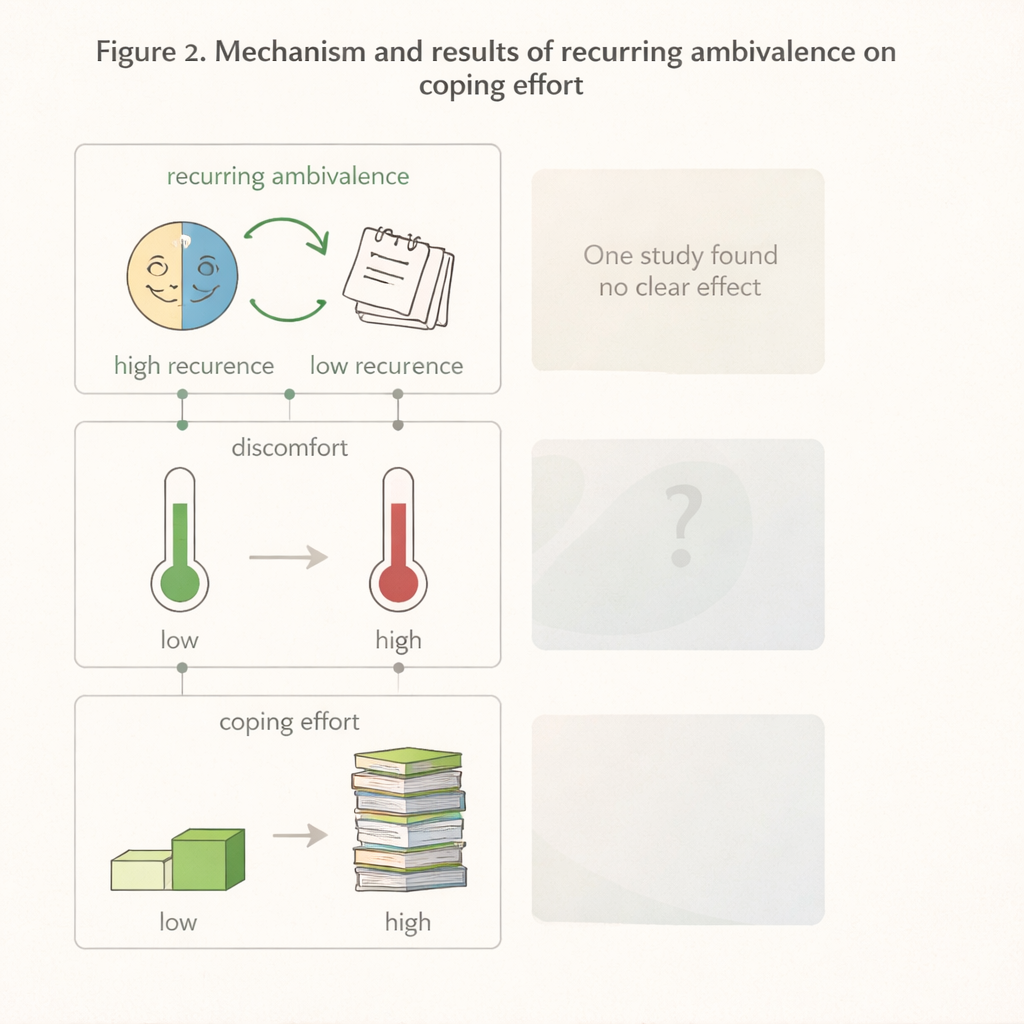
Study 2 used a more controlled but still realistic approach. Participants were randomly guided to think about topics they were either ambivalent or indifferent about, and that they encountered either frequently or rarely. Again, people reported how much effort they were willing to invest in dealing with the topic. The pattern largely replicated the first study: ambivalence combined with frequent recurrence tended to produce the strongest motivation for effortful, problem‑focused coping. People also described recurring ambivalence as more negative and bothersome, and this negativity partly explained why they wanted to work harder to address it. In other words, feeling “sick of” repeatedly revisiting the same inner conflict seemed to nudge people toward more constructive, long‑term solutions rather than quick emotional escapes.
When Anticipated Conflict Is Not Enough
In Study 3, the researchers tried to isolate the forward‑looking part of their theory: does simply expecting that an ambivalent decision will come up again in the future increase people’s willingness to seek out more information and think harder? Participants evaluated a fictional worker whose record was clearly positive, clearly negative, or mixed, and were told they would be judging similar cases either many times or just once. Here, the anticipated recurrence manipulation was weaker. While ambivalent descriptions did produce more mixed judgments of the worker, expecting to repeat the task did not reliably increase information‑seeking or other signs of effortful coping. This suggests that mere abstract expectation of future ambivalence may not be enough to spark extra effort in the absence of a history of personally feeling that conflict over and over.
What This Means for Everyday Decisions
Put together, the studies suggest that recurring mixed feelings can sometimes act as a kind of internal alarm bell. When we repeatedly find ourselves torn about the same issue and dislike that experience, we may become more willing to invest time and mental energy to understand the trade‑offs, gather information, and move toward a clearer stance. However, this pattern is not automatic and did not show up in every experimental setup. For a layperson, the takeaway is that noticing which inner conflicts keep returning—and which ones you are simply predicting in the abstract—may matter. The recurring, uncomfortable kind may be precisely the ones worth tackling with more deliberate, problem‑focused effort, because resolving them can reduce both present discomfort and the likelihood of feeling stuck in the same ambivalence again.
Citation: Pauer, S., Rutjens, B.T. & van Harreveld, F. The experience of recurring ambivalence and its relation to effortful problem-focused coping. Sci Rep 16, 2601 (2026). https://doi.org/10.1038/s41598-026-35032-4
Keywords: ambivalence, coping strategies, decision making, psychological conflict, self-regulation