Clear Sky Science · en
Compact integrated self-multiplexing antenna for sub-6 GHz and millimeter wave 5G frequency spectrum
Why this tiny antenna matters for your future phone
Fifth‑generation (5G) networks promise faster downloads, smoother video calls, and the ability to connect huge numbers of devices—from cars to factory sensors. To deliver all this, wireless systems must use both “low” 5G frequencies (good for range) and “high” millimeter‑wave frequencies (good for ultra‑fast data). This paper reports a new, very compact antenna that can handle many channels in both ranges at once, potentially shrinking future base stations and connected devices while boosting performance.
Two kinds of 5G signals, one smart platform
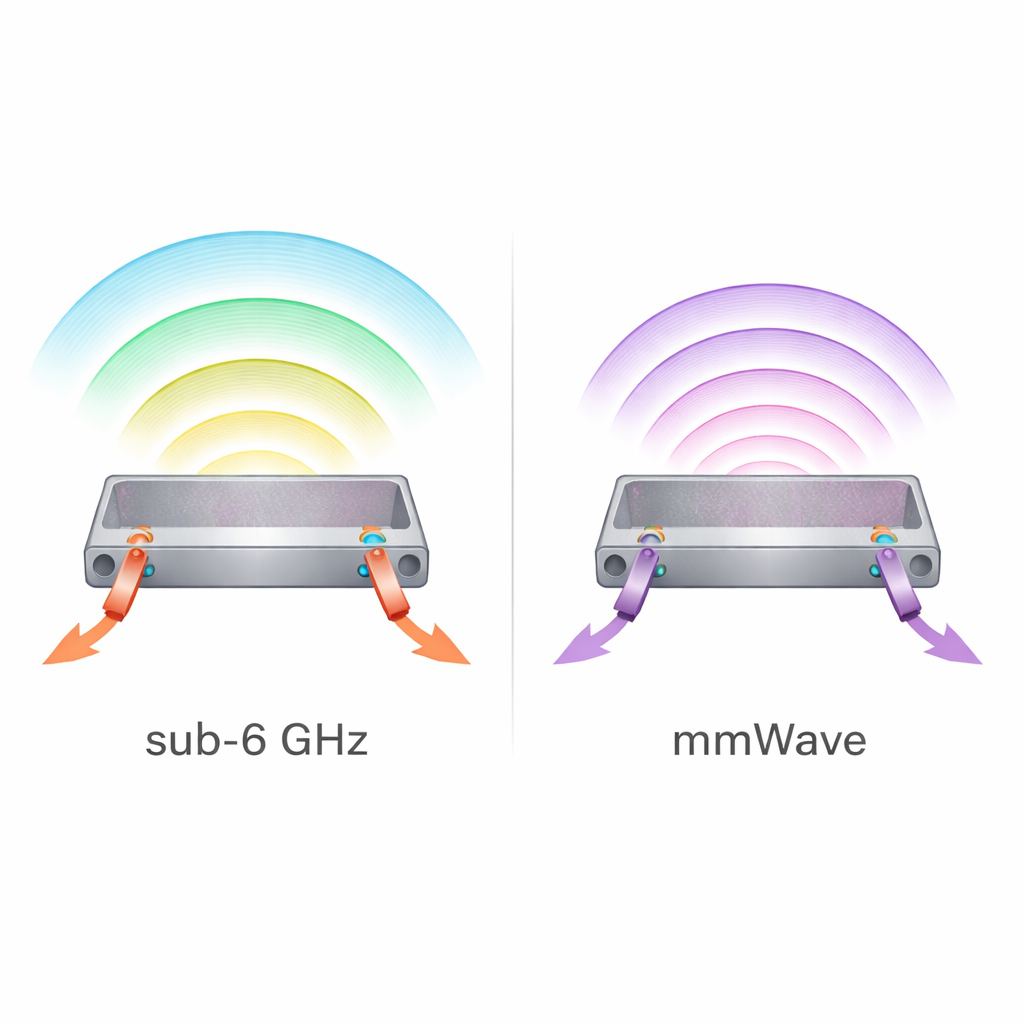
Today’s 5G networks are split into sub‑6 GHz bands (often called FR1) and millimeter‑wave bands (FR2). Sub‑6 GHz signals travel far and penetrate walls reasonably well, making them ideal for broad coverage. Millimeter‑wave signals, by contrast, carry far more data but fade quickly and are easily blocked, so they are used for short‑range, ultra‑high‑speed links. Existing antenna designs typically focus on either one range or only a few channels across both, which means more hardware, more space, and more complexity when operators want lots of separate frequency channels.
A compact “16‑lane highway” for radio waves
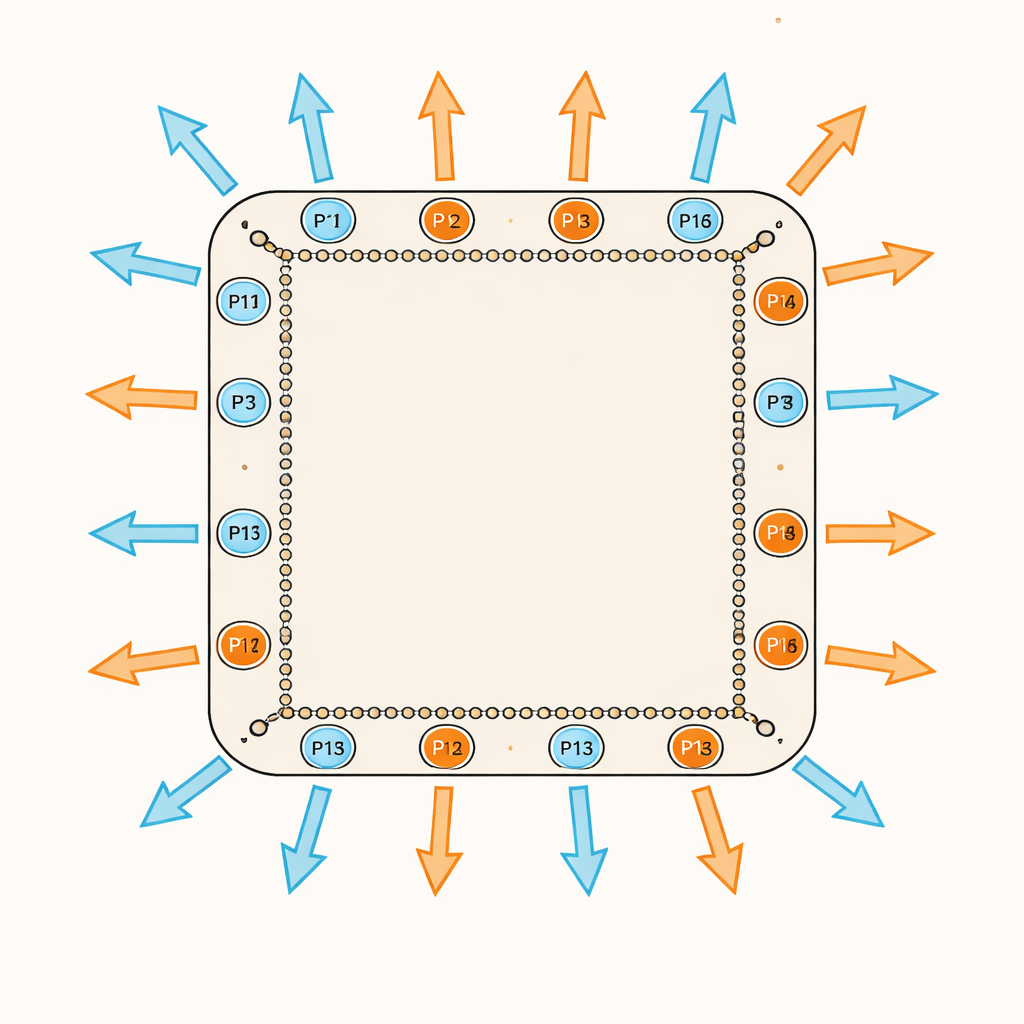
The authors propose an integrated antenna that works like a 16‑lane highway for radio waves. It has 16 separate ports: eight assigned to different sub‑6 GHz channels and eight to different millimeter‑wave channels. Each port is tuned to its own frequency, so the antenna can send or receive on sixteen distinct channels without needing bulky external multiplexing hardware. All of this is implemented on a single flat circuit board with an overall footprint of only about 0.43 times the square of the wavelength at the lowest operating frequency—quite small for what it does.
How the design squeezes in so many channels
At the heart of the design is a structure called a substrate‑integrated waveguide, which confines radio waves inside a cavity formed by rows of metal via holes in the circuit board. The researchers start with a square cavity and then “slice” it conceptually into smaller portions to save space while keeping the same basic resonance behavior. They further introduce carefully shaped slots and feeding structures so that some elements resonate at sub‑6 GHz frequencies and others at millimeter‑wave frequencies. These unit elements are interleaved—sub‑6 GHz and millimeter‑wave pieces woven together inside the same square area—so that the available board space is used efficiently while keeping the different channels from interfering with one another.
Keeping the channels from talking over each other
For such a dense design to work, signals on one port must not leak strongly into others. The team tackles this in several ways: by placing elements at right angles to each other, by using different internal field patterns (or “modes”) for different ports, and by maintaining enough physical spacing where possible. Simulations and measurements of the finished prototype show that, in the sub‑6 GHz range, unwanted coupling between ports is suppressed by more than 40 decibels, and in the millimeter‑wave range by more than 20 decibels—levels that are considered very good in antenna engineering. The antenna also delivers useful gain (signal strength) and high efficiency across all 16 operating frequencies, matching well with computer predictions.
From single antenna to many‑antenna arrays
Modern 5G and future 6G systems often rely on multiple‑input, multiple‑output (MIMO) arrays, where many antennas work together to steer beams and serve many users at once. The authors show that their 16‑port design can be tiled into a larger 64‑port configuration using four identical cavities. Ports that share the same index across the four cavities operate at the same frequency but are physically isolated by the cavity walls, preserving good separation between channels. This scalability suggests the concept could be used not only in compact base stations, but also in dense access points for smart factories, smart cities, and vehicle‑to‑everything communication.
What this means for everyday users
In simple terms, this work demonstrates a small, efficient antenna that can juggle sixteen different 5G channels across both long‑range and ultra‑fast bands without those channels getting in each other’s way. By combining so many functions into one compact piece of hardware, it could help equipment makers build smaller, cheaper, and more capable radios for future networks. For end users, such technology paves the way for more reliable connections, higher data rates, and support for a larger number of connected devices—from smartphones and home sensors to cars and industrial robots—within the same wireless infrastructure.
Citation: Srivastava, G., Kumar, A., Rana, S. et al. Compact integrated self-multiplexing antenna for sub-6 GHz and millimeter wave 5G frequency spectrum. Sci Rep 16, 5457 (2026). https://doi.org/10.1038/s41598-026-35031-5
Keywords: 5G antenna, millimeter wave, sub-6 GHz, MIMO, self-multiplexing