Clear Sky Science · en
Manual massage versus foam rolling within the NASM corrective framework: a trial for upper crossed syndrome rehabilitation in university students
Why slouching students should care
Hours hunched over laptops and phones can slowly reshape the upper body, contributing to sore necks, rounded shoulders, and nagging headaches. This pattern, known as upper crossed syndrome, is especially common in university students who sit and study for long stretches. The study summarized here asks a practical question many people and clinicians face: when trying to fix this problem using a structured exercise program, is a therapist’s hands-on massage more effective than self-treatment with a foam roller?
The posture problem in modern study life
Upper crossed syndrome describes a common postural pattern where the head juts forward, the upper back rounds, and the shoulders roll inward. Tight muscles in the chest and the back of the neck, combined with weak muscles in the front of the neck and mid-back, pull the body out of alignment. Among university students who spend more than 35 hours a week at a computer, this posture is not just a cosmetic issue. It has been linked to neck and shoulder pain, reduced shoulder movement, headaches, and even breathing changes. The authors set out to test whether different ways of loosening tight tissues at the start of a corrective exercise program would change how well students could recover from this pattern.
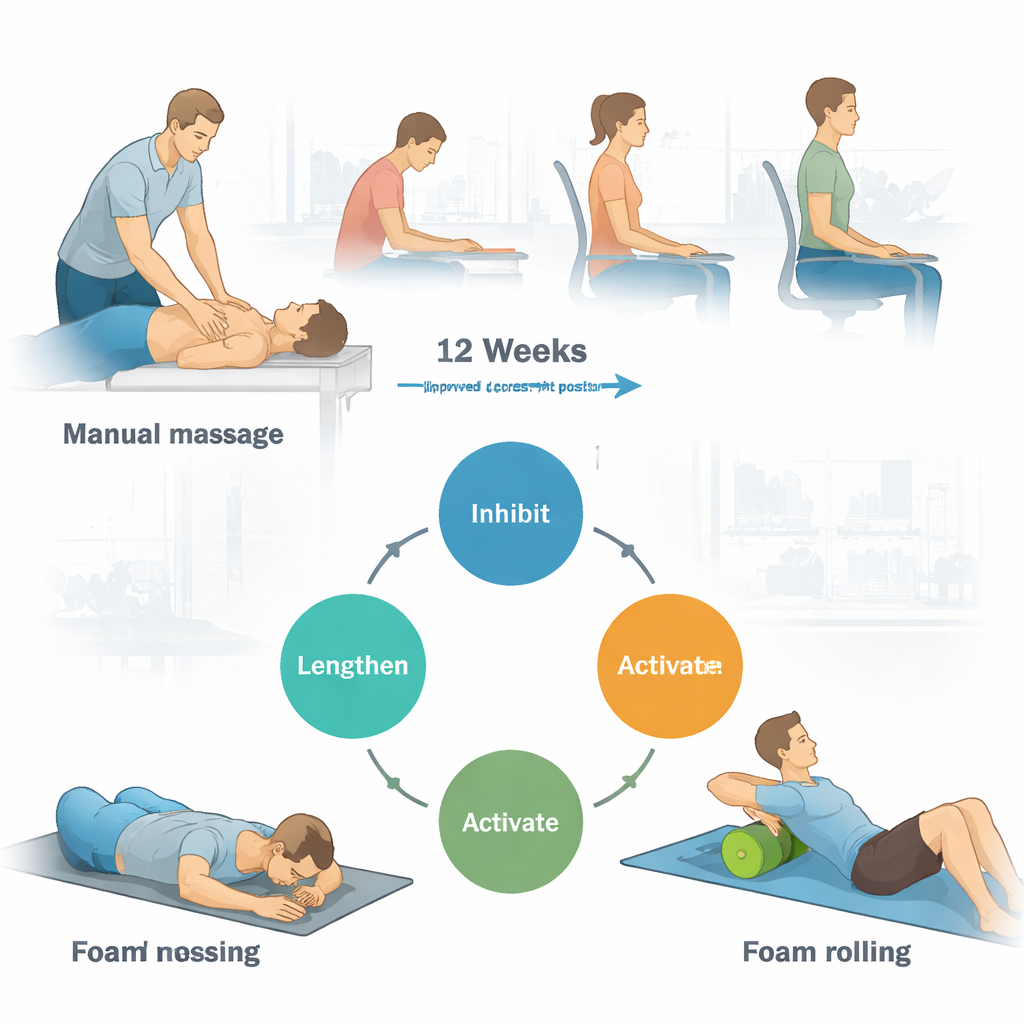
Two ways to release tight tissues
The research team worked with 30 male engineering students aged 18 to 25 who clearly showed upper crossed syndrome and reported regular neck or shoulder pain. Everyone followed the same 12-week program based on the National Academy of Sports Medicine’s four-phase corrective model: first calming overworked tissues (Inhibit), then stretching tight muscles (Lengthen), strengthening weak ones (Activate), and finally teaching the body to move well in everyday tasks (Integrate). The only difference between groups was how the first phase was done. One group received manual massage from a trained specialist, using controlled hands-on pressure and specific techniques on the chest, neck, and upper back muscles. The other group learned to use a foam roller and similar tools to apply pressure to the same areas by themselves under supervision.
Measuring pain, posture, movement, and daily life
To see which approach worked better, the researchers measured several things before and after the 12 weeks. These included how far the head and upper back leaned forward, how rounded the shoulders were, how intense neck and shoulder pain felt on a simple 0–10 scale, and how much the shoulder could rotate inward and outward. They also tested upper arm and shoulder control in a demanding balance test and asked students to complete a standard survey of physical and mental quality of life. All sessions were closely supervised, and every participant completed the full program, giving a clear picture of how each method performed when done properly.
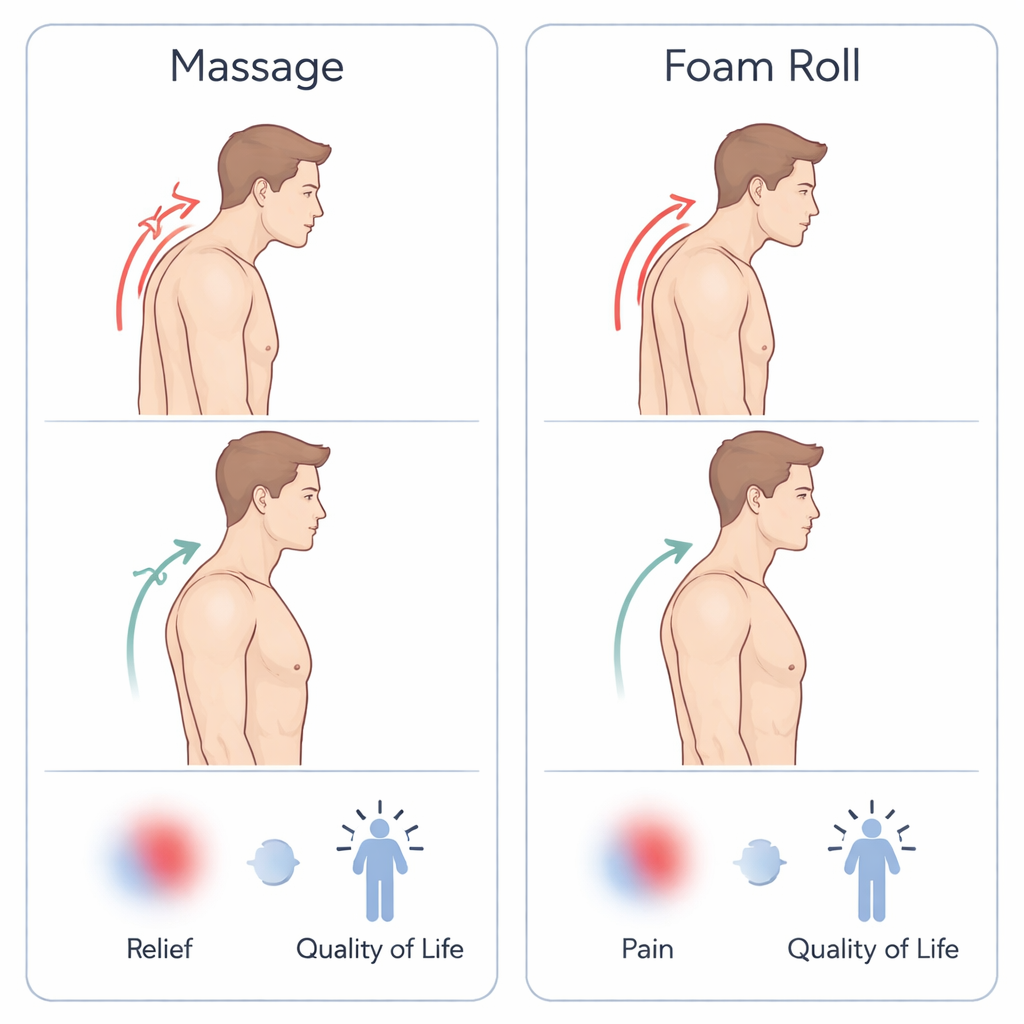
What changed with massage versus foam rolling
Both groups improved in meaningful ways. After three months, students stood with less forward head and upper-back rounding, reported less pain, moved their shoulders through a larger range, and performed better on the arm balance test. Their reported quality of life also improved, suggesting that easing postural strain can translate into feeling better overall. However, the massage group gained an edge in several important areas. They showed greater reduction in how rounded their shoulders were, larger increases in both inward and outward shoulder rotation, and more substantial drops in pain. They also reported bigger gains in both the physical and mental parts of the quality-of-life survey. In contrast, for head and upper-back posture and functional arm balance, the two groups improved by similar amounts.
What this means for students and clinicians
For people living with upper crossed syndrome, this study suggests that a well-designed, phase-based exercise plan is key, and both manual massage and foam rolling can help when used as the entry step. But when deeper chest and shoulder tightness, limited shoulder movement, and pain are major issues, hands-on massage by a trained therapist may provide extra benefits that a foam roller cannot fully match. Foam rolling remains a practical, low-cost option, especially where professional help is limited. Ultimately, the best choice will depend on access to care, personal preference, and specific goals—but this work shows that investing in expert manual treatment can meaningfully boost results for slouched, sore students trying to stand tall again.
Citation: Kalantariyan, M., Sadeghi, M. & Samadi, H. Manual massage versus foam rolling within the NASM corrective framework: a trial for upper crossed syndrome rehabilitation in university students. Sci Rep 16, 5471 (2026). https://doi.org/10.1038/s41598-026-35030-6
Keywords: upper crossed syndrome, posture, manual massage, foam rolling, corrective exercise