Clear Sky Science · en
Climatic and governance determinants of malaria transmission in Rivers State, Nigeria
Why weather and leadership matter for malaria
Malaria is often thought of as a purely biological problem—mosquitoes, parasites, and people. But this study from Rivers State in southern Nigeria shows that the weather over our heads and the decisions made in government offices can strongly shape how many people fall ill. By analyzing 15 years of data, the researchers ask a practical question: can we use climate information and shifts in health policy to better predict and prevent dangerous surges in malaria?
A closer look at malaria in one Nigerian state
Rivers State sits in the wet, humid Niger Delta, where malaria is present all year. The team gathered monthly records of confirmed malaria cases from 2007 to 2021, along with satellite-based data on temperature, rainfall, and humidity. They also created two simple on–off markers: one for wet versus dry season, and another to capture a major change in state leadership and malaria-control policy around 2015. Because health-worker strikes left gaps in clinic reports, the researchers used a standard time-series method to fill in missing months, ensuring a complete picture of how malaria ebbed and flowed over the 15-year period.
Patterns hidden in rising and falling case numbers
When the team plotted malaria cases over time, they saw two distinct phases. From 2007 to about 2013, malaria numbers climbed gradually but smoothly. After 2014, the pattern became much more jagged, with sharp spikes and sudden drops. Statistical checks showed that the data were highly skewed and far more variable than a simple bell-shaped curve, meaning that methods designed for average, "well-behaved" data would not work well. This erratic behavior hinted that something more than just steady climate conditions—such as changes in reporting systems or health programs—was influencing the counts.
Testing different ways to explain the numbers
To dig deeper, the researchers compared several mathematical approaches that are widely used to model counts of events such as disease cases. They started with basic models that relate malaria counts directly to the climate and policy variables, then moved to a more advanced time-series approach that also captures how this month’s malaria levels depend on previous months. Among the simpler models, those that allow for “extra noise” in the data performed better, and temperature appeared as the only consistently strong climate signal. However, these models still struggled to reproduce the rapid ups and downs seen in the real-world data, especially after 2014.
Adding time and seasons to the forecasting toolkit
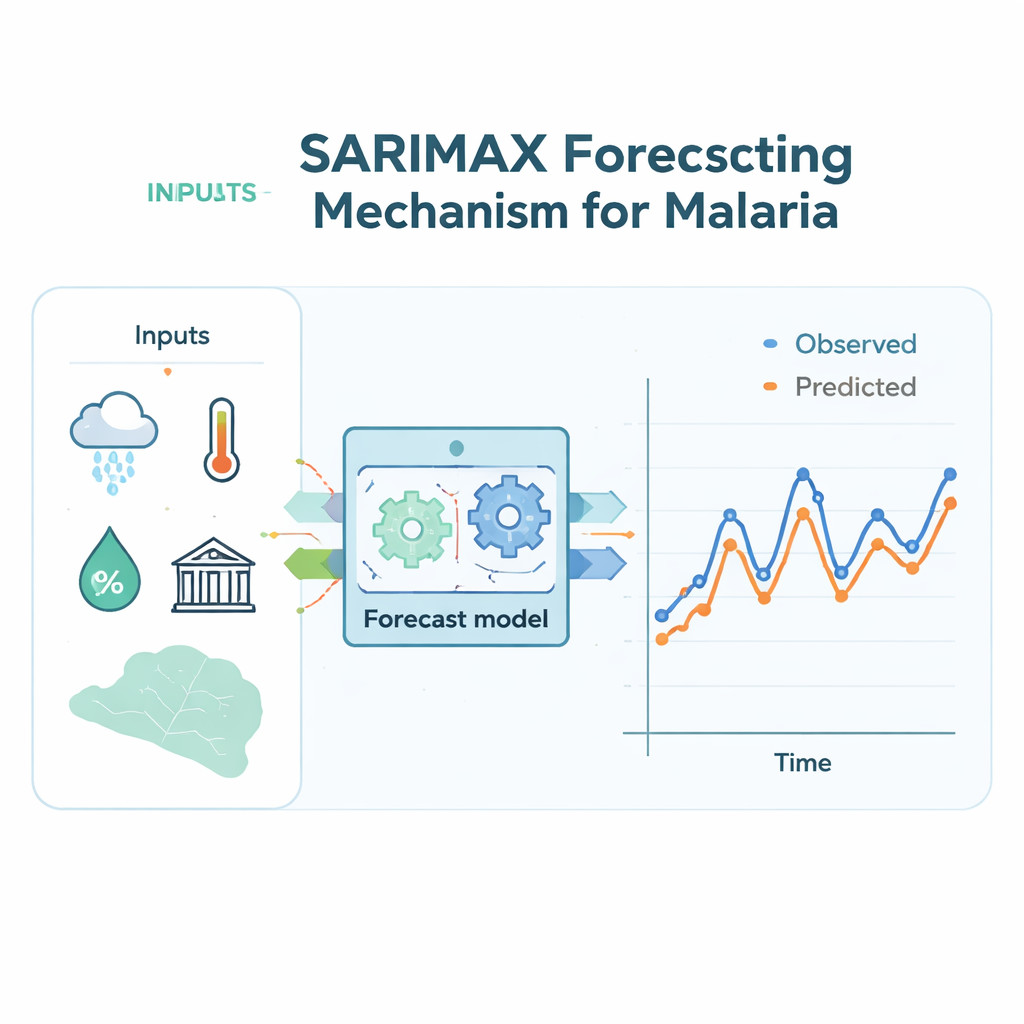
The turning point came with a model known as SARIMAX, which is specifically designed for data that change over time and repeat with the seasons. In addition to climate and policy inputs, this model explicitly uses the pattern of past malaria counts to forecast future ones. Here, rainfall emerged as an important driver: wetter months tended to have more malaria, reflecting the creation of mosquito breeding sites. The wet–dry season marker and the change in government period were also significant. The later policy period (2016–2021) was linked to fewer malaria cases than the earlier one, suggesting that shifts in funding, bed-net campaigns, or health-worker performance may have started to pay off.
From research findings to early-warning systems
When the researchers compared how well each model predicted real malaria numbers, SARIMAX clearly outperformed the simpler approaches, with smaller errors and a much closer match to observed spikes and dips. For a layperson, this means that paying attention to both the sky and the statehouse—tracking rainfall, seasons, and policy changes together—can greatly improve our ability to see dangerous malaria surges coming. The authors argue that such climate- and governance-aware forecasting tools could help health officials in Rivers State, and similar regions, plan ahead: stocking medicines, organizing mosquito-control campaigns, and protecting vulnerable communities before the next malaria wave hits.
Citation: Egbom, S.E., Nduka, F.O., Nzeako, S.O. et al. Climatic and governance determinants of malaria transmission in Rivers State, Nigeria. Sci Rep 16, 5459 (2026). https://doi.org/10.1038/s41598-026-35029-z
Keywords: malaria, climate, governance, Nigeria, forecasting