Clear Sky Science · en
Insights into the seismogenesis and tectonic implications of an isolated intraplate earthquake (M4.0) on February 17, 2025, in Delhi
Why a Delhi tremor matters to everyday life
In the early hours of February 17, 2025, a magnitude‑4.0 earthquake rattled Delhi. It was not strong enough to topple buildings, but people felt sharp shaking and heard a low rumble across the city. For a crowded megacity built on complex underground geology, even such a modest quake is a warning. This study uses dense networks of sensors and satellites to uncover what happened beneath Delhi that night, what it says about hidden faults under the city, and how similar events could affect residents in the future.
A small quake in a tangled underground landscape
The earthquake struck near Jheel Park in South Delhi, close to where a slightly larger magnitude‑4.6 event occurred in 2007. Although the official depth reported by routine monitoring was about 5 km, more detailed analysis placed the main energy release deeper in the crust, around 41 km. The area lies between two major fault systems, the Sohna and Mathura faults, and is crisscrossed by many smaller cracks in the crust. Over three centuries of records show numerous moderate earthquakes around Delhi, yet very few have occurred exactly where this 2025 event did, making it something of an isolated but important clue to how stress is stored and released below the city. 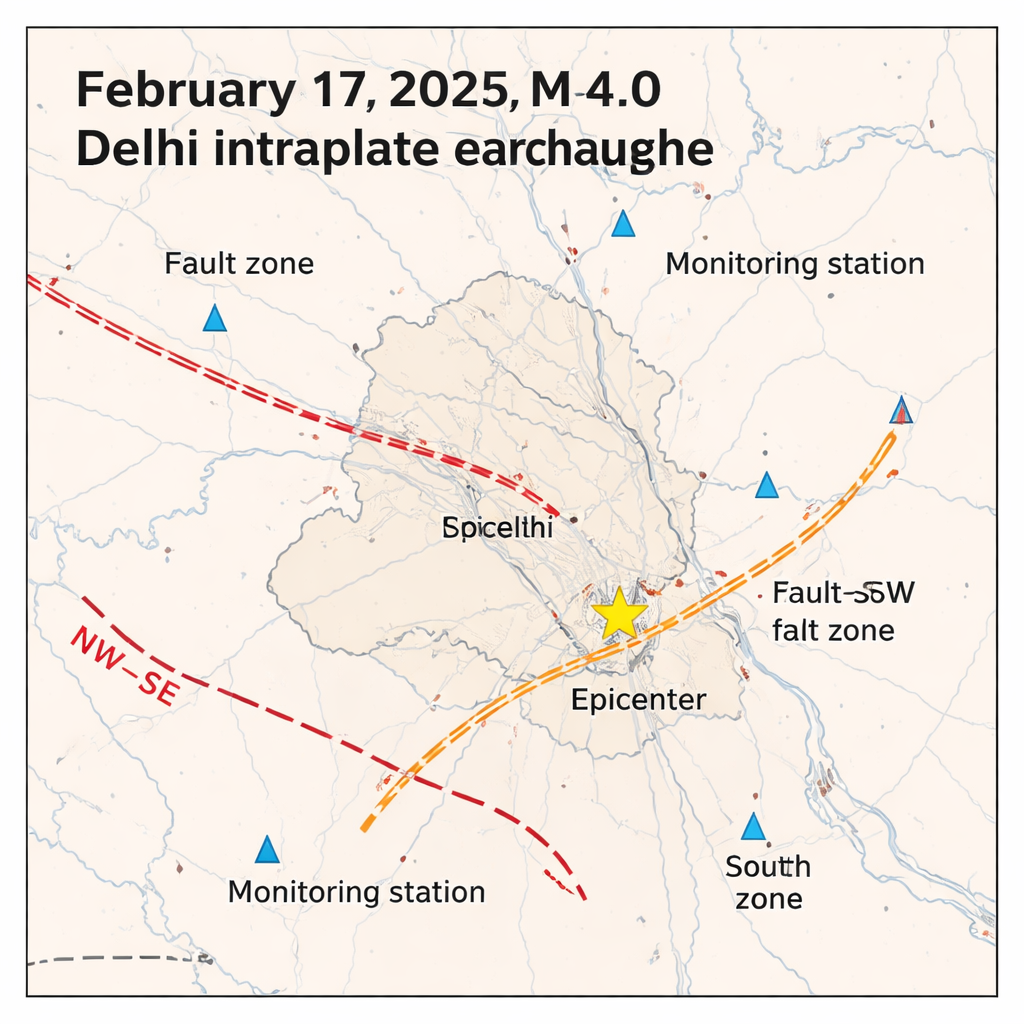
Reading the earthquake’s fingerprint
Scientists examined ground vibrations recorded at 17 seismological stations and 13 strong‑motion instruments around Delhi, as well as high‑rate satellite positioning (GNSS) data. By carefully matching observed waveforms with computer‑generated ones, they reconstructed the “focal mechanism” of the quake—essentially the pattern of motion on the fault. The results show a predominantly strike‑slip motion, where two blocks of rock slide past each other sideways along a near‑vertical fracture oriented northwest–southeast. The event also displayed unusual components that cannot be explained by simple shearing alone, hinting that changes in rock volume and opening or closing of cracks accompanied the slip.
Hidden fluids and buried river channels at work
The team links these odd source characteristics to the presence of fluids in the fault zone. Water and other fluids in cracks and pores can reduce friction, weaken the rock, and help trigger slip—a process sometimes called fluid‑assisted faulting or hydrofracturing. Beneath Delhi, old river channels and lake deposits from past courses of the Yamuna have left soft, water‑bearing sediments buried below the surface. These weak, porous layers and fluid‑rich zones likely acted as local “soft spots” where stress could concentrate and then be released abruptly. Statistical analyses of decades of nearby earthquakes, along with similarities to the 2007 event, suggest that long‑lived faults are being slowly reactivated inside what is otherwise a stable part of the Indian plate. 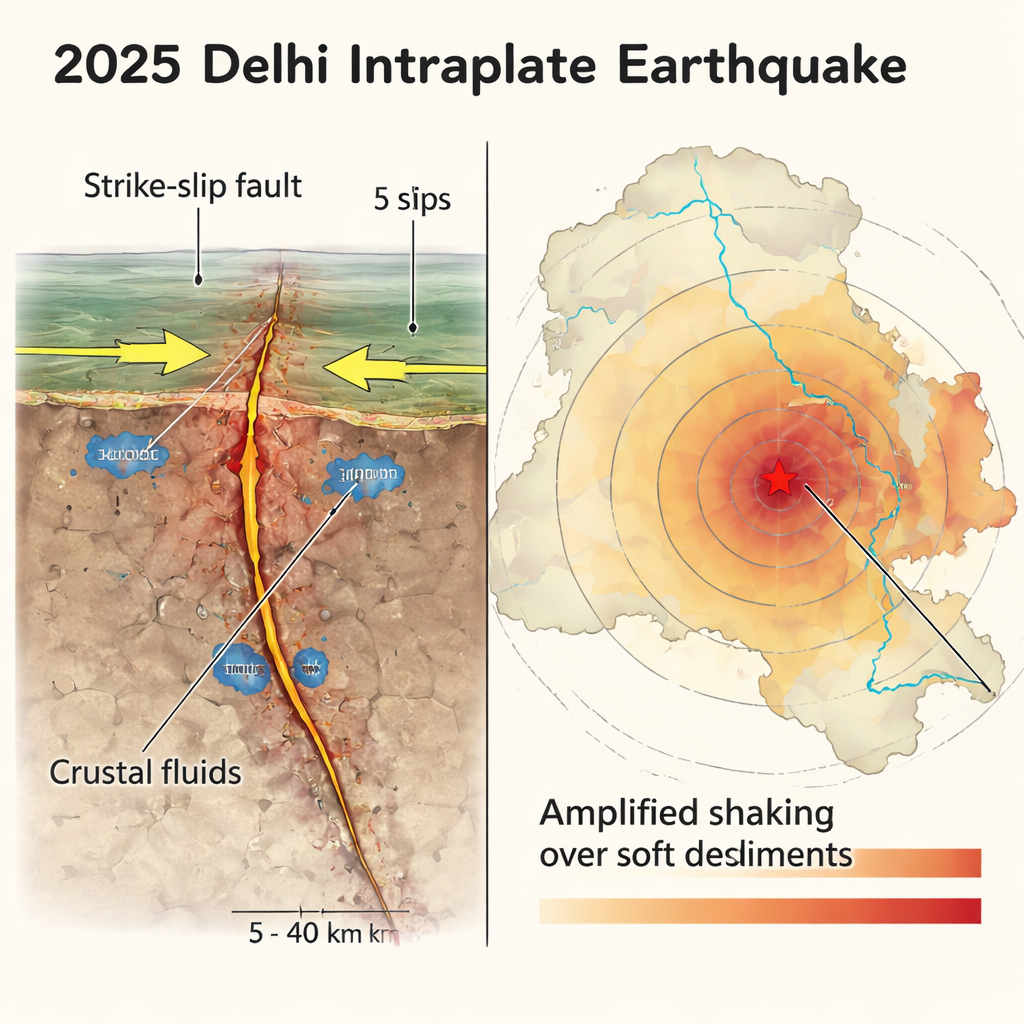
Shaking patterns shaped by the ground under our feet
Despite its modest size, the quake produced noticeable shaking over a wide area. Instruments showed that the strongest motions did not always occur closest to the epicenter. Instead, some stations tens of kilometers away, located on thick, soft sediments in old river basins and paleochannels, recorded amplified shaking. In contrast, sites built on harder rock felt relatively less motion. This pattern mirrors findings from other parts of the world, where buried valleys and loose alluvial deposits can trap and boost seismic waves. High‑rate GNSS sensors, newly installed across the region, even detected tiny ground movements of only a few millimeters, demonstrating that modern satellite networks can track subtle motions during moderate earthquakes and complement traditional seismometers.
What this means for Delhi’s future
The study concludes that the 2025 Delhi earthquake was a strike‑slip event on a pre‑existing fault that has likely slipped before and may do so again. Elevated stress levels in the deep crust, combined with pockets of fluid and soft, buried river sediments, create conditions where even a stable continental region can host unexpected quakes. While this particular event caused no serious damage, it exposed gaps in our knowledge of the faults beneath South Delhi and highlighted how local ground conditions can strongly shape shaking. For residents, the message is clear: moderate earthquakes can still be disruptive in a dense, aging city, and improving fault mapping, subsurface imaging, and the joint use of GNSS and seismic networks will be essential to refine hazard estimates and guide safer building and planning in the decades ahead.
Citation: Prajapati, S.K., Bhattacharjee, S., Pandey, A.K. et al. Insights into the seismogenesis and tectonic implications of an isolated intraplate earthquake (M4.0) on February 17, 2025, in Delhi. Sci Rep 16, 5476 (2026). https://doi.org/10.1038/s41598-026-35028-0
Keywords: Delhi earthquake, intraplate seismicity, strike-slip fault, crustal fluids, paleochannels