Clear Sky Science · en
Advanced polymer-based humidity sensor for aerospace applications implementing ZnO-G: theoretical and experimental study
Why Moisture Monitoring Matters in Space
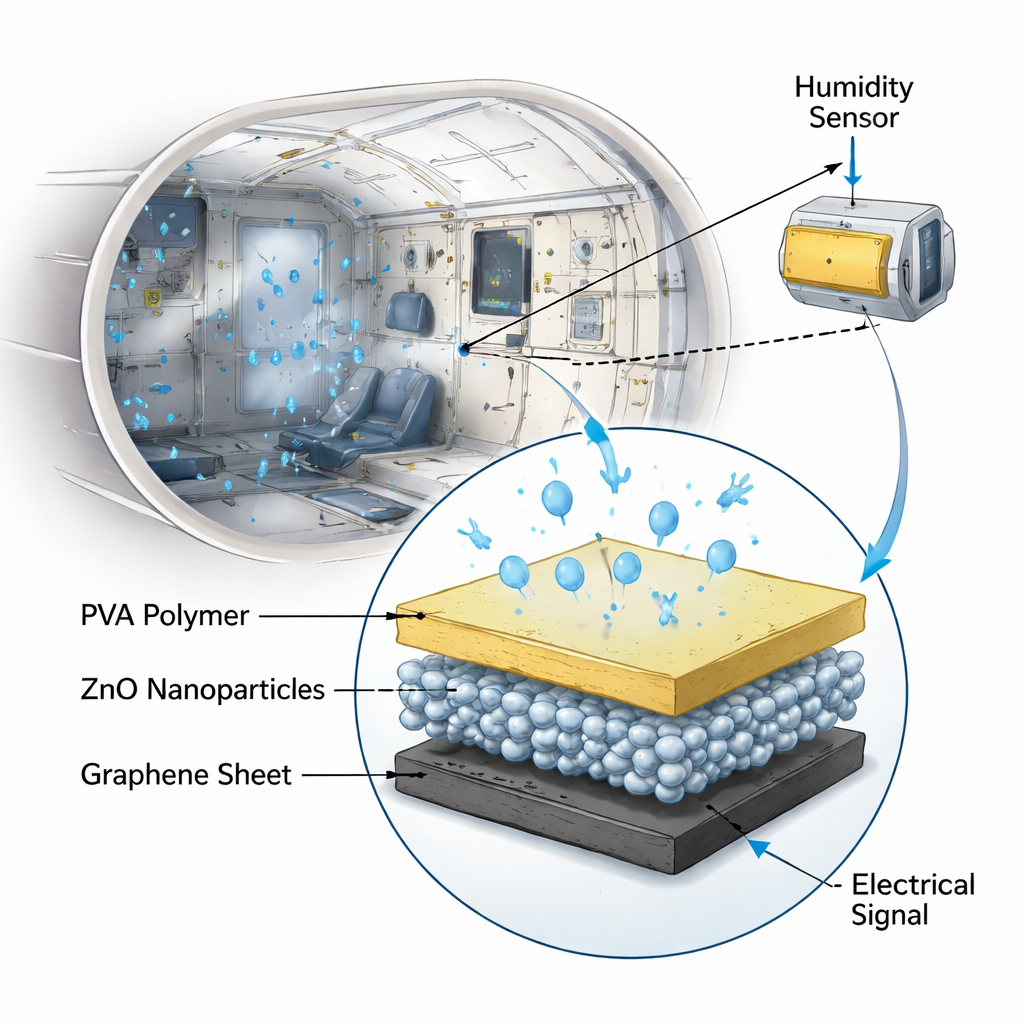
Inside spacecraft and high-altitude aircraft, the air has to be carefully controlled so that equipment runs safely and astronauts can breathe comfortably. Humidity – the amount of water vapor in the air – is a key part of that control. Too much or too little can damage electronics, fog optics, and stress the human body. This paper presents a new material for tiny humidity sensors designed specifically with these demanding aerospace environments in mind.
Building a Better Sensing Film
Traditional humidity sensors often struggle to be sensitive, stable, and low power at the same time, especially in the harsh, changeable conditions of space missions. The authors focus on a common plastic, polyvinyl alcohol (PVA), which already absorbs water and is cheap, flexible, and easy to process. On its own, however, PVA has drawbacks: it has limited internal surface area, modest electrical conductivity, and only moderate sensitivity to humidity. The researchers set out to upgrade PVA into a smarter sensing film by mixing it with very small metal oxide particles and sheets of carbon called graphene. Their goal was to boost how strongly the material interacts with water while also making it easier for electrical signals to move through it.
Designing the Material Atom by Atom
Before going into the lab, the team used advanced computer simulations to see how PVA behaves when combined with different metal oxides such as magnesium oxide, silica, titanium dioxide, and zinc oxide. These calculations treat electrons and atoms using quantum mechanics, allowing the scientists to predict how easily charges can move through each mixture and how strongly water molecules will attach. The simulations showed that adding metal oxides generally makes the PVA more electrically responsive. Among all of the candidates, zinc oxide (ZnO) offered the most promising improvement, narrowing the material’s electronic “energy gap” and increasing its tendency to interact with its surroundings – both good signs for a humidity sensor.
Adding Graphene for Extra Punch
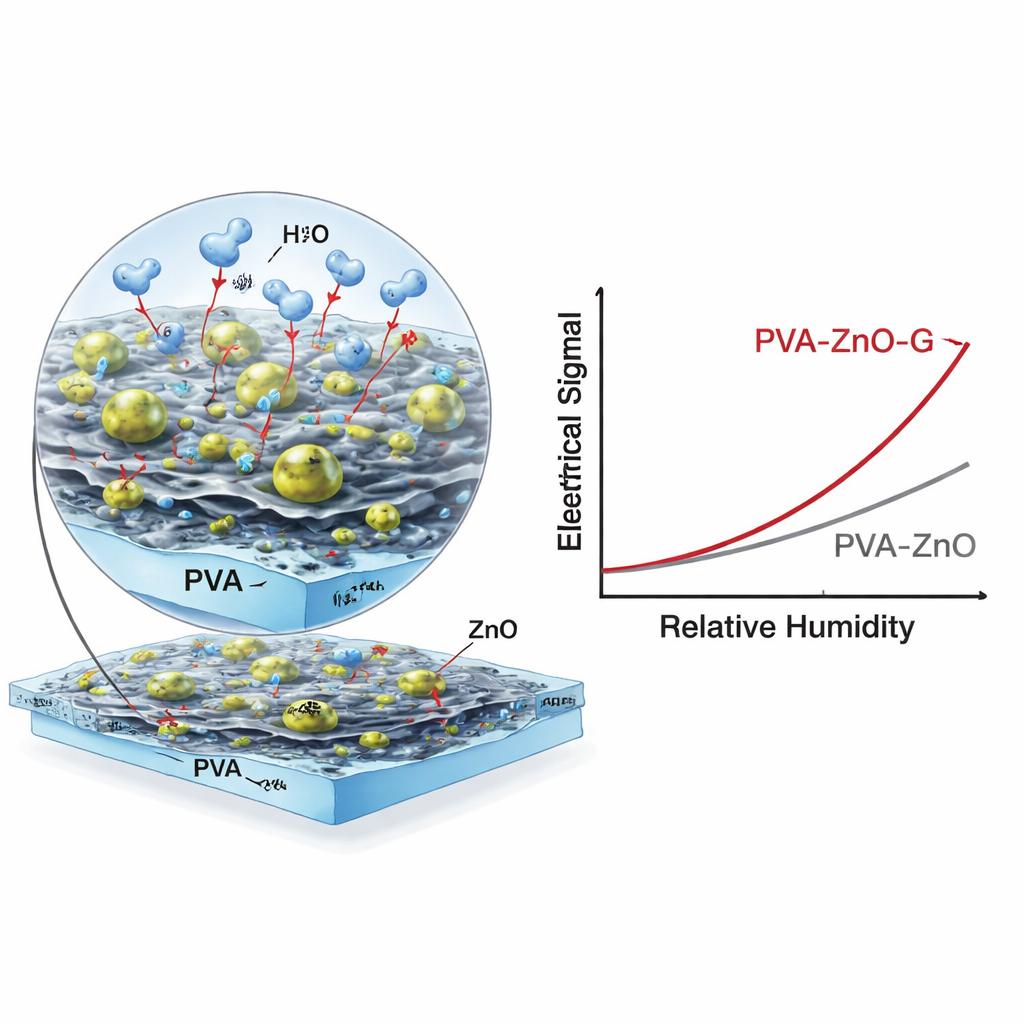
The next step was to see whether this already improved PVA–ZnO blend could be pushed further by adding graphene, a single-atom-thick carbon sheet known for its high conductivity and huge surface area. The calculations predicted that when graphene is integrated with PVA and ZnO, the material’s energy gap shrinks even more and its polarity increases, meaning it should respond strongly to water vapor. The model also showed that areas of high electrical activity extend across both the ZnO particles and the graphene surface, creating many active spots where water molecules can stick. Simulating a small cluster of water molecules on the surface revealed that the PVA–ZnO–graphene (PVA‑ZnO‑G) hybrid should bind water more strongly and more readily than PVA–ZnO alone, yet still through reversible, physical adsorption – ideal for sensing.
From Computer Screen to Real Membrane
Guided by these predictions, the authors fabricated thin membranes of the PVA‑ZnO‑G composite. They first prepared ZnO nanoparticles and graphene in the lab, then blended them with a hot, stirred PVA solution and cast the mixture into flexible films. A suite of laboratory techniques confirmed that all three ingredients had combined as intended. Infrared spectroscopy showed shifts in the chemical bonds of PVA, indicating new hydrogen bonds linking PVA, ZnO, and graphene. X-ray diffraction confirmed that the crystalline structure of ZnO and graphene was preserved within the plastic, while electron microscope images revealed a highly textured surface: ZnO particles distributed across and between rippled graphene layers embedded in the PVA. This rough, porous landscape increases the area available for water to land on and provides many pathways for charges to move.
How the New Sensor Interacts with Water
Theoretical tests of humidity sensing behavior showed that when water molecules approach the PVA‑ZnO‑G film, they are attracted to oxygen-rich sites and tiny defects on the ZnO and graphene surfaces. There, the water can break apart slightly, creating mobile ions that carry electrical current through the moist film. The calculations found that the hybrid material has a stronger, yet still reversible, attraction to water than the PVA‑ZnO film without graphene. Its electronic properties change more sharply with moisture, and the overall process is predicted to be spontaneous and energetically favorable. Comparisons with other metal oxide and graphene-based systems reported in the literature suggest that this hybrid could rival or surpass existing state-of-the-art humidity sensing materials, particularly for fast, contactless detection.
What This Means for Future Space Sensors
In simple terms, the authors demonstrate a recipe for a plastic film that becomes much more “aware” of water in the air by loading it with tiny zinc oxide particles and ultra-thin carbon sheets. The result is a flexible, low-cost coating that should change its electrical signal strongly and reliably as humidity rises or falls. Because it works through gentle, reversible adsorption of water, it can respond quickly and repeatedly – useful for monitoring the air inside spacecraft, in medical devices, or in non-contact human–machine interfaces. While full sensor prototypes and flight tests are still to come, this combined theoretical and experimental study lays out a clear path toward smarter humidity sensors tailored for aerospace and other demanding environments.
Citation: Hegazy, M.A., Nada, N., Elhaes, H. et al. Advanced polymer-based humidity sensor for aerospace applications implementing ZnO-G: theoretical and experimental study. Sci Rep 16, 6339 (2026). https://doi.org/10.1038/s41598-026-35026-2
Keywords: humidity sensor, aerospace environment, polyvinyl alcohol, zinc oxide, graphene composite