Clear Sky Science · en
Translational assessment of butyrylcholinesterase activity as a diagnostic biomarker for depression using a chemiluminescent probe
Looking for a Simple Blood Test for Depression
Depression affects hundreds of millions of people, yet doctors still rely mainly on interviews and questionnaires to diagnose it. Unlike diabetes or high cholesterol, there is no routine blood test that can say who is currently in a depressive episode or who is improving with treatment. This study explores whether the activity of a blood-borne enzyme, measured with a highly sensitive light-emitting probe, could help fill that gap and become part of an objective test for depression.
An Enzyme Hiding in Plain Sight
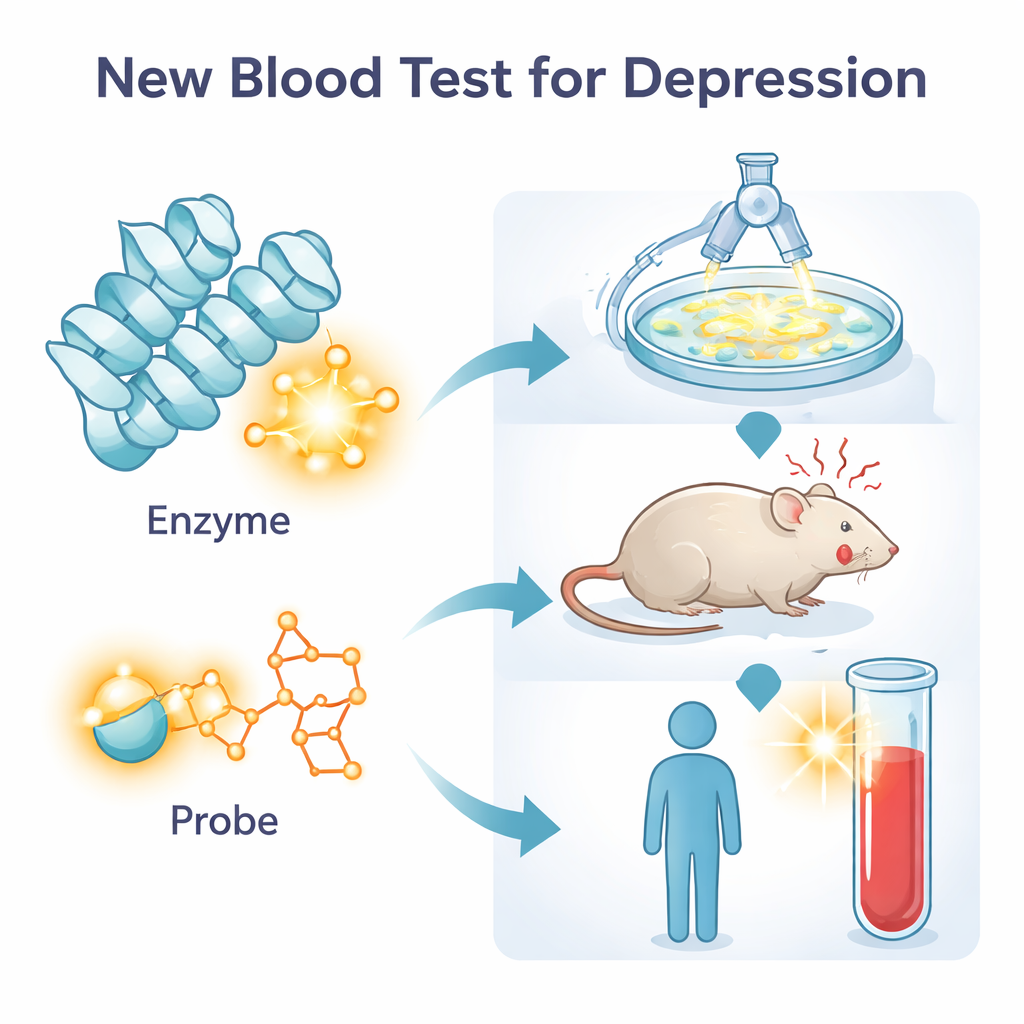
The research centers on an enzyme called butyrylcholinesterase, or BChE, which circulates in blood and also helps regulate brain signaling related to attention, motivation, and stress. BChE has been studied in conditions such as COVID-19 and heart disease, but its role in depression has remained unclear, partly because older laboratory methods could not measure it cleanly in complex fluids like serum. The authors use a new chemiluminescent probe—called BCC—that reacts with BChE and produces a burst of light. By simply mixing tiny amounts of blood or cell samples with BCC and reading the light signal, they can quantify BChE activity with high sensitivity and little background noise.
From Patients to Rats to Cells
To see whether BChE activity tracks depression, the team applied this probe in three linked settings: people, laboratory rats, and cultured nerve-like cells. In human volunteers, they compared blood from healthy individuals with blood from people in a depressive episode, either unipolar depression or bipolar disorder with depression. They then followed a subset of patients for eight weeks of antidepressant treatment. In rats, they used a standard chronic mild stress procedure that triggers depression-like behavior, such as reduced interest in sweet solutions (a sign of anhedonia, or loss of pleasure), and tested how BChE changed with or without the antidepressant fluoxetine. Finally, in a cell model, they exposed neuron-like cells to stress hormones and signaling chemicals to mimic biological changes seen in depression and in treatment.
A Consistent Signal of Low and Rising Activity
Across these experiments, a clear pattern emerged. In human blood, BChE activity was significantly lower in people with active depression than in healthy controls, regardless of whether the diagnosis was unipolar or bipolar depression. When patients were treated and reached remission, their BChE activity rose toward normal levels, and higher enzyme activity was linked to lower depression scores, including reduced suicidal thinking. In stressed rats, BChE activity in blood fell compared with unstressed animals and was positively related to how much pleasure they still took in sweet solutions. Rats receiving fluoxetine showed a tendency toward restored BChE activity. In the cell experiments, exposure to the stress hormone corticosterone reduced BChE activity, while the antidepressant fluoxetine reversed this drop. By contrast, exposure to norepinephrine—a chemical that often rises with successful treatment—increased BChE activity, an effect that was further boosted by fluoxetine.

What This Could Mean for Future Care
Taken together, these converging lines of evidence suggest that BChE activity falls during a depressive episode and rises as people recover or as antidepressant treatments take effect. Because the same pattern appears in human blood, animal models, and cell systems, BChE looks like a promising “translational” biomarker that links basic biology to real-world symptoms. The light-based BCC probe makes it practical to measure this enzyme quickly and sensitively in very small amounts of serum or plasma. While more work is needed before any single enzyme can serve as a standalone diagnostic, this study points toward a future in which a simple blood test, based in part on BChE activity, might help doctors detect depression earlier, gauge suicide risk more objectively, and track who is truly responding to treatment.
Citation: Bozkurt, B., Aksahin, I.C., Selvi, S. et al. Translational assessment of butyrylcholinesterase activity as a diagnostic biomarker for depression using a chemiluminescent probe. Sci Rep 16, 5472 (2026). https://doi.org/10.1038/s41598-026-35023-5
Keywords: depression biomarker, butyrylcholinesterase, chemiluminescent probe, antidepressant response, chronic stress model