Clear Sky Science · en
Sci-Tech finance efficiency promotes the construction of a modernized industrial system evidence from double machine learning
Why Smarter Money Matters for Industry
How a country finances new ideas can quietly shape everything from the jobs people hold to how resilient supply chains are in a crisis. This study looks at China and asks a simple question with big implications: when the financial system does a better job of backing science and technology, does the whole industrial economy become more modern, innovative, and resilient—and if so, how?
Connecting Labs, Banks, and Factories
China has made building a “modernized industrial system” a national goal. In practice, that means industries that are cleaner, more innovative, digitally connected, and globally competitive. At the same time, the country has been expanding what the authors call “Sci‑Tech finance”—loans, investment, and public spending targeted at research, high‑tech firms, and innovation. This paper focuses not on how big that support is, but on how efficiently it is used: how well do government funds, bank credit, and R&D workers turn into real scientific and technological results and, eventually, better industries? 
Measuring Modern Industry and Smart Finance
To explore this, the authors assembled data from 31 Chinese provinces covering 2010 to 2023. They built two key yardsticks. The first is an index of how modern each region’s industrial system is, spanning seven aspects: basic industrial strength, innovation, digital integration, environmental performance, openness to the world, regional balance, and supportive institutions such as finance, education, and public services. The second is a score for Sci‑Tech finance efficiency, which compares inputs like public R&D spending, firms’ research budgets, and R&D staff against outputs such as technology‑market sales, scientific papers, and patents. Higher scores mean financial and human resources are being converted into visible innovation more effectively.
Using Machine Learning to Untangle Cause and Effect
Simply comparing regions is not enough, because richer or more urbanized provinces might naturally have both better finance and more advanced industries. To separate correlation from causation, the study uses a method called double machine learning. In essence, modern algorithms first learn how many other factors—urbanization, income levels, existing financial depth, education spending, fiscal health, and consumption patterns—are related to both finance efficiency and industrial modernization. The model then strips out these influences to estimate the “clean” impact of Sci‑Tech finance efficiency itself. The authors also test their results using historical telecom data and lagged values as instrumental variables, alternate measures of both finance efficiency and industrial modernization, and different algorithmic setups. Across all checks, the main finding holds: regions where Sci‑Tech finance becomes more efficient also see a statistically strong rise in the level of industrial modernization.
How Efficient Finance Transforms the Real Economy
The study then asks what actually changes on the ground when Sci‑Tech finance works better. Three channels stand out. First, technology transfer improves: more scientific breakthroughs are turned into products and services, as seen in booming technology‑market transactions. Second, digital tools such as big data and artificial intelligence spread more deeply into factories, logistics, and other real‑economy activities, tightening the link between the digital and physical worlds. Third, key resources—capital, skilled workers, and technology itself—cluster more efficiently where they can be used best, especially in emerging and high‑tech industries. Among these, the concentration of talent appears particularly sensitive to better Sci‑Tech finance. However, the benefits are uneven: they are much stronger in provinces that are already wealthier, more market‑oriented, and under less fiscal strain, underscoring the importance of local institutional quality. 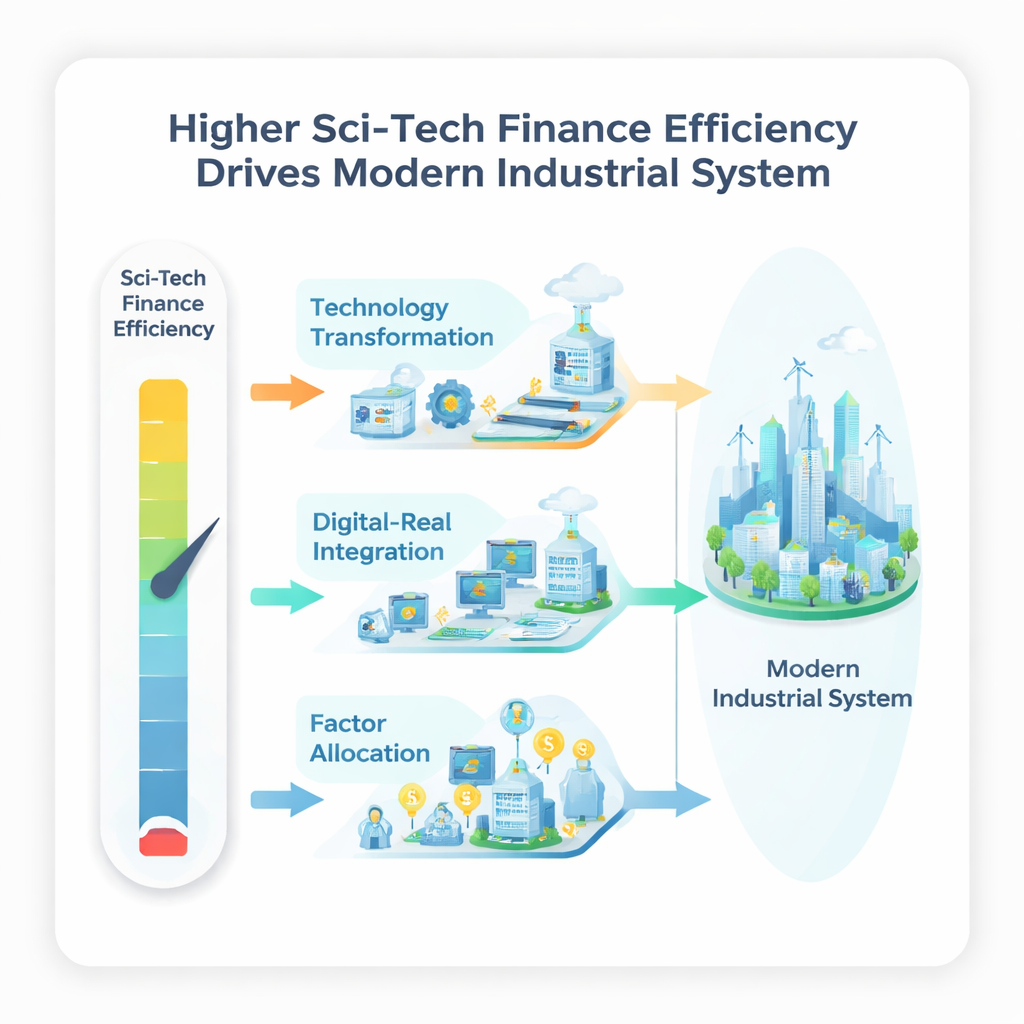
What This Means for the Future of Industry
For non‑specialists, the message is straightforward. It is not just how much money a country spends on science and technology that matters, but how wisely that money is channeled. When financial systems quickly and accurately direct funds and support toward promising ideas, capable teams, and digital upgrades, industrial structures become cleaner, smarter, and more resilient. Where markets are less developed or public budgets are tight, the same financial tools pack a weaker punch. The authors conclude that improving the efficiency of Sci‑Tech finance—while also strengthening local market institutions and easing fiscal pressures—is a powerful lever for guiding whole industrial systems toward a more innovative and sustainable future.
Citation: Huang, R., Liu, X., Tian, J. et al. Sci-Tech finance efficiency promotes the construction of a modernized industrial system evidence from double machine learning. Sci Rep 16, 4800 (2026). https://doi.org/10.1038/s41598-026-35019-1
Keywords: science and technology finance, industrial modernization, innovation policy, digital economy, China regional development