Clear Sky Science · en
Influence of six different RE3+ ions as modifier agents on the photoluminescent, electrical, magnetic and thermal properties of B-Na glass
Glasses That Do More Than Just Let Light Through
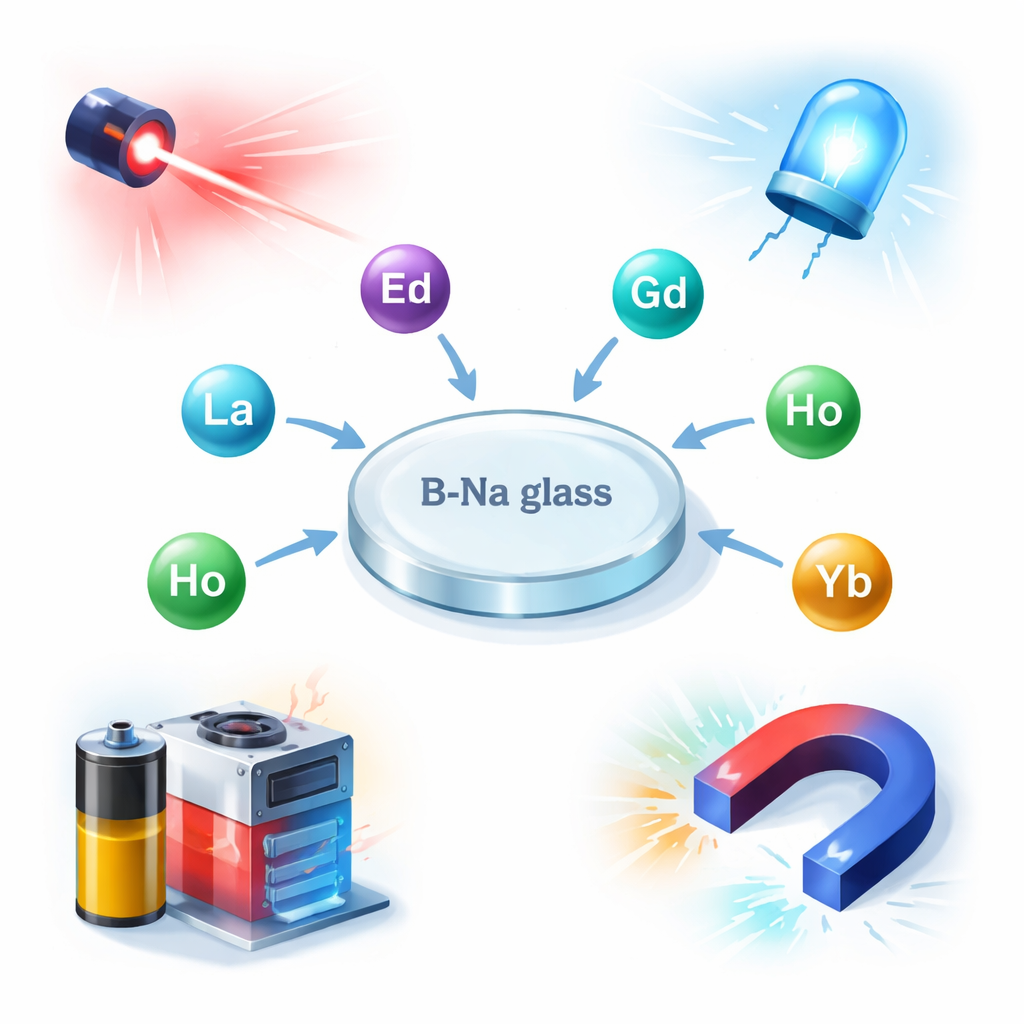
We usually think of glass as something transparent and passive: it lets light in, keeps the weather out, and that’s about it. In this study, researchers show how a very simple boron–sodium glass can be turned into a smart, multifunctional material just by adding tiny amounts of rare‑earth elements. With only one percent of these special metal oxides, the same glass can be tuned to glow in different colors, carry or block electricity and heat, respond to magnets, and withstand high temperatures—capabilities that matter for lasers, efficient lighting, sensors, and energy devices.
Building a Smarter Kind of Glass
The team started from a basic recipe: a 50–50 mixture of boron oxide and sodium oxide, often called sodium borate glass. Boron atoms can link together in flexible ways, making this kind of glass easy to adjust chemically. Into this simple host, the scientists separately added one percent of six different rare‑earth oxides: lanthanum, neodymium, gadolinium, holmium, erbium, and ytterbium. All samples were melted, rapidly cooled into glass, and then gently reheated to remove internal stresses. By keeping the base composition and processing the same, any changes in behavior could be traced mainly to which rare‑earth ion was present.
Making Glass Glow in Designer Shades
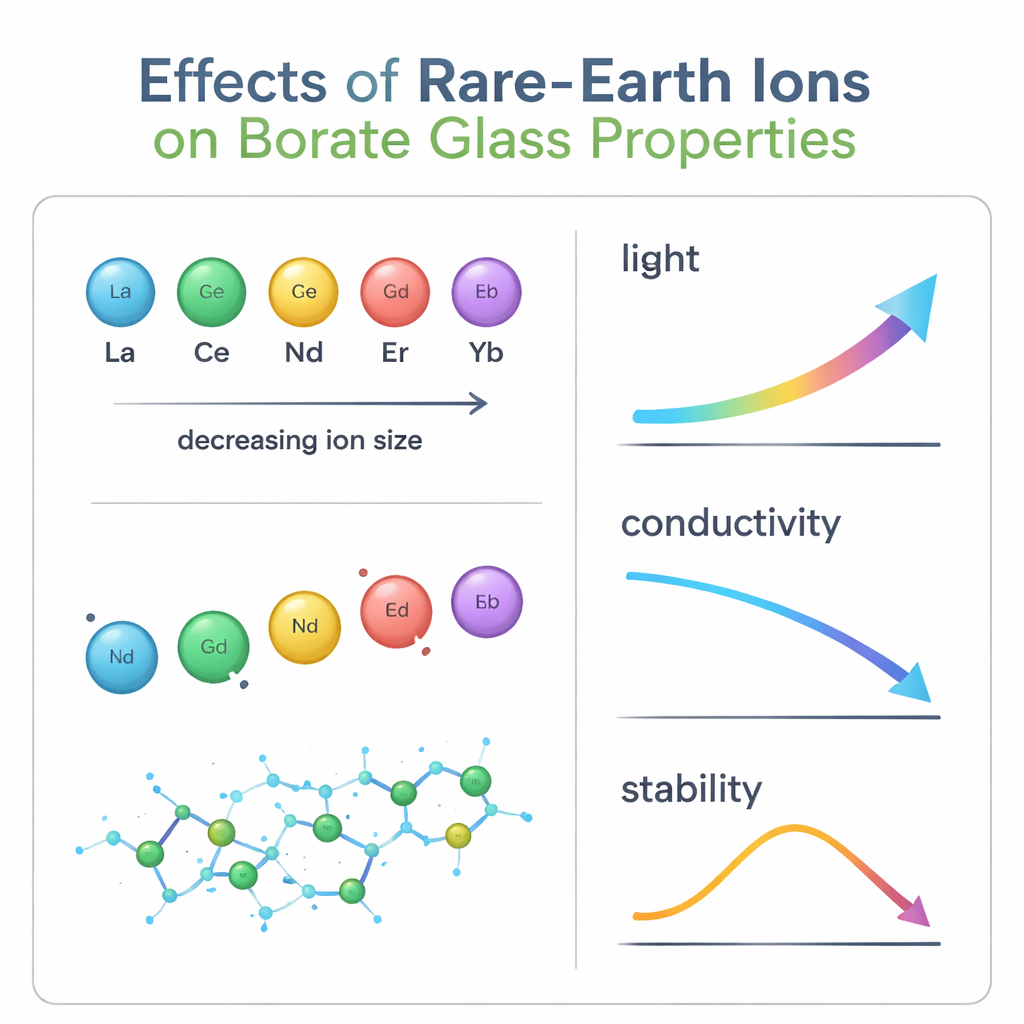
When the glasses were excited with ultraviolet light, all of them emitted a strong blue glow, but the brightness and subtle color tints depended strongly on the rare‑earth ion. Gadolinium and erbium produced especially intense emissions—Gd giving very bright blue light and Er adding greenish tones—while some ions, like ytterbium and lanthanum, gave weaker visible signals. Using a standard color chart, the authors showed that all samples fall in the blue to violet region, with very high “color temperature” values, indicating cool, bluish light like a clear northern sky. At the same time, calculations showed that erbium‑doped glass has the highest nonlinear optical response, meaning its refractive index can change under strong laser light. That combination of strong luminescence and nonlinear behavior makes Er‑doped samples attractive for optical switching, laser amplification, and advanced photonic circuits.
Controlling Electricity, Magnetism, and Heat
Beyond light, the doped glasses also showed tunable electrical and magnetic behavior. All of them behaved like electrical insulators whose conductivity rises with temperature, but the current became smaller as the rare‑earth ions got smaller in size (from lanthanum to ytterbium). Detailed modeling indicated that charge flows mainly by ions hopping between localized sites in the disordered network, in line with established “hopping” mechanisms used to describe semiconducting glasses. Magnetically, most rare‑earth doped samples were clearly paramagnetic—they are weakly attracted to a magnet—because their 4f electrons carry unpaired spins. Gadolinium, with a half‑filled 4f shell, showed the strongest response, while lanthanum, which has no unpaired 4f electrons, actually rendered the glass slightly diamagnetic. Thermal measurements revealed that all compositions are stable up to about 800 °C, with neodymium‑doped glass showing the widest safety window between softening and crystallization, a sign of excellent glass‑forming ability.
Keeping Heat In or Out on Demand
The authors also examined how well each glass conducts heat, a key question for both insulation and thermoelectric technologies. At room temperature, the undoped sodium borate glass carried heat relatively well for a glass, whereas adding rare‑earth ions generally lowered the thermal conductivity into the range typical of good insulators. Gadolinium‑doped glass showed the lowest value, implying that the mismatched mass and size of Gd disrupts vibrations in the glass network and scatters heat‑carrying waves more effectively. Breaking the total heat flow into contributions from vibrations, electrons, and paired charge carriers confirmed that vibrations in the disordered network dominate, consistent with an insulating material that could still be integrated into devices where electrical behavior is tuned separately.
From Simple Recipe to Multifunctional Platforms
Overall, the study demonstrates that a very simple glass recipe can be turned into a flexible platform for advanced technologies by carefully choosing which rare‑earth ion to add. Erbium stands out for nonlinear optics and bright emission, making it promising for compact lasers and optical switches. Gadolinium combines very bright luminescence, strong magnetism, and low heat conduction, pointing to uses in radiation shielding, medical imaging, and thermoelectric modules. Neodymium enhances thermal stability, favoring laser hosts and durable optical components. By swapping one rare‑earth for another at the same low concentration, engineers can dial in the desired mix of optical brightness, electrical resistivity, magnetism, and thermal behavior—much like choosing ingredients in a recipe—to design next‑generation glass for photonics and energy applications.
Citation: El-shabaan, M.M., Mohamed, A., Youssif, M.I. et al. Influence of six different RE3+ ions as modifier agents on the photoluminescent, electrical, magnetic and thermal properties of B-Na glass. Sci Rep 16, 5017 (2026). https://doi.org/10.1038/s41598-026-35015-5
Keywords: rare-earth doped glass, sodium borate, photoluminescence, nonlinear optics, thermoelectric materials