Clear Sky Science · en
Both emissions and ageing altered brown carbon aerosols in the East Asian outflow
Invisible specks with a big climate punch
High above East Asia, tiny airborne particles called brown carbon quietly soak up sunlight and warm the atmosphere. This study follows those particles as they drift from crowded cities and burning fields on the Asian continent out over the ocean to a remote Japanese island. By tracking where these particles come from, how their properties change over time, and how they respond to strict pollution controls—like those during the COVID-19 lockdown—the researchers show how human activity and natural processes together shape a hidden but important driver of regional climate.
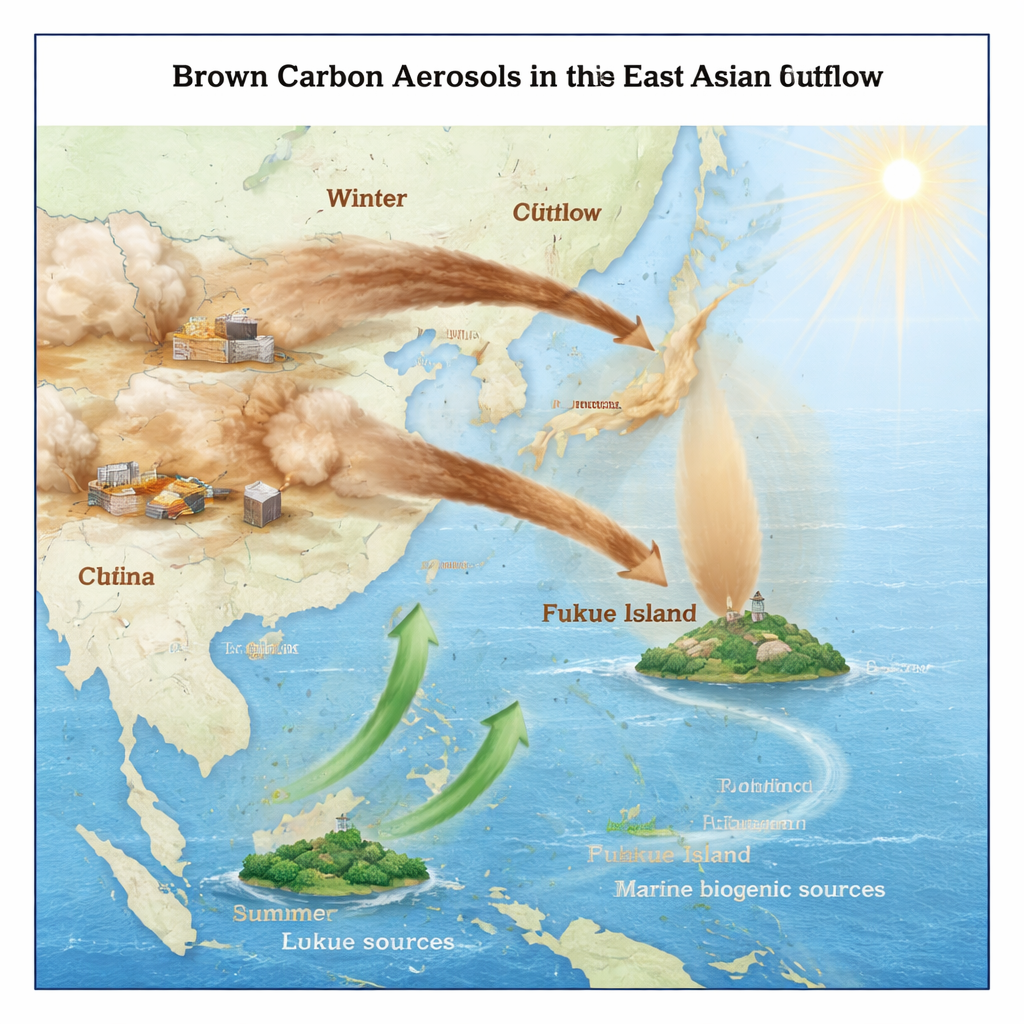
Following pollution from continent to island
The team set up their measurements on Fukue Island, a quiet site off western Japan that lies directly in the path of air flowing out of East Asia. Over a full year, they collected fine particles in the air every five days and analyzed how strongly the brown carbon component absorbed light, paying particular attention to the part of the spectrum where these particles are especially effective at trapping solar energy. They also separated out different types of carbon in the particles—such as water‑soluble and methanol‑soluble forms—to capture both the more “dissolvable” fraction and the stickier, more oily fraction that can also absorb light.
Tracing where the brown carbon comes from
To understand the origins of the brown carbon, the researchers combined several detective tools. They looked at specific “marker” molecules that are known to come from fossil fuel burning, crop and wood fires, plant debris, and gases given off by vegetation that later turn into particles. They also used computer models that trace air back in time to see whether it had mainly traveled over land or over the ocean, and they measured radioactive carbon to separate fossil sources from modern, plant‑based ones. The picture that emerged is highly seasonal: in winter, brown carbon is dominated by fossil fuel use such as coal and oil; in spring, open burning of crop residues and other biomass becomes more important; and in summer, local vegetation and biogenic gases around Fukue Island make a much larger contribution.
How sunlight slowly erases brown carbon’s darkness
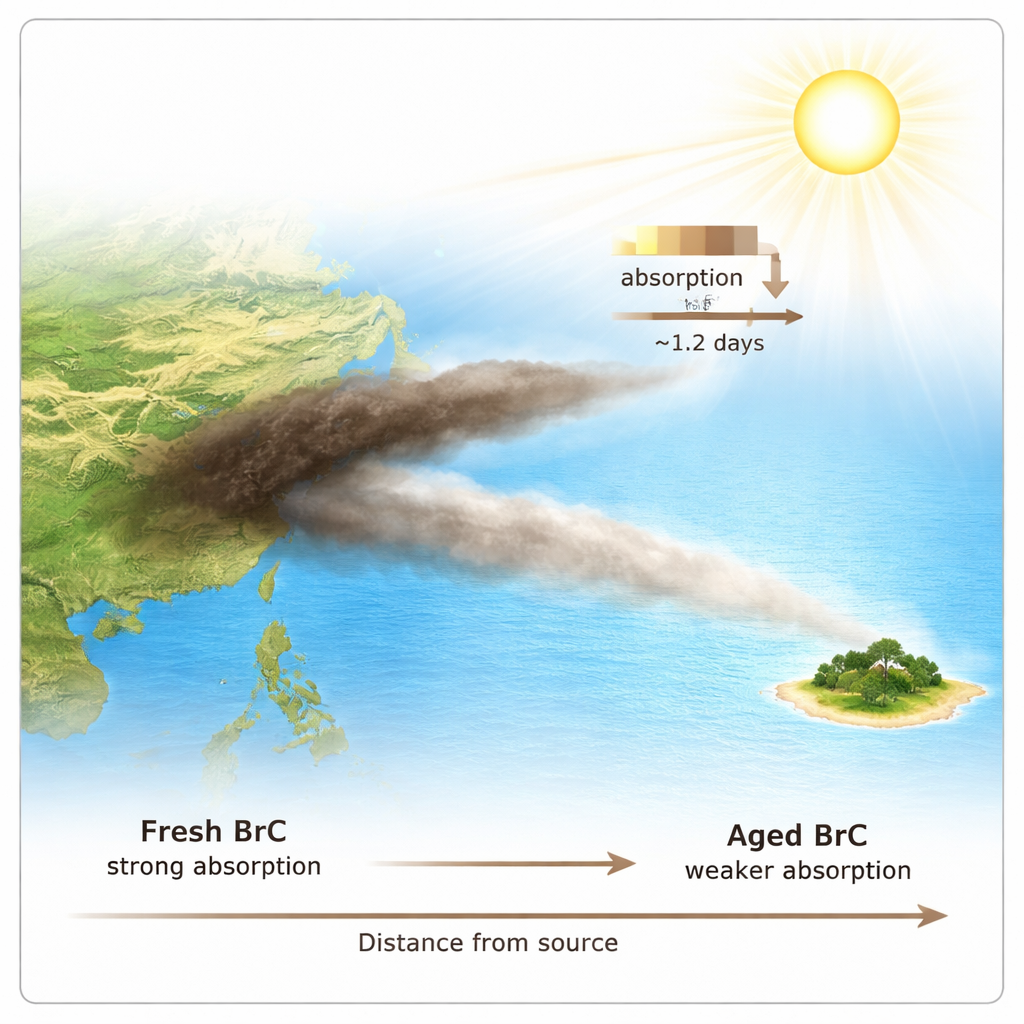
Brown carbon does not stay equally dark as it travels. At Fukue, the researchers found that the light‑absorbing power of water‑soluble brown carbon arriving from the continent steadily faded with transport time, a process they call photobleaching. By fitting how the absorption weakened as air masses aged, they estimated that these particles lose about half of their light‑absorbing strength in just over a day of travel. This rapid “fading” helps explain why brown carbon measured near major emission regions such as northern China looks much darker than what is observed further downwind over the ocean or at remote islands. At the same time, there were signs that some brown carbon forms along the way from gas‑phase chemical reactions, partly replacing what sunlight destroys.
Land, sea, and lockdown: contrasts in warming power
The study also found that not all air reaching Fukue carries equally strong brown carbon. When air masses had traveled mostly over land, their brown carbon absorbed more than twice as much light per unit carbon as air that had mainly come over the ocean. This contrast means that climate models should treat land‑ and sea‑influenced brown carbon differently, rather than assuming a single, uniform behavior. A natural experiment came during the COVID‑19 lockdown in China, when transportation and industry abruptly slowed. During this period, measured brown carbon absorption at Fukue fell sharply, in step with known drops in black carbon and other pollution. This real‑world test showed that strict emission controls can quickly cut levels of these warming particles in the regional atmosphere.
What this means for climate and clean air policy
For non‑specialists, the key message is that brown carbon is a small but powerful piece of the climate puzzle—one that can warm the atmosphere yet changes rapidly as it moves and reacts. This work provides concrete numbers on how strong its light absorption is for different seasons and source types, and how fast that strength declines as sunlight “bleaches” the particles. These benchmarks can be fed into climate models to better estimate how much brown carbon is heating East Asia and beyond. Just as important, the pronounced drop in brown carbon during the COVID‑19 slowdown shows that policy‑driven emission cuts, especially in fossil fuel use and open burning, can meaningfully reduce this hidden warming influence while also improving air quality.
Citation: Zhu, C., Miyakawa, T., Taketani, F. et al. Both emissions and ageing altered brown carbon aerosols in the East Asian outflow. Sci Rep 16, 4774 (2026). https://doi.org/10.1038/s41598-026-35012-8
Keywords: brown carbon, East Asia pollution, aerosol ageing, biomass burning, climate warming